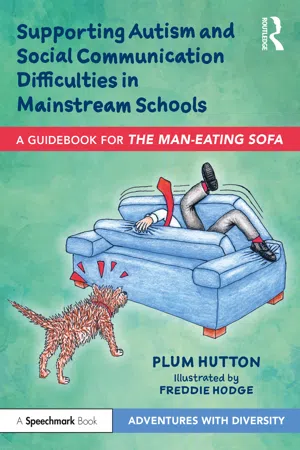
This guidebook is designed to be used alongside the storybook The Man-Eating Sofa (for 8-12 year-olds). Written in an engaging and accessible style, chapters explore the educational, social and psychological impact of autism and social communication and interaction difficulties (SCID). Strategies are provided to help parents and practitioners recognise and support these issues in the school environment. A chapter-by-chapter exploration of The Man-Eating Sofa provides an opportunity to generate discussion and facilitate understanding of autism and SCID amongst young people and adults who might not have considered the impact of social communication difficulties upon day-to-day life.
Key features include:
an accessible introduction to autism and SCID
discussion points for use with The Man-Eating Sofa, to accompany young people's reading of the story
strategies are provided to support the education, mental health and wellbeing of young people who find social communication, interaction, sensory processing and emotional regulation challenging in mainstream educational settings.
This is an essential resource to help parents, teachers and professionals understand and support pupils who are autistic as well as those who find social communication a challenge in the mainstream classroom.
This guide is intended to be used with the storybook The Man-Eating Sofa, which is an adventure featuring 12-year-old Lara, an intellectually able girl who has been diagnosed with autism. The story is likely to appeal to young people of approximately 8–14 years old. It highlights some of the challenges faced by young people in mainstream educational settings who find social communication difficult. Issues include social interaction, understanding and processing language, as well as tolerating the experience of school, which may be perceived as stressful, noisy and unpredictable.
The strategies mentioned in this guide may be useful for young people on the autism spectrum as well as those who have some social communication and interaction difficulties (SCID) but whose needs are not significant enough to meet the criteria for a diagnosis of autism spectrum disorder (ASD). As The Man-Eating Sofa is set in a mainstream secondary school, the focus of this guide will be on pupils whose needs would typically be met in a mainstream setting (with additional support), rather than exploring those who face severe challenges and may require more specialist educational provision. Some of the psychological impacts of autism and SCID will also be explored, such as anxiety, low mood and poor emotional regulation.
A Note on the Language Used in this Guide
In recent years, the language used to discuss autism has altered significantly. This is partly due to terms changing in the medical manuals that are used to diagnose autism and partly due to opinions raised by autistic people about the language they prefer. The term ‘autism spectrum disorder (ASD)’ is the diagnostic term used for autistic young people according to The Diagnostic and Statistical Manual of Mental Disorders 5th Edition (DSM-5), published by the American Psychiatric Association (2013). In the past, Lara, the main character of the story, would have most likely been diagnosed with Asperger’s syndrome, a category that includes individuals on the autism spectrum with average or above-average intellectual abilities. This group is increasingly included in the general diagnostic term ASD.
It has been suggested that use of the word ‘disorder’ in relation to the autism spectrum gives negative connotations. Some members of the autistic community have called for autism to be termed a ‘condition’ rather than a ‘disorder’, arguing that autism is a different way of perceiving the world, not a worse or disordered way. Increasingly, there is a recognition that neurodiverse people offer a range of strengths and perspectives that complement their neurotypical peers. In this guide, the decision has been made to use the term autism spectrum disorder (ASD) when referring to the actual diagnosis, as this is currently the diagnostic term used in DSM-5. There is also debate about whether using the term ‘autistic person’ is preferable to the phrase ‘person with autism’. I understand that the former is often preferred by the autistic community. Therefore, the phrases ‘autistic young people’ or ‘young people on the autism spectrum’ will predominantly be used. The terms ‘neurotypical’ or ‘typically developing’ will be used when referring to young people without autism.
The term ‘social communication and interaction difficulties (SCID)’ will be used to describe young people who have some difficulties with social communication, but whose difficulties are not severe enough to meet the criteria for a diagnosis of ASD, or for those who are perhaps waiting for the diagnostic process to be completed.
Although every effort has been made to ensure that the language used in the guide is appropriate at the time of writing, it is acknowledged that the terms used to discuss autism and neurodiversity are continually evolving. Readers are therefore advised to keep up to date with any changes in terminology.
The bench where Lara used to sit to calm down when she started primary school.
Synopsis of The Man-Eating Sofa
This synopsis may be helpful for adults using this guide, who have not yet had the opportunity to read the storybook.
Lara Frost is 12 years old and has been diagnosed with autism. She reflects on her school experience so far, including when she ran away on her first day at primary school and an incident at a museum where she panicked due to a fear of bears. She was asked to leave her school after the ‘bears’ incident and enjoyed two years in a small village primary school under the nurturing care of Mrs Bingle. Lara was well prepared for her transfer to Kingscott Secondary School at the start of Year 7 but was traumatised by a fire practice in her first few weeks at the school and did not return. She was educated at home for two terms before joining Highfield Secondary School at the start of the summer term of Year 7.
Mr Harris, the headteacher of her new school, is worried because Lara appears to be anxious and unhappy. He suspects that she has social communication difficulties. However, when Lara’s parents applied for her to join the school, they made no mention of her having any special educational needs. He plans to speak to Lara’s parents. He also resolves to solve his other problem, a bad-tempered teacher called Mr Prendergast.
Lara is usually stressed when she arrives home after school. She likes to be alone to relax and indulge her passion for James Bond films. She is fascinated by all the gadgets and by the idea of a revolving sofa that appears to eat people by flipping them under the sofa seat. Lara often feels overwhelmed when her younger sister and twin cousins pester her to play with them. With her father’s support, she has designed and made her own man-eating sofa. She plans to escape her cousins by disappearing into a cosy compartment under the sofa seat when she hears the younger children approaching. The plan works well, apart from one afternoon when her grandmother is accidentally spun under the sofa seat and back again.
Mr Harris meets with Lara’s parents, and they explain that she has autism. They had decided not to mention her difficulties because they thought it might be best for her to have a fresh start at the school, without everyone focusing on her problems. They are now worried that Mr Harris might ask Lara to leave the school. Mr Harris reassures them that he is keen to support Lara, and they form a plan together to support her at school.
Lara is looking forward to her design and technology (DT) lessons. She is skilled at using all the power tools because she helps her father in his carpentry workshop. Unfortunately, her teacher is the awful Mr Prendergast, who refuses to believe that she is already competent. In an attempt to demonstrate her knowledge, she operates a jigsaw without Mr Prendergast’s permission. He claims that she has threatened him with a power tool and banishes her from his lessons.
With support from her teachers, Lara settles into her new school. She develops a small group of friends, with whom she enjoys attending a gardening club and computer programming sessions. Other pupils in the school protect her from Julia Smythe, the school bully. One evening, Lara is involved in a traffic accident, and Mr Harris is injured saving her from being hit by an oncoming car. Lara is upset by the accident and feels she should repay him. She decides to give Mr Harris her man-eating sofa to say thank you for saving her life. The sofa is moved into his office. Mr Harris accidentally makes the sofa eat Mr Prendergast, who is so outraged that he resigns on the spot, much to everyone’s relief. Lara goes on to represent the school as part of a team competing in a national design competition.
The Main Messages in the Story
The story gives an insight into what life might be like for an autistic young person.
Autism/SCID are quite common, so most secondary schools will need to support young people with these conditions.
Parents, schools, peers and members of the community can all play a role in supporting autistic young people to be successful.
It is helpful if the school is informed when a young person joining the school has special educational needs, to ensure that teachers understand the pupil’s needs and can plan appropriate support to aid the transition to a new school and throughout their education.
Autistic young people:
usually find social communication and interaction difficult.
frequently have a good range of strengths and skills.
often feel anxious and may find school overwhelming and unpredictable, particularly if they have sensory sensitivities.
often find it difficult to remain emotionally and physiologically regulated.
may appear to be rude, due to social misunderstandings.
often find it hard to process language, particularly if the words are spoken quickly or if they are feeling stressed.
may find it difficult to adjust to unexpected situations.
typically want to make friends but may need some support initiating and maintaining friendships.
may behave in ways that seem puzzling, but this behaviour is usually an attempt to communicate or a way of coping with a situation that they find difficult.
2. Understanding Autism
DOI: 10.4324/9781003208013-2
Autism is a lifelong neurodevelopmental condition that affects how individuals communicate and interact with others and their environment (Rapin & Tuchman, 2008). The difficulties experienced by autistic young people range from mild to severe. Likewise, the autism spectrum includes a wide range of intellectual abilities from those who are exceptionally talented to those who find learning extremely challenging (Centers for Disease Control and Prevention, 2020). Behaviours associated with autism usually become apparent in the first three years of life as the child’s language may be delayed or develop atypically. Autistic children often appear to prefer to play alone. They may find social situations difficult to interpret, which in turn can make the world feel stressful and unpredictable. Many autistic children experience sensations in a different way, and so some situations may feel uncomfortably intense, or they may seek additional sensation, such as by spinning or rocking. Autistic children often show restricted or repetitive behaviour such as preferring to complete tasks in a particular way and find changes in routine or transitions from one activity to another stressful. It is often hard for autistic infants to communicate their feelings and needs, and so they may physically demonstrate their distress through crying, screaming, physical aggression, becoming withdrawn or fleeing a situation.
In the past, some practitioners felt it was best to encourage children to minimise the behaviours that were particularly associated with autism, so that autistic children appeared to be ‘more normal’. However, it is now understood that behaviours such as spinning or arm flapping are usually strategies that autistic children employ to help themselves feel grounded and calm. As stated by Prizant and Fields-Meyer (2015), the behaviours associated with autism are all human behaviours. Rather than seeing these behaviours as being deficits, they should be viewed as strategies that young people employ to help them to communicate and cope in a world that feels intense and frightening.
As many young people on the autism spectrum look no different to their neurotypical peers, their challenges may not initially be apparent to t...
Table of contents
Cover
Endorsements
Half-Title
Series
Title
Copyright
Contents
Acknowledgements
List of Abbreviations
1. Introduction
2. Understanding Autism
3. The Psychological Impact of Autism
4. Using The Man-Eating Sofa to Promote Discussion
5. Supporting Autism/SCID in School
6. Conclusion
References
Trusted by 375,005 students
Access to over 1.5 million titles for a fair monthly price.
Study more efficiently using our study tools.
Frequently asked questions
Yes, you can cancel anytime from the Subscription tab in your account settings on the Perlego website. Your subscription will stay active until the end of your current billing period. Learn how to cancel your subscription
No, books cannot be downloaded as external files, such as PDFs, for use outside of Perlego. However, you can download books within the Perlego app for offline reading on mobile or tablet. Learn how to download books offline
Perlego offers two plans: Essential and Complete
Essential is ideal for learners and professionals who enjoy exploring a wide range of subjects. Access the Essential Library with 800,000+ trusted titles and best-sellers across business, personal growth, and the humanities. Includes unlimited reading time and Standard Read Aloud voice.
Complete: Perfect for advanced learners and researchers needing full, unrestricted access. Unlock 1.5M+ books across hundreds of subjects, including academic and specialized titles. The Complete Plan also includes advanced features like Premium Read Aloud and Research Assistant.
Both plans are available with monthly, semester, or annual billing cycles.
We are an online textbook subscription service, where you can get access to an entire online library for less than the price of a single book per month. With over 1.5 million books across 990+ topics, we’ve got you covered! Learn about our mission
Look out for the read-aloud symbol on your next book to see if you can listen to it. The read-aloud tool reads text aloud for you, highlighting the text as it is being read. You can pause it, speed it up and slow it down. Learn more about Read Aloud
Yes! You can use the Perlego app on both iOS and Android devices to read anytime, anywhere — even offline. Perfect for commutes or when you’re on the go. Please note we cannot support devices running on iOS 13 and Android 7 or earlier. Learn more about using the app
Yes, you can access Supporting Autism and Social Communication Difficulties in Mainstream Schools by Plum Hutton,Freddie Hodge in PDF and/or ePUB format, as well as other popular books in Pedagogía & Educación general. We have over 1.5 million books available in our catalogue for you to explore.