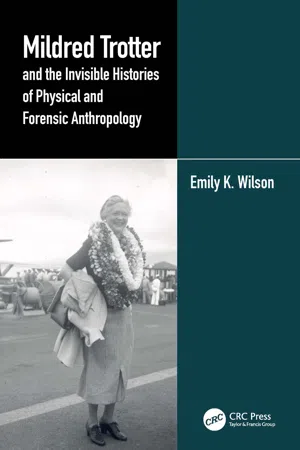
In the wake of World War II, anatomist and anthropologist Mildred Trotter left the Midwest for a temporary post as the forensic anthropology expert for the Army in the Territory of Hawaii. Her formidable task was to identify the remains of war dead in order to return them to their families, in a national effort that continues to this day.
Mildred Trotter and the Invisible Histories of Physical and Forensic Anthropology is the first, long overdue biography on this woman of immense stature in her field. She was the first woman to serve as President of the American Association of Physical Anthropologists and the first woman to be full professor at the Washington University School of Medicine in St. Louis.
While primarily a biography of Trotter, this book also examines aspects that are so often left out of retrospectives of science and scientific figures. This includes scientific error, the historical experiences of the few women and individuals from other marginalized groups active in the discipline, sexism, and scientific and social racism. This book also provides novel historical context regarding her major and now well-known tibia mismeasurement.
Mildred Trotter and the Invisible Histories of Physical and Forensic Anthropology is a must-read for anyone interested in the history of science and women in science, and for all practicing and aspiring biological and forensic anthropologists.
Mildred Trotter’s disarmingly serene expression stands out among the portraits of the current and past laboratory directors lining a wall at the Defense POW/MIA Accounting Agency (DPAA), on Joint Base Pearl Harbor–Hickam in Hawaii. With few exceptions, portraits of Trotter all capture this placid affect, even as a baby. Not only is she the only woman pictured, but also her calm expression seems to belie the general impressions modern anthropologists often have of her. Though Trotter’s name is well known in forensic anthropology, not much is actually known about her. What is remembered of this anatomist who excelled in a male-dominated field indicates a tenacious personality, that of a person who gave unabashed critiques to Army Colonels and insisted on her own promotion to full professor at Washington University in St. Louis. Beyond just being one of the very few women in the discipline at the time, she has also had a considerable and lasting influence on the field. For these reasons, even when people know nothing more than a few basic facts, she often attracts interest.
This is a book that I sincerely wish I could have just read, but it did not exist. This sentiment is shared by others, particularly those in her growing and now majority-female field. Physical/biological anthropology and, in one of its more specific forms, forensic anthropology have experienced a boom in popularity and recognition with programs such as Bones, CSI, and NCIS, as well as true crime series and podcasts. Not only are more people intrigued by the details of forensic anthropology, but this has also resulted in an influx of young students, mostly women, who consider pursuing careers in this field. To historians of science though, Trotter is not likely to be widely known. A more comprehensive accounting of this one person’s life is long overdue. So, I wrote this book for anthropologists curious about Trotter and for the increasing number of people investigating the overlooked histories of women and marginalized people in science.
I have worked as a forensic anthropologist at the DPAA laboratory since 2013, first as an Oak Ridge Institute for Science and Education fellow, then as a civilian employee of the Department of Defense, and currently as a remote contractor. As with most others at DPAA, I was always well aware of Trotter’s existence and understood the gist of her time and influence within the Army’s identification efforts after World War II. I was also vaguely familiar with Trotter’s connection to the Robert J. Terry Anatomical Collection from doing a master’s degree at George Washington University. Osteology courses relied on the Collection at the National Museum of Natural History, assiduously taught by David Hunt and Marilyn London. When I was first there, the Terry Collection was still housed on the National Mall, in some of the original olive drab cabinets that Trotter had shipped all the way from Missouri.
Studio portrait of Trotter taken in 1950. VC170-i170024, Becker Medical Library, Washington University School of Medicine.
Like any historical figure, Trotter remains somewhat of an enigma due to the limitations of surviving documentation. Once I started searching, I found there were very few readily available secondary sources to turn to for more information. Most of it was piecemeal, and none of it was truly in-depth. Her story will always be incomplete, but she did leave behind ample primary materials to explore. Trotter maintained extensive correspondence with countless colleagues, which are archived in St. Louis at the Bernard Becker Medical Library of the Washington University School of Medicine. Also preserved there is her oral history, a loose transcript of which is available on the Library’s website, and her unpublished history of the anatomy department at the University. Her obituary was published in the American Journal of Physical Anthropology, and several anthropologists have written briefly about her. My sources also include Washington University publications, Trotter’s own scientific publications, newspaper and magazine articles, and other archival sources. Her papers at the Beaver County History Center unfortunately only consist of genealogical material (Alice Kern, Personal Communication, October 4, 2019), and I did not access the small amount of materials related to Trotter that are present within the archival collection of her attorney, Lucile W. Ring, at the St. Louis Mercantile Library of the University of Missouri – St. Louis. I did have the opportunity to speak with her nephew, James Trotter, and great-nephew, David Trotter, who were kind enough to share their memories and stories of their dear Aunt Mamie. Some time periods are particularly well covered because she saved an excess of documentation when, presumably, she felt they were important parts of her life and career. Other specific time periods are featured just by dint of available documentation. More personal content is only preserved by chance and memories. This variability of detail on different aspects of her life is unavoidable.
Trotter’s story is, in short, that of a woman raised on a farm in Pennsylvania, who graduated from Mount Holyoke College, earned a PhD in anatomy, became the first woman to be full professor at the Washington University School of Medicine, was one of only two women who were founding members and the first woman to serve as president of the American Association of Physical Anthropologists (now the American Association of Biological Anthropologists), authored more than 100 academic works, shaped and improved the military’s ongoing process of human identification, developed widely used stature estimation references, expanded and secured the preservation and accessibility of the Terry Collection at the Smithsonian, and taught more than 4,000 medical students over nearly five decades. J. Lawrence Angel named her as the one founding mother, among all the founding fathers, of physical anthropology.1 But this is not a hagiography; I do not intend to portray Trotter as a mythical origin figure, devoid of faults and flatteringly blurry from a distance. She was human and had all the attendant strengths and weaknesses. This fact will already be obvious to anyone who may be familiar with Trotter’s work, knowing that she made and continued to miss a major and now well-known error in her tibia measurement in her renowned stature estimation research, which I will specifically address.
This book is at times more of a history of anthropology through Mildred Trotter than it is strictly a standard biography. While I provide the details of her life, her experiences, and her scholarship, these topics bring up broader themes in physical anthropology and science that are sometimes ignored, such as scientific error, the historical experiences of women and marginalized people within the discipline, sexism, and scientific and social racism. Though women are now better represented, the discipline continues to suffer from disparities and a distinct lack of diversity. Where pertinent, I branch out into further details on these subjects, even when they stray momentarily from Trotter. When I deviate in this way, I am attempting to give her story more substance through the relevant and parallel experiences of others connected to her in various ways. I explore the vast and commonly overlooked domains of professional women and underrepresented people. From these perspectives, I hope to fill in the world she inhabited from multiple angles, some of which she may, and some of which she may not, have been aware of at the time.
When writing a story about the past, we are always necessarily also writing a story about the present. The timing of a biography can affect its contents nearly as much as the original events and experiences themselves. I hope to be sensitive to that, and also to open myself and readers up to other perspectives on the topics in this book. Trotter was just as much a product of her time as we are, and as much as this book must be. Certainly, I will fail to pursue questions that would have been more apparent if I were writing at another time or if I were another person.
Trotter was an organized person, and so I want to present her life in an orderly way, but it will not be strictly chronological. Please be patient then if I initially mention important concepts only in passing; I will return to these later. Because one aspect of Trotter’s life is likely of greatest interest and familiarity to many readers – the year she spent working for the military in Hawaii – this is where her story will begin. And for anyone who is not already familiar with Trotter, this time consulting as an expert for the Army serves as an excellent introduction to her professionalism and character. It was also during this appointment in Hawaii that Trotter collected much of the data for her seminal publication on stature estimation. Trotter was certainly humble, but also uncompromising and resolute in her approach to obstacles on matters for which she held authority. As Trotter described her career, “I really don’t think I have done anything more than establish an endurance record.”2 That distillation may be partly accurate, but there is so much more to her story.
Notes
J. Lawrence Angel, “Symposium in Honor of T. Dale Stewart, 75th Birthday Celebration,” American Journal of Physical Anthropology 45, no. 3 (1976): 519–530, p. 521.
Quoted in Twink Cherrick, “Named Lectureship, Portrait to Honor Anatomy Professor Mildred Trotter,” Washington University Record (May 22, 1975), p. 4.
CHAPTER2Hawaii and the Army
DOI: 10.4324/9781003252818-2
For many biological anthropologists today, the defining moment for Mildred Trotter stems from her work identifying US war dead, though it counted as only a brief amount of time in her life and career. In many other narratives, this period is only presented as a side note to the life of an accomplished anatomist, professor, and founding American physical anthropologist. But this particular episode is what brought her prominence and a legacy within the history of physical and forensic anthropology. Here, we follow the story of a middle-aged professor in St. Louis who suddenly found herself on an US island territory in the Pacific, identifying the remains of World War II casualties, writing harsh critiques of military processes to Army officials, and undertaking the most comprehensive stature estimation project of the time.
In 1948, at the age of 49, Trotter accepted an approximately 1-year appointment as the anthropological consultant to the US Army at a laboratory dedicated to the identification of World War II dead. Identification efforts have been a national priority since the Civil War, usually under the operation of the American Graves Registration Service (AGRS). For a brief history of these efforts, see Emanovsky and Belcher.1 The first central identification point was established in Strasbourg, France for World War II European theater remains in 1946, headed by Harry L. Shapiro from the American Museum of Natural History in New York. A laboratory for the Pacific Theater was started in Hawaii, first overseen by Charles E. Snow from 1947 to 1948. From June 1948 to June 1949 Trotter then served as the lead anthropology expert. This work has continued on, in various forms throughout the world, and today is undertaken by the Defense POW/MIA Accounting Agency (DPAA) laboratories at Joint Base Pearl Harbor-Hickam in Hawaii and at Offutt Air Force Base in Nebraska.
Trotter was offered the position in April of 1948, just a couple of months prior to the start date. Before accepting, she was careful and firm in negotiating her salary and other conditions of employment. She wrote to a fellow anthropologist, Stella Leche Deignan, that she had requested a higher rating than they first offered her, and she got it.2 Her annual salary would be $8,578.50 and designated a “P-6,” which was categorized as comparable to a field-grade officer.3 She was required to list her current salary on an application document. Although only 2 years previously she had, with her hard-won promotion to full professor, received a 25% salary increase, the dean of the medical school told her to claim yet a higher sum. When she returned to St. Louis after the year in Hawaii, she did not get a raise to reflect that amount, and she suspected that the dean had perhaps simply been “ashamed to have the Army know how little my salary was.”4 Her Washington University salary at that time was $6,500.5 Trotter’s biggest point of negotiation for Army employment in May of 1948 was access to her car, and despite extensive issues securing its shipment, she refused travel to Hawaii without it.6 After she gave her final acceptance, her specialized training consisted of 2 days spent with Charles E. Snow at the University of Kentucky.7 Snow had completed his PhD at Harvard under Earnest A. Hooton in 1938, and prior to his identification work for the AGRS had contributed to an anthro...
Table of contents
Cover
Half Title
Title Page
Copyright Page
Table of Contents
Acknowledgments
Notes on Terminology
Author Biography
Chapter 1 Introduction
Chapter 2 Hawaii and the Army
Chapter 3 The Tibia ‘A Very Troublesome Bone’
Chapter 4 Life and Career
Chapter 5 Women in Early Physical Anthropology Contemporary Women
Chapter 6 Women’s Experiences Trotter’s Personal Life
Chapter 7 Marginalized Contemporaries
Chapter 8 Race, Sex, and Research Race, Hair, and Applied Science
Chapter 9 Later Years
Index
Trusted by 375,005 students
Access to over 1.5 million titles for a fair monthly price.
Study more efficiently using our study tools.
Frequently asked questions
Yes, you can cancel anytime from the Subscription tab in your account settings on the Perlego website. Your subscription will stay active until the end of your current billing period. Learn how to cancel your subscription
No, books cannot be downloaded as external files, such as PDFs, for use outside of Perlego. However, you can download books within the Perlego app for offline reading on mobile or tablet. Learn how to download books offline
Perlego offers two plans: Essential and Complete
Essential is ideal for learners and professionals who enjoy exploring a wide range of subjects. Access the Essential Library with 800,000+ trusted titles and best-sellers across business, personal growth, and the humanities. Includes unlimited reading time and Standard Read Aloud voice.
Complete: Perfect for advanced learners and researchers needing full, unrestricted access. Unlock 1.5M+ books across hundreds of subjects, including academic and specialized titles. The Complete Plan also includes advanced features like Premium Read Aloud and Research Assistant.
Both plans are available with monthly, semester, or annual billing cycles.
We are an online textbook subscription service, where you can get access to an entire online library for less than the price of a single book per month. With over 1.5 million books across 990+ topics, we’ve got you covered! Learn about our mission
Look out for the read-aloud symbol on your next book to see if you can listen to it. The read-aloud tool reads text aloud for you, highlighting the text as it is being read. You can pause it, speed it up and slow it down. Learn more about Read Aloud
Yes! You can use the Perlego app on both iOS and Android devices to read anytime, anywhere — even offline. Perfect for commutes or when you’re on the go. Please note we cannot support devices running on iOS 13 and Android 7 or earlier. Learn more about using the app
Yes, you can access Mildred Trotter and the Invisible Histories of Physical and Forensic Anthropology by Emily K. Wilson,Emily Wilson in PDF and/or ePUB format, as well as other popular books in Technology & Engineering & Science & Technology Biographies. We have over 1.5 million books available in our catalogue for you to explore.