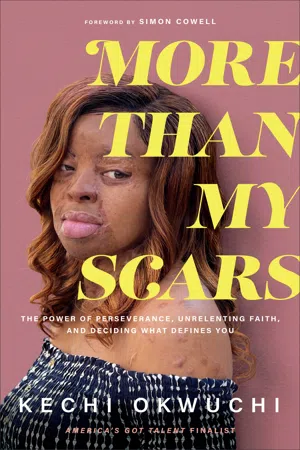
The first thing you will notice when you meet Kechi Okwuchi is her scars. One of just two survivors of a devastating plane crash that killed more than 100 people, 16-year-old Kechi was left with third-degree burns over 65 percent of her body. More Than My Scars is her incredible story. A story of not just surviving impossible odds but thriving in a world that is too often caught up with how we look on the outside rather than seeing that our true value is within.
Now in her early 30s, Kechi has spent the last 16 years refusing to be defined by her trauma. Follow her as she decides for herself what role her scars will play in her life before society decides for her. Her strong sense of identity, rooted in seeing herself the way God sees her, has allowed her to live authentically in a world that constantly seeks to define us by its ever-changing (and ever-shallow) standards. Kechi's story will inspire you to love and accept yourself as you are and confidently present your true self to the world.
eBook - ePub
More Than My Scars
The Power of Perseverance, Unrelenting Faith, and Deciding What Defines You
- 240 pages
- English
- ePUB (mobile friendly)
- Available on iOS & Android
eBook - ePub
More Than My Scars
The Power of Perseverance, Unrelenting Faith, and Deciding What Defines You
About this book
Information
Print ISBN
9781540901590
Subtopic
Religious BiographiesChapter One
The Day
DECEMBER 10, 2005
The dormitory bell rang loudly on the Saturday that would change my life forever.
I got up from bed, grabbed my towel and toilet bag, and headed wearily for the dorm’s public showers. I was not alone, of course. Several other students and friends who would be traveling the same route as me that day were also making their way to the bathroom, all of us blearily blinking sleep away as we shuffled like sheep in the narrow hallway.
It was the last day of the 2005 fall semester at Loyola Jesuit College, Abuja, Nigeria, the day we would all be heading home for the Christmas holidays. The last exams for the semester had ended on Tuesday, and the remainder of the week had been used to clean up the classrooms, hang out with friends, and pack up for the holidays. We would all be back on campus in less than three weeks. But it didn’t matter; those last few days right before we headed home were always so much fun, not only because they were exam-free but also because we got to hang out with each other without the usual pressures of constant studying and strict schedules to keep to.
Freshly showered, I got dressed in my red checkered school uniform. I threw the remainder of my things into my open suitcase, including my self-written novel to show my mom when I got home, then headed out of the dorm toward the dining hall, luggage in tow.
Toke Badru, one of my closest friends and favorite travel companions, walked next to me, offering nothing but her silent company as we entered the dining hall and sat down for an early breakfast. I’m not a morning person so it wasn’t unusual that I was a bit standoffish, but seeing as Toke and I were close, perhaps she could sense that the reason for my silence went beyond that.
“How do you manage to look so good in this stupid uniform?” she said, pulling at the waist of my dress.
I chuckled a little and batted her hand away. “You’re an idiot.”
“I’m just saying.” She shrugged her dainty shoulders. “If not for my butt, I’d be a shapeless piece of string in this dumb dress.”
I couldn’t help but chuckle again, and she laughed her adorable laugh. I loved her sense of humor.
As I thought, she’d sensed something was on my mind but didn’t want to pry. She was trying to cheer me up instead. Typical of her, really.
“Are you okay though?” The concern in her voice was palpable. “You’re never this quiet, Kechi.”
True. I’m not a quiet person, especially not on the last day of school, a day that every boarding school student looks forward to more than any other kind of secondary school student. After three long months away from home, in a few hours we’d be with our families, eating home-cooked food, sleeping in much more comfortable beds. Normally I’d be ecstatic and chattering nonstop.
But I was not going home under normal circumstances that day.
Before I could respond to her, the teacher on duty suddenly spoke. “Okay everyone,” he said loudly, “as I call out your names, come up to get your ticket.”
Later, we all stepped outside and started loading our luggage on the school buses that would be taking us to the airport.
I said goodbye to friends who had woken up early just to see us off: Womiye Ojo, Jude Igboanugo (Womiye’s boyfriend at the time and also my good friend), and even Atuora Erokoro, who I usually said goodbye to in the dorms. They, like many others, were students who either lived right there in Abuja or had later flights and thus didn’t need to be up as early as we did.
We all knew we would see each other again in less than a month—some of us maybe even during the course of the Christmas holidays—so there wasn’t a lot of hugging. We never really said things like “have a safe flight” to one another. Obviously, everyone would get to their homes safely, not because plane crashes were rare in Nigeria—they unfortunately weren’t—but because at sixteen, death is typically nothing but an abstract concept.
I learned a very big lesson that day: appreciate every single moment like it’s your last. Hug your friends, wish them well. Tell loved ones you love them while you can.
I got on one of the buses and made my way to the first available window seat I spotted (my consistent preference on any mode of transport). Soon enough, the buses drove out of the LJC campus in single file.
I looked back, like I always did, to watch the school gates shut.
It always brought a smile to my face to see those gates close behind my bus with me on the outside. I was finally free, if only for a few short weeks.
Who could’ve known that the next time I’d set eyes on those gates would be at a reunion a decade later?

The airport terminal was packed. Girls in dresses, girls in uniforms, boys in suits, boys in flannel shirts. Many people in African print clothing. Folks in T-shirts and jeans scattered in. It was loud too. Way too loud. People shouted all over the place, as though haggling for ticket prices, which weren’t exactly negotiable.
My schoolmates and I shuffled after our teacher in one large group of sixty-one. We were easily identifiable in our red, blue, green, and yellow checkered uniforms. We headed to the lounge area, only to discover our flight had been delayed. Typical. The students whose buses had left campus earlier than ours were still here as well, waiting for their own Lagos-bound flight.
We all filed into the lounge and immediately spread out. Our teacher disappeared, but I’d occasionally spot him scanning the room, most likely doing a head count. God forbid any of us go missing on his watch.
Toke and I found a couple seats together and sat, setting our backpacks down on the ground next to us.
My mood had improved significantly since leaving campus. It was only when I got a chance to step outside the confines of LJC that I was reminded just how much pressure that environment put on me, even more so now that I was in my final year.
“God, every single time,” Toke grumbled. She was referring to the flight delay. “We might as well go home by bus!”
I laughed at her exaggeration. A three-hour flight delay followed by a two-and-a-half-hour flight didn’t even come close to the twelve hours it would take to get home from school by bus.
Still, I understood her frustration. “It’s so messed up that we spend pretty much one whole day traveling,” I said. “Christmas holidays are already so short.”
“I know! And this one won’t even be fun ’cause I’ll be studying throughout.”
“Same here.”
As seniors, the only things on our mind were the SATs, the WAEC1, and of course, college applications.
“Are you gonna apply to any of the schools we saw at the college fair?” I asked Toke. Earlier that semester, the entire senior class had been taken into the city to attend a college fair that hosted more than twenty different foreign colleges.
“Yeah, mostly the UK ones,” she replied.
“Me too. I really liked London School of Economics.” I sighed, trying not to fall back into the slump I’d barely just come out of. That college fair had been the beginning of all my worries. I had no business aiming for a school of that caliber. I’d gotten a chance to look at LSE’s academic requirements, and my grades were definitely not up to par.
“Will you talk about what’s bothering you now?” Toke asked gently.
I looked at her patient expression and decided I would this time. But where to even begin? So much was on my mind, so many anxieties to unpack . . . “I just feel like my whole future depends on my SAT scores,” I told her.
Toke nodded in understanding. “I know what you mean. It’s so scary. It’s the only way to get into schools outside Nigeria. And there’s this vibe, like, if you don’t get accepted into a college outside Nigeria—”
“You’re a failure,” I said, finishing the sentence.
“Exactly!” Toke made a sound of disgust. “What is that? I hate that mentality, like you’re not ‘cool’ if you don’t study abroad.”
I hated that mentality too, so much. I hated myself more for buying into it.
Relief suddenly washed over me. “Oh my God, it feels so good to finally say all this stuff out loud!” I exclaimed.
“I know, right?” Toke said with a small laugh. “No one likes talking about grades, sha.”2
She was right. It wasn’t normal, even between close friends, to talk about academic grievances in depth, but I wished it was. It felt good to voice these thoughts to someone who not only understood but could also relate.
“But Kechi,” Toke continued, “schools look at everything, not just SATs.”
“I know, that’s the problem.” I shook my head. “My grades are nothing to write home about.”
“What about me?”
“No, but you’ve been improving since last year, Toke. Steadily. The schools you apply to will take note of the improvement. They like that kind of thing, like when a student shows progress. Me, I’m just so . . . average. My grades are not the kind that a school like LSE would look twice at.”
“Calm down, Kechi, it’s not that bad jor.”3
“I swear it actually is. Math alone is so horrible.” I shook my head again. “My parents spent so much money, sacrificed so much to put me through this expensive secondary school, and for what? I’m such an average student. There’re a few semesters where I excelled, but for the rest, I just never bothered applying myself more than I needed to in order to pass from one year into the next.” I laughed self-deprecatingly. Now I was paying the price for doing the barest minimum.
“Kechi . . .” Toke leaned over and grabbed my hand. “Listen, we’ll get home and study like crazy. We’ll do our best with the time we have. I mean, what else is there to do?”
“Yeah, that’s true,” I said, huffing out a breath. “My mom is ready for me. She said she hired an SAT coach for me.”
“You’re not even home yet and they’ve already gotten you a lesson teacher?” Toke let go of my hand to pat my back in pity, making me laugh. “I hope they let you eat and sleep at least.” She laughed with me.
“At this point, who knows,” I said, still chuckling.
I felt so much better again. Toke had made me feel better. She didn’t pressure me into talking, but in the natural way she had about her, she’d made it easy to open up about the stuff that had been bothering me pretty much all semester. And it turned out we were worrying about the same things.
“LSE, so you’re thinking of doing economics?”
“Yeah,” I said.
“But what about your writing?” she asked. “You...
Table of contents
- Cover
- Endorsements
- Half Title Page
- Title Page
- Copyright Page
- Dedication
- Contents
- Foreword
- Introduction
- Prologue
- 1. The Day
- South Africa
- Nigeria
- America
- A Final Word
- Acknowledgments
- About the Author
- Back Ads
- Back Cover
Trusted by 375,005 students
Access to over 1.5 million titles for a fair monthly price.
Study more efficiently using our study tools.
Frequently asked questions
Yes, you can cancel anytime from the Subscription tab in your account settings on the Perlego website. Your subscription will stay active until the end of your current billing period. Learn how to cancel your subscription
No, books cannot be downloaded as external files, such as PDFs, for use outside of Perlego. However, you can download books within the Perlego app for offline reading on mobile or tablet. Learn how to download books offline
Perlego offers two plans: Essential and Complete
- Essential is ideal for learners and professionals who enjoy exploring a wide range of subjects. Access the Essential Library with 800,000+ trusted titles and best-sellers across business, personal growth, and the humanities. Includes unlimited reading time and Standard Read Aloud voice.
- Complete: Perfect for advanced learners and researchers needing full, unrestricted access. Unlock 1.5M+ books across hundreds of subjects, including academic and specialized titles. The Complete Plan also includes advanced features like Premium Read Aloud and Research Assistant.
We are an online textbook subscription service, where you can get access to an entire online library for less than the price of a single book per month. With over 1.5 million books across 990+ topics, we’ve got you covered! Learn about our mission
Look out for the read-aloud symbol on your next book to see if you can listen to it. The read-aloud tool reads text aloud for you, highlighting the text as it is being read. You can pause it, speed it up and slow it down. Learn more about Read Aloud
Yes! You can use the Perlego app on both iOS and Android devices to read anytime, anywhere — even offline. Perfect for commutes or when you’re on the go.
Please note we cannot support devices running on iOS 13 and Android 7 or earlier. Learn more about using the app
Please note we cannot support devices running on iOS 13 and Android 7 or earlier. Learn more about using the app
Yes, you can access More Than My Scars by Kechi Okwuchi in PDF and/or ePUB format. We have over 1.5 million books available in our catalogue for you to explore.