A critical examination of the complex system of college pricing—how it works, how it fails, and how fixing it can help both students and universities.
How much does it cost to attend college in the United States today? The answer is more complex than many realize. College websites advertise a sticker price, but uncovering the actual price—the one after incorporating financial aid—can be difficult for students and families. This inherent uncertainty leads some students to forgo applying to colleges that would be the best fit for them, or even not attend college at all. The result is that millions of promising young people may lose out on one of society's greatest opportunities for social mobility. Colleges suffer too, losing prospective students and seeing lower enrollments and less socioeconomic diversity. If markets require prices to function well, then the American higher-education system—rife as it is with ambiguity in its pricing—amounts to a market failure.
In A Problem of Fit, economist Phillip B. Levine explains why institutions charge the prices they do and discusses the role of financial aid systems in facilitating—and discouraging—access to college. Affordability issues are real, but price transparency is also part of the problem. As Levine makes clear, our conversations around affordability and free tuition miss a larger truth: that the opacity of our current college-financing systems is a primary driver of inequities in education and society. In a clear-eyed assessment of educational access and aid in a post-COVID-19 economy, A Problem of Fit offers a trenchant new argument for educational reforms that are well within reach.
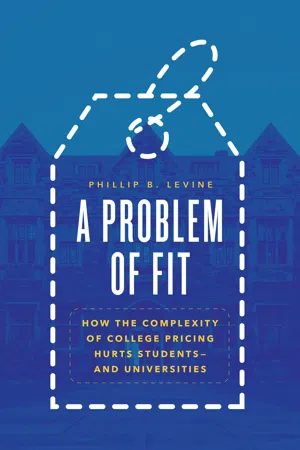
eBook - ePub
A Problem of Fit
How the Complexity of College Pricing Hurts Students—and Universities
- English
- ePUB (mobile friendly)
- Available on iOS & Android
eBook - ePub
A Problem of Fit
How the Complexity of College Pricing Hurts Students—and Universities
About this book
Information
Publisher
University of Chicago PressYear
2022Print ISBN
9780226818559
9780226818535
eBook ISBN
9780226818542
Topic
Negocios y empresaSubtopic
Negocios en generalCHAPTER ONE
The Institution of Financial Aid
The system of paying for college in the United States is not simple. Our higher-education system is decentralized, made up of independent, private colleges and universities scattered throughout the country and public colleges and universities organized at the state level. Each state system and each private institution sets their own prices. The federal government provides subsidies to students who attend these institutions, but it is not involved in setting prices. Those entities interact in the marketplace in complex ways to determine how much it will cost to attend college.
The goal of this chapter is to provide a broad overview of the institutional features that characterize the American system of financial aid. This discussion emphasizes nonprofit, four-year residential colleges, which are the focus of this book. I highlight the role played by the government along with that played by the institutions themselves in reducing how much students pay to attend college relative to the sticker price.
I start with a brief history of the financial aid system that currently exists. After that, I provide an overview of how students navigate the system and how colleges and universities determine individual student financial aid awards. Aside from the important concepts, this discussion also introduces the language of financial aid, which itself can be daunting, adding to the general confusion regarding how the system works. As a point of comparison, I also present a brief discussion about higher-educational institutions in other countries and how students elsewhere pay for college.
Since higher-educational institutions are businesses (albeit mainly not for profit; I only focus on those), I also provide a broad discussion of colleges’ finances. Where does the money come from that enables nonprofit colleges and universities to pay their bills? What do they spend their money on? How does student financial aid fit into the business model of higher-education institutions?
The final section of this chapter sets up the discussion for the rest of the book by categorizing higher-educational institutions into a set of distinct markets. Aside from their academic mission, the operation of an institution like Babson College in Wellesley, Massachusetts, has very little in common with that at the University of Massachusetts at Amherst. UMass Amherst is the flagship institution in the state of Massachusetts’s public university system; it enrolls twenty-two thousand students, receives $400 million from the state of Massachusetts, and charged around $30,000 in 2020–21 to students who lived on campus and received no financial aid. Babson College is an undergraduate business school with a $450 million endowment for twenty-four hundred undergraduates and a full price tag of around $75,000 in 2020–21. Yet these two institutions compete for some of the same students. In this chapter, I discuss the distinct market sectors in which institutions operate and document differences in their operations to provide background for later discussions regarding financial aid.
The History of Financial Aid
The federal government did not substantively become involved in financial aid until the 1960s, but such aid existed privately long before then (see Wilkinson, 2005, for the authoritative treatment on this topic; Fuller, 2014, provides an outstanding summary). Not long after universities sprang up in colonial America, philanthropists donated money to colleges and universities for this purpose. Harvard received its first gift, the proceeds of which were to be used to fund financial aid, in 1643. Competition is present everywhere, including among colonial philanthropists, as this initial gift led to similar gifts to William and Mary, Yale, Princeton, and the University of Pennsylvania (Thelin, 2011).
The origin of the financial aid system in the United States is partly based on philanthropy, but it also includes elements of financial aid as a pricing strategy. In the period following the Revolutionary War, the country began to expand westward, and higher-educational institutions opened in these new areas. Financial aid was necessary to attract enough students to fill them. The Louisiana Purchase in 1803 similarly led to an expansion in higher education and in financial aid.
The introduction of merit awards was tied to the introduction of the Scholastic Aptitude Test (SAT) in 1926, which was intended to identify talented, lower-income students. Although identifying meritorious students is always a challenge, test scores provide a simple mechanism to do so, even if there are limitations in following this approach. Once such a test became available, it was used for this purpose. Harvard University relied on this form of standardized testing in its introduction of the National Scholarship Plan in 1934. The Plan was designed to increase educational opportun...
Table of contents
- Cover
- Title Page
- Copyright Page
- Dedication
- Contents
- Preface
- introduction
- chapter 1. The Institution of Financial Aid
- chapter 2. An Econ 101 View of College Pricing and Financial Aid
- chapter 3. The Real Cost of College and Its Worth
- chapter 4. Pricing Transparency
- chapter 5. Addressing Affordability
- chapter 6. Fixing the Pricing System in Higher Education
- chapter 7. Other Barriers to College Access
- conclusion
- Acknowledgments
- References
- Index
Trusted by 375,005 students
Access to over 1.5 million titles for a fair monthly price.
Study more efficiently using our study tools.
Frequently asked questions
Yes, you can cancel anytime from the Subscription tab in your account settings on the Perlego website. Your subscription will stay active until the end of your current billing period. Learn how to cancel your subscription
No, books cannot be downloaded as external files, such as PDFs, for use outside of Perlego. However, you can download books within the Perlego app for offline reading on mobile or tablet. Learn how to download books offline
Perlego offers two plans: Essential and Complete
- Essential is ideal for learners and professionals who enjoy exploring a wide range of subjects. Access the Essential Library with 800,000+ trusted titles and best-sellers across business, personal growth, and the humanities. Includes unlimited reading time and Standard Read Aloud voice.
- Complete: Perfect for advanced learners and researchers needing full, unrestricted access. Unlock 1.5M+ books across hundreds of subjects, including academic and specialized titles. The Complete Plan also includes advanced features like Premium Read Aloud and Research Assistant.
We are an online textbook subscription service, where you can get access to an entire online library for less than the price of a single book per month. With over 1.5 million books across 990+ topics, we’ve got you covered! Learn about our mission
Look out for the read-aloud symbol on your next book to see if you can listen to it. The read-aloud tool reads text aloud for you, highlighting the text as it is being read. You can pause it, speed it up and slow it down. Learn more about Read Aloud
Yes! You can use the Perlego app on both iOS and Android devices to read anytime, anywhere — even offline. Perfect for commutes or when you’re on the go.
Please note we cannot support devices running on iOS 13 and Android 7 or earlier. Learn more about using the app
Please note we cannot support devices running on iOS 13 and Android 7 or earlier. Learn more about using the app
Yes, you can access A Problem of Fit by Phillip B. Levine in PDF and/or ePUB format, as well as other popular books in Negocios y empresa & Negocios en general. We have over 1.5 million books available in our catalogue for you to explore.