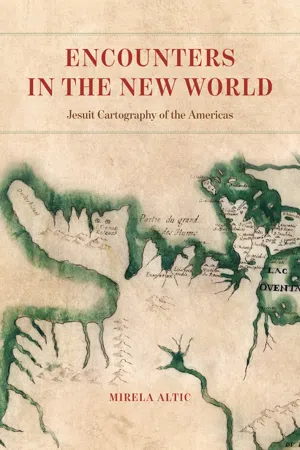
Analyzing more than 150 historical maps, this book traces the Jesuits' significant contributions to mapping and mapmaking from their arrival in the New World.
In 1540, in the wake of the tumult brought on by the Protestant Reformation, Saint Ignatius of Loyola founded the Society of Jesus, also known as the Jesuits. The Society's goal was to revitalize the faith of Catholics and to evangelize to non-Catholics through charity, education, and missionary work. By the end of the century, Jesuit missionaries were sent all over the world, including to South America. In addition to performing missionary and humanitarian work, Jesuits also served as cartographers and explorers under the auspices of the Spanish, Portuguese, and French crowns as they ventured into remote areas to find and evangelize to native populations.
In Encounters in the New World, Mirela Altic analyzes more than 150 of their maps, most of which have never previously been published. She traces the Jesuit contribution to mapping and mapmaking from their arrival in the New World into the post-suppression period, placing it in the context of their worldwide undertakings in the fields of science and art. Altic's analysis also shows the incorporation of indigenous knowledge into the Jesuit maps, effectively making them an expression of cross-cultural communication—even as they were tools of colonial expansion. This ambiguity, she reveals, reflects the complex relationship between missions, knowledge, and empire. Far more than just a physical survey of unknown space, Jesuit mapping of the New World was in fact the most important link to enable an exchange of ideas and cultural concepts between the Old World and the New.
- English
- ePUB (mobile friendly)
- Available on iOS & Android
eBook - ePub
About this book
Information
1
The History and Concept of Jesuit Mapmaking
1.1 The Organization of the Society of Jesus and Its Educational System
Ignatius Loyola (1491–1556) was a Spanish Basque priest and theologian who founded the religious order called the Society of Jesus and became its first Superior General. The personal history of the founder, as well as the general historical context prevailing at the time of the order was founded, largely determined the structure and the activity of the Society of Jesus in the centuries to come. Born Iñigo López de Oñaz y Loyola, he started his career by joining the army of the Kingdom of Castile at the age of seventeen. His military career, which ended when he was seriously wounded in battle while defending the Spanish city of Pamplona against the French in 1521, strongly influenced his later activity as a superior. In particular, the strict military hierarchy and discipline that he experienced while serving in the army had a powerful impact on the way in which the future Superior General would set up the Jesuit order. After a pilgrimage to the Holy Land in 1523, he studied Latin and theology at the Universities of Alcalá (1526) and Salamanca (1527). He then moved to Paris to study at the Collège de Montaigu (1528), where he remained for over seven years.1 While in Paris, Ignatius witnessed the expansion of Protestantism as well as the Counter-Reformation, two movements that contributed to the permanent transformation of Europe’s religious and political landscape and had strong repercussions on Jesuit activities.
In 1534 Ignatius gathered around him the six key companions with whom he founded the Society of Jesus in 1539. They created a centralized organization for the order and stressed absolute obedience to the pope and to superiors in the church hierarchy. The Society was approved in 1540 by Pope Paul III, and Ignatius was chosen as its first Superior General. When the Society was founded, the Age of Encounter and Exploration was already in full swing. The Society of Jesus was preceded by other religious orders—Franciscans, Dominicans, Carmelites, Recollects, and Augustinians—in the rapid territorial expansion of European empires into the New World.2 Even though these religious orders predated the Jesuits, the Society of Jesus soon became the most influential order in both worlds, the Old and the New. Up until the eighteenth century, the Society amassed a huge fortune and became immensely influential owing to the number and spread of its missions, their stability and economic self-sufficiency, the close links between the Jesuits and the Creole population whom they educated, the Society’s tremendous material wealth (a significant part of its estates had been bequeaths from wealthy Creoles), and the authority of the educational system it established, which was exquisite in all areas of science. That also lent to their prominence as explorers and cartographers, activities in which the Jesuits soon outstripped all the rest in extent and quality.
One of the most prominent features of the Society of Jesus was its missionaries’ mobility. In order to maintain discipline and efficiency in very remote areas and with members that traveled frequently, the Jesuits had to have an extremely centralized, almost military organizational structure. The order was governed by a Superior General, elected by a general congregation. The Superior General was the only person appointed by election. A province consisted of cities, as urban and educational centers of the Jesuit structure, and missions, as their provincial outposts. Several provinces constituted an administrative territory known as an assistancy (the name comes from the fact that each fell under the competence of one of the Jesuit general’s assistants), which corresponded approximately to the major nations or linguistic divisions in Europe: Italian, Spanish, Portuguese, French, and German.3 Assistancies and provinces were the main intermediaries between the heads of the order and the lower instances, such as cities and missions. Heads of individual assistancies and provinces were appointed from above rather than being elected locally, which created a strict hierarchical pyramid. The Jesuit organizational structure is clearly laid out in the so-called Ignatian Tree, published by Athanasius Kircher (fig. 1).4 The main branches of the tree correspond to the assistancies (their spatial sequence reflects more or less the chronological order of their establishment), while smaller limbs representing the provinces terminate in leaves bearing the names of towns in which Jesuit colleges were located. Ignatius himself is shown kneeling at the base of the tree and holding in his hands the Jesuit Constitutions. In that sense, the Ignatian Tree captured nicely the themes of unity so crucial for the governance of a geographically dispersed religious order.5

Figure 1. The Ignatian Tree, as represented in Athanasius Kircher’s Ars magna lucis et umbrae (Rome, 1646). (Eidgenössische Technische Hochschule, Zurich)
The fact that missionaries came to America from a number of different countries proved to be extremely important in influencing Jesuit activities in missions as well as their relationships and status in the New World. Their ethnic diversity included not only educational and cultural differences but also different approaches to certain social and political issues, especially those related to the enslavement of the native population (this difference was especially visible between missionaries of European descent and those of Creole descent). For that reason, Spain normally exerted strict control of the entry not only of foreigners but also of Spaniards into all its overseas possessions. Thanks to some very complex agreements between Castile and Aragon, the New World was agreed to belong solely to Castile. Immigration to overseas countries was thus allowed only for the subjects of Castile and not for the subjects of other crowns—which is why many non-Spanish Jesuits entered the Americas under false names. The same concern about missionaries of foreign origin existed in the Portuguese realm. The number of non-Portuguese missionaries, especially those in high positions, has been the source of much controversy and tension in Brazil.6 As an instrument of political precaution, all the colonial powers as well as the Jesuits themselves took special care to balance the number of foreign missionaries against domestic ones.7 Yet, although their different backgrounds created tensions as well as a certain suspicion of the crown, the missionaries’ multinationalism contributed to a better understanding of native cultures and facilitated the creation of a multicultural colonial society.
According to the Constitutions, all provinces had to maintain regular correspondence with the headquarters in Rome and, ideally, between themselves as well.8 It was from that obligation that so many Jesuit reports (known as relations) were produced; these were, in addition to their personal correspondence, the most important source of information about their activities in the field, including their explorations and mapping. In this regard, the Jesuits’ travels and field tasks were highly regulated as well.9 The Jesuits were instructed to record all local events and the characteristics of every indigenous culture with which they came into contact. This practice resulted in a robust textual production, composed of diverse documentary species—letters, reports, diaries, instructions, minutes, chronicles, natural histories, and so on. Not only was the production of texts a constant beginning with the early years of the order, but so were their circulation, both within the Society and to a wider audience that had access to part of it through publications. Thus, although dispersed, the Jesuits were not isolated. Official and private correspondence kept them in touch. Furthermore, their narratives consisted not only of text, but also of images. The abundance of images produced by the Jesuits, among which the maps had special meaning and value, distinguishes the order from their evangelizing counterparts. Their efforts led to the creation of many accounts accompanied by cartographic presentations that were based upon their original field observations and surveys. According to the map historian Júnia Ferreira Furtado, the reports were required to follow certain patterns of form and content to be considered reliable. The emphasis on reliability coincided with the Enlightenment’s scientific agenda of hypothesis and experimentation: the repeated gathering of data provided scientific reliability and accuracy.10 Each missionary had to send a report to his provincial, sometimes weekly but more often monthly, and the provincial would then put together four-month reports (litterae quadrimestres). At the end of the sixteenth century, these were pared down to annual reports known as litterae annuae. The gathering and redaction of the reports written by provincials were among the chief duties of the secretary to the general. All letters and reports were reviewed and edited, and only after these documents had passed a strict procedure would they be prepared to be printed for the general public in annual reports.11 Correspondence between the Jesuits was also of particularly great importance for the dissemination of knowledge. Jesuit explorers often shared the experiences and results of their explorations. Several examples were known where personal correspondence led to the development or continuation of an exploration that would otherwise have been left unfinished or forgotten.12
Another central feature of the order was their academic excellence, both in science and in the humanities. Thanks to their well-organized colleges and seminaries, the Jesuits were among the best-educated people of their time, and many of them became tutors, confessors, and counselors to countless prominent figures and rulers. The most important decision in that respect was in 1560, when Diego Laínez (1512–1565), Ignatius’s successor, ordered that all Jesuits had to teach. Laínez’s decree determined the careers of almost all future Jesuits as teachers. The goal of Jesuit teaching went beyond saving souls: Jesuit schools had the secular purpose of improving civil society by educating boys to earn a living and to fill leadership positions. Moreover, the Jesuits soon recognized the potential of their education to serve and influence others, primarily the sons of the nobility. Their boarding schools for youths of noble birth, and a limited number of schools for boys from the citizen class, became numerous and extremely important in the seventeenth and eighteenth centuries. Yet, in practice, the vast majority of their students did not come from noble families. The existing data from the Jesuit school in Munich, one of the very few schools for which matriculation lists have survived, testify that between 1601 and 1776 only 4.9 percent of the students came from noble families, while another 11.9 percent came from families of civic office holders and no less than 83.2 percent of the students came from the rest of society.13 Jesuits’ status as the most prestigious educators of all social strata, including the nobility, explains their centuries-long influence on modern society. As soon as the first Jesuit school was founded in Messina in 1548, many others appeared across Europe. The first major Jesuit school was established in Rome in 1551 (Collegio Romano), which in 1556 was elevated to a university (studium generale). By the time of Ignatius’s death in 1556, the Jesuits were operating a network of forty-six colleges on three continents.14 They established an educational presence at every level—at universities and in seminaries, missions, and schools affiliated with the Society.15 Some of the most prominent Jesuit educational institutions in Europe were established in Italy (Rome, Messina, Macerata, Parma, Mantua, Palermo, Naples, and Bologna), France (Paris, La Fléche. Lyon, Billom, Poitiers, Dijon, Bordeaux, Reims, and Rouen), Spain (Alcalà, Salamanca, Seville, Toledo, Valladolid, and Gandía), German-speaking countries (Vienna, Innsbruck, Ingolstadt, Augsburg, Dillingen, Paderborn, Molsheim, Osnabrück, Bamberg, Munich, Cologne, Würzburg, Heidelberg, Trier, and Mainz), Portugal (Lisbon, Coimbra, Évora, Porto, Braga, and Bragança), and the Low Countries (Bruges, Antwerp, Liège, Leuven, and Douai).
Shortly after arriving in the New World, the Jesuits began founding their own colleges and universities there as well. The creation of educational centers in the main Spanish, Portuguese, and French cities in the Americas was instrumental to the establishment of the Society of Jesus on the continents. To meet the educational needs of the elite and to prepare future members of the order for their service, many Jesuit colleges soon developed into universities.16 The principles of their education in Europe and America had common foundations. The prevailing view so far has been that the largest number of Jesuit cartographers came from the lands of the German assistancy, that is, from the German-speaking area. Indeed, a large number of Jesuit cartographers working in the Americas were educated in Germany and the lands of the Habsburg monarchy (Eusebio Kino, Ivan Rattkay, Samuel Fritz, Bernhard Havestadt, Tadeáš Xaver Enis, and Martin Dobrizhoffer, among others). However, almost the same number of Jesuit cartographers came from Spain (such as José Cardiel, José Quiroga, José Gumilla, Bernardo Rotella, and José Sánchez Labrador), Italy (Antonio Machoni, Domenico Capacci, Giuseppe Bressani, and Filippo Salvatore Gilii), Portugal (Diogo Soares), and several other countries, including Belgium and France (Jean Magnin, Jérôme Lalemant, Jean de Brébeuf, Jacques Marquette, Claude-Jean Allouez, and Pierre Raffeix, to name a few). Also, it should be emphasized that not only did European Jesuit colleges serve as nurseries for Jesuit explorers, but a significant number of Jesuit cartographers were educated in Jesuit colleges in the Americas, such as Juan Francisco Dávila, Juan de Velasco, Alonso de Ovalle, Juan Ignacio Molina, and Joaquín Camaño y Bazán or José Palomino.
The basic document of their educational system, which came to be known as the Ratio Studiorum, promulgated in 1599, defined the main areas of teaching and teaching methods, including among them geography and astronomy (although at first only as additional content in the teaching of mathematics).17 Although the text of the Ratio Studiorum changed little in succeeding centuries, it is known that the original scope and theoretical approaches of Jesuit teaching expanded significantly, particularly their approach to the natural sciences. In the sixteenth century, geography was considered a part of cosmography—description of the universe—and its scope was to describe it and inscribe it on the terrestrial globe. Two traditions from ancient Greece were applied in early Jesuit colleges, one descriptive and indebted to Strabo, the other mathematical and derived from Ptolemy. While descriptive geography was taught as part of natural philosophy together with the commentaries of Aristotle and treaties on the heavens and meteors, mathematical geography belonged to the field of mathematics and involved the application of spherical geometry to the Earth, its projection onto a plane, and the determination of geographical latitude and longitude.18
At first heavily based upon Aristotelian philosophy and Ptolemaic astronomy, Jesuit geography gradually developed into an experimental science that used mathematical techniques.19 Christopher Clavius’s Christophori Clauii Bambergensis Ex Societate Iesu in Sphaeram Ioannis De Sacro Bosco Commentarius (Rome, 1581), one of the earliest textbooks for the teaching of mathematics and astronomy in Jesuit schools, presents geography in chapters II and III.20 Another Jesuit, Giovanni Battista Riccioli, published an extensive work on geography entitled Geographiae et hydrographiae (Bologna, 1661). Following the tra...
Table of contents
- Cover
- Title Page
- Copyright Page
- Dedication
- Contents
- List of Abbreviations
- Introduction
- 1 The History and Concept of Jesuit Mapmaking
- 2 The Possessions of the Spanish Crown
- 3 Portuguese Possessions: Brazil
- 4 New France: Searching for the Northwest Passage
- Plates
- Concluding Remarks
- Notes
- Bibliography
- Index
Trusted by 375,005 students
Access to over 1.5 million titles for a fair monthly price.
Study more efficiently using our study tools.
Frequently asked questions
Yes, you can cancel anytime from the Subscription tab in your account settings on the Perlego website. Your subscription will stay active until the end of your current billing period. Learn how to cancel your subscription
No, books cannot be downloaded as external files, such as PDFs, for use outside of Perlego. However, you can download books within the Perlego app for offline reading on mobile or tablet. Learn how to download books offline
Perlego offers two plans: Essential and Complete
- Essential is ideal for learners and professionals who enjoy exploring a wide range of subjects. Access the Essential Library with 800,000+ trusted titles and best-sellers across business, personal growth, and the humanities. Includes unlimited reading time and Standard Read Aloud voice.
- Complete: Perfect for advanced learners and researchers needing full, unrestricted access. Unlock 1.5M+ books across hundreds of subjects, including academic and specialized titles. The Complete Plan also includes advanced features like Premium Read Aloud and Research Assistant.
We are an online textbook subscription service, where you can get access to an entire online library for less than the price of a single book per month. With over 1.5 million books across 990+ topics, we’ve got you covered! Learn about our mission
Look out for the read-aloud symbol on your next book to see if you can listen to it. The read-aloud tool reads text aloud for you, highlighting the text as it is being read. You can pause it, speed it up and slow it down. Learn more about Read Aloud
Yes! You can use the Perlego app on both iOS and Android devices to read anytime, anywhere — even offline. Perfect for commutes or when you’re on the go.
Please note we cannot support devices running on iOS 13 and Android 7 or earlier. Learn more about using the app
Please note we cannot support devices running on iOS 13 and Android 7 or earlier. Learn more about using the app
Yes, you can access Encounters in the New World by Mirela Altic in PDF and/or ePUB format, as well as other popular books in History & Military & Maritime History. We have over 1.5 million books available in our catalogue for you to explore.