Considers the avant-garde rethinking of poetic language in terms of physical speech production.
Avant-garde writers and artists of the twentieth century radically reconceived poetic language, appropriating scientific theories and techniques as they turned their attention to the physical process of spoken language. This modernist "sound writing" focused on the bodily production of speech, which it rendered in poetic, legible, graphic form.
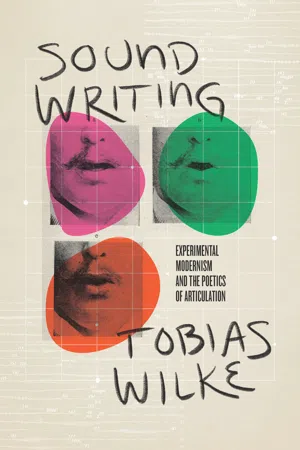
Modernist sound writing aims to capture the acoustic phenomenon of vocal articulation by graphic means. Tobias Wilke considers sound writing from its inception in nineteenth-century disciplines like physiology and experimental phonetics, following its role in the aesthetic practices of the interwar avant-garde and through to its reemergence in the postwar period. These projects work with the possibility of crossing over from the audible to the visible, from speech to notation, from body to trace. Employing various techniques and concepts, this search for new possibilities played a central role in the transformation of poetry into a site of radical linguistic experimentation. Considering the works of writers and artists—including Raoul Hausmann, Kurt Schwitters, Viktor Shklovsky, Hugo Ball, Charles Olson, and Marshall McLuhan—Wilke offers a fresh look at the history of the twentieth-century avant-garde.
- English
- ePUB (mobile friendly)
- Available on iOS & Android
eBook - ePub
About this book
Information
Publisher
University of Chicago PressYear
2022Print ISBN
9780226817774
9780226817750
eBook ISBN
9780226817767
Topic
ArtSubtopic
Art General1: Voice Figures
Visible Sound and the Poetics of Articulation (1787–1965)
Oaoa, or The Eidophonetic Poem
A photograph taken in the mid- to late 1960s by Marthe Prévot, Raoul Hausmann’s companion of the postwar decades and subsequent heir of his estate, shows the nearly eighty-year-old writer, painter, and “Dadasoph” engaged in a private poetic performance (fig. 1). The picture captures Hausmann against the backdrop of his studio’s shaded walls, his head and upper body partially exposed to radiant light emerging from an invisible source to his right. He has turned his eyes away from the camera at a slight angle—directing them perhaps toward another observer of his presentation whom we cannot see—while resting his chin on the edge of a framed piece of paper which he holds tightly in front of his chest with both hands. From within this photo-internal frame, a second pair of eyes looks out directly at the photographer and at us: the shot is taken from below, which means that it is this second, disembodied pair of eyes, rather than the first, that appears at eye level with the beholder, and that, consequently, constitutes the compositional center of the photograph as a whole. These other eyes, however, are also Hausmann’s own—or rather, they were his, almost half a century before, at the moment when their gaze was recorded in a different picture, which was then subsequently cut up and rearranged into the work of montage Hausmann here displays.1 Within the context of Prévot’s photograph, the presence of these fragments of an earlier portrait creates a differential doubling: They reproduce a past expression of the same eyes that are pictured above, and in so doing they prefigure—in a mode of asynchronous simultaneity—the moment in which this second, later image would be taken.

Figure 1. Marthe Prévot, Raoul Hausmann in his apartment in Limoges, ca. 1965–1970, photographic print. © Collection Musée d’art contemporain de la Haute-Vienne, Château de Rochechouart
Even more conspicuous, visually speaking, is an additional, closely related reduplication, for the shape of Hausmann’s opened mouth also appears twice, in near-identical positions, revealing both times—at the center of his lips and teeth—the darkness of his oral cavity. Both photographs, this correspondence suggests, show Hausmann in the process of emitting sound—a sound inaudible to us but visible in the process of its bodily emergence. The performance staged in front of Prévot’s camera thus links two different acts of vocalization across a divide of nearly five decades: Reenacting his earlier gesture in a corporeal form, while also displaying its mechanical reproduction, Hausmann aligns past and present movements spatially, along a vertical axis that defines the image we see. Once again, however, it is the mouth inside the collage that takes precedence in this constellation, as emphasized most clearly by its visual framing through two overlapping circles. This framing not only delineates, quite literally, the primary target for the viewer’s gaze; it also serves to underscore that another correspondence is at play between the photographic cutout and the surrounding graphic elements. For the image of the gaping mouth appears here in an opening that functions simultaneously as part of the collage’s written character. By placing this element on top of the hand-drawn letter O, Hausmann inscribes the photographic trace of his own bodily gesture in an arrangement otherwise readable as (a kind of) text. This act of inscription, in turn, suggests that Hausmann’s presentation before the camera aims to highlight, at its literal-spatial core, a certain relation between the oral production of linguistic sound and the latter’s graphic transcription in the form of alphabetic signs. What is fundamentally at stake in this scenario is thus the relationship between speech and writing—between corporeal expression and symbolic code—and the mediation of these two poles via a poetic practice that encompasses both the optical and acoustic dimensions of its material.
It is Hausmann’s lifelong insistence on the significance of this doubled focus that renders his work a suitable lens through which to introduce the larger concerns of this book as a whole. The following discussion unfolds, therefore, by way of a close consideration of the specific poetic and performative arrangement captured in Prévot’s photograph. It does so, however, with the primary goal of opening up a much wider perspective on the manifold, wide-ranging historical contexts this arrangement evokes: contexts that make it possible to recognize in Hausmann’s work a retrospective reflection on the way in which articulation was able to become an object of literary relevance in the first place. And what emerges, on the basis of such a contextualizing reading, is first and foremost the intimate association between this twentieth-century becoming-object of articulation, within the domain of poetic practice, and its nineteenth century becoming-object within the domain of experimental science—as registered, above all, by the appearance of new, apparatus-based methods for inscribing bodily speech. The experimental-modernist “return” to orality, so the present chapter makes clear, did not take shape through the withdrawal of the speaking body from the regime of written signs. Rather, it unfolded on the basis of technologies designed to record acoustic phenomena in visual, and hence also readable, form. This alternative media history matters, on the one hand, because it allows us to gain access to the specific textual logic of the many avant-garde compositions like Hausmann’s, which might otherwise appear to simply evade any and all literary-analytical explication. But it matters also, at a significantly higher level of generality, because the surprising readability of individual works like Oaoa turns out to cast new light on the historico-theoretical stakes of avant-garde poetic practice as a whole, including broadly influential concepts like “originary language,” aesthetic “defamiliarization,” and the “destruction” of conventional meaning.

Figure 2. Raoul Hausmann, Oaoa, 1965, crayon on paper with photographic collage, 30.8 × 23.8 cm. © Collection Musée d’art contemporain de la Haute-Vienne, Château de Rochechouart
Produced in the same year in which Prévot photographed Hausmann performing the piece, the composition of Oaoa (fig. 2) seems to afford, at first sight, relatively little opportunity for a reading that would go beyond the mere identification of its individual elements, a description of their numerical and spatial distribution over the page they fill, or perhaps a characterization of the rhythmic pattern that results from the sequential variation of letters across the four horizontal lines. A biographical perspective, which places its focus on the source material of the photographic collage, adds to these options the possibility of viewing the work as a retrospective reflection on Hausmann’s career as a writer: It becomes meaningful, for instance, from this perspective, that both the cut-up portrait and the collage configuration date back to the pivotal years of 1918 and 1919, during which Hausmann first began to experiment with phonetic poetry.2 It becomes meaningful, furthermore, that this earlier collage was initially conceived as an illustration for the 1918 manifesto Synthetisches Cino der Malerei (Synthetic Cinema of Painting), the work whose public presentation marked the inception of Hausmann’s Dada activities (fig. 3).3 And it becomes meaningful, finally, that Hausmann recycles (part of) this photographic collage in his 1965 poem by mounting it on top of the handwritten, capital letter O, which reinscribes the metonymic reference to his literary beginnings within a graphic symbol of circular (en)closure.4

Figure 3. Raoul Hausmann, Synthetisches Cino der Malerei, date uncertain, typographic print with photographic collage. Photograph © Anja Elisabeth Witte/Berlinische Galerie
What, however, does the photographic collage actually show? We see here, as the result of a multistep process of cutting and pasting, an iconic constellation of sense organs, in which Hausmann’s eyes appear to be orbiting, like two planets or satellites, around the gravitational center of his wide-open mouth. The collage thus rejoins the previously disjointed (or dissected) organs of vision and vocalization, of sight and sound production, inside a graphically defined force field designed to pull the gaze toward the void enclosed by lips and teeth. The oral gesture thereby highlighted has most often been understood in the context of Dada’s response to World War I, as a politically motivated scream reflecting the societal experience of catastrophic violence and destruction. Richard Sheppard, for example, places Hausmann’s collage in proximity to George Grosz’s well-known war paintings, maintaining that “Hausmann, too . . . transmitted something of the same sense of human bestiality in the image of the gaping mouth filled with carnivorous teeth.”5 Hanne Bergius, in a similar vein, characterizes Hausmann’s photographically captured act of “yelling” as an expression of Dada’s “actionist-iconoclastic”6 tendencies, which were oriented toward the instigation of social revolt. Readings of this kind are, without doubt, biographically legitimate and historically plausible. They are also, however, crucially incomplete, for the domain that they leave untouched is the very one that Hausmann’s later recycling of this collage, within the context of Oaoa, suggests is fundamental to his own (perhaps retroactive) understanding of its importance, namely: the domain of poetic activity.
Viewed with respect to this domain—which is to say, also, with respect to the work’s very conditions of production—the gesture of the wide-open mouth needs to be considered not only as a reference to the emphatically inarticulate phenomenon of screaming, but also, and perhaps primarily, as a reference to the all-important moment of transition from scream to speech, cry to vowel, primordial utterance to poetry. Indeed, as the position of Hausmann’s lips and teeth quite clearly indicates, he has in fact been photographed not in the act of simply “yelling,” but rather of (loudly) pronouncing the German vowel “a”—and hence of forming precisely that sound traditionally presumed to demarcate the threshold between prelinguistic and articulate forms of vocalization. Jacob and Wilhelm Grimm, in the first entry of their groundbreaking Deutsches Wörterbuch (German Dictionary), write of the vowel “a” that it is “the noblest, most original of all sounds, resounding from chest and throat, which the child learns first of all and most easily, and which, quite justifiably, the alphabets of most languages place at their very beginning.”7 As the sound that lies already nascent in the infant’s earliest cries, but only later takes on a clearly bounded linguistic shape, the “a” is traditionally aligned, for the Grimms and their contemporaries as for the linguists of Hausmann’s time, with the natural beginnings of speech. It consequently deserves its conventional status, in the Grimms’ view, as the first element within the cultural order of phonetic writing systems. Hausmann, in other words, is here citing the origins of human language—or rather, making art by citing himself citing the origins of human language—in a gesture that goes definitively beyond the biographical, sociohistorical contexts of both past work and war.
On the one hand, then, the portrait turns out to evoke the evolutionary beginnings of articulation, demarcating the surrounding poem as a text that is concerned with the emergence and most basic condition of spoken sound. On the other hand, the placement of the collage within the context of Oaoa simultaneously reframes the transition from scream to articulate “a” through the bounded structure of a written sign—the poem’s other principal letter, “o”—which underscores Hausmann’s focus on a natural origin of linguistic expression that has been culturally, because graphically, contained. By combining the two media of photographic record and alphabetic code, Hausmann effectively creates a hybrid figure of sound within which the (indexical image of the) corporeal production of speech coalesces with its graphic symbolization.8 And this semiotic constellation suggests not only that the entire letter sequence of Oaoa possesses a specifically articulatory dimension; it implies also that this articulatory dimension bears a privileged relationship to the project of “renewing” poetic language.
This latter aspect of Hausmann’s project takes on clearer contours in light of some of the other intertexts with which his 1965 poem corresponds, and which can therefore help to take the analysis of its compositional logic a few critical steps further. With its choice of purely vocalic material—and the corresponding exclusion of any consonantal characters—Oaoa mirrors first of all one of the iconic examples of early twentieth-century avant-garde poetry, published by the Russian Futurist Alexei Kruchenykh in 1913, as part of his manifesto “Declaration of the Word as Such.” Operating within the broader Futurist program of “liberating” language from conventional meaning, Kruchenykh’s poem was famously and self-consciously the first to be created “exclusively of vowels,”9 with an opening line combined of the same three letters that make up the entirety of Hausmann’s later text:
o e a
i e e i
a e e E.10
Kruchenykh credited poetic compositions like this one with the abi...
Table of contents
- Cover
- Title Page
- Copyright Page
- Contents
- Introduction
- 1. Voice Figures: Visible Sound and the Poetics of Articulation (1787–1965)
- 2. Toward a Science of Verse: Speech Movements, Graphic Inscription, and the Study of Poetry (1871–1915)
- 3. Mama—Papa—Dada: Poetic Expression at the Threshold of Language (1916–1947)
- 4. Verbi-Voco-Visual Explorations: Experimental Modernism in a Technical Age (1947–1967)
- Acknowledgments
- Bibliography
- Index
- Footnotes
Trusted by 375,005 students
Access to over 1.5 million titles for a fair monthly price.
Study more efficiently using our study tools.
Frequently asked questions
Yes, you can cancel anytime from the Subscription tab in your account settings on the Perlego website. Your subscription will stay active until the end of your current billing period. Learn how to cancel your subscription
No, books cannot be downloaded as external files, such as PDFs, for use outside of Perlego. However, you can download books within the Perlego app for offline reading on mobile or tablet. Learn how to download books offline
Perlego offers two plans: Essential and Complete
- Essential is ideal for learners and professionals who enjoy exploring a wide range of subjects. Access the Essential Library with 800,000+ trusted titles and best-sellers across business, personal growth, and the humanities. Includes unlimited reading time and Standard Read Aloud voice.
- Complete: Perfect for advanced learners and researchers needing full, unrestricted access. Unlock 1.5M+ books across hundreds of subjects, including academic and specialized titles. The Complete Plan also includes advanced features like Premium Read Aloud and Research Assistant.
We are an online textbook subscription service, where you can get access to an entire online library for less than the price of a single book per month. With over 1.5 million books across 990+ topics, we’ve got you covered! Learn about our mission
Look out for the read-aloud symbol on your next book to see if you can listen to it. The read-aloud tool reads text aloud for you, highlighting the text as it is being read. You can pause it, speed it up and slow it down. Learn more about Read Aloud
Yes! You can use the Perlego app on both iOS and Android devices to read anytime, anywhere — even offline. Perfect for commutes or when you’re on the go.
Please note we cannot support devices running on iOS 13 and Android 7 or earlier. Learn more about using the app
Please note we cannot support devices running on iOS 13 and Android 7 or earlier. Learn more about using the app
Yes, you can access Sound Writing by Tobias Wilke in PDF and/or ePUB format, as well as other popular books in Art & Art General. We have over 1.5 million books available in our catalogue for you to explore.