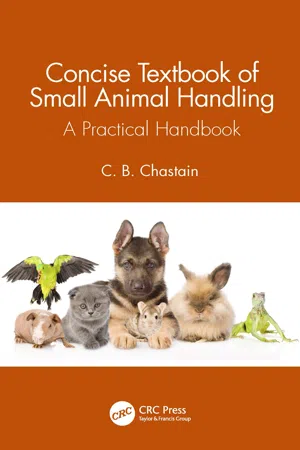
Concise Textbook of Small Animal Handling
eBook - ePub

Concise Textbook of Small Animal Handling

A Practical Handbook

  1. 222 pages
  2. English
  3. ePUB (mobile friendly)
  4. Available on iOS & Android
eBook - ePub

Concise Textbook of Small Animal Handling

A Practical Handbook

About this book

This instructional pocket reference condenses the most important aspects of small animal handling. It provides a portable, durable means of learning 'on the ground', as well as a convenient way to refresh on how to strive for safety and efficacy in animal handling techniques. Spiralbound for practical use at the animal's side during veterinary placements in a clinic or laboratory, the text covers:

  • Handler safety
  • Animal safety
  • Sanitation
  • Approach and capture
  • Routine handling and release procedures
  • Handling for medical procedures
  • Use and supply sources of restraint equipment

A Companion Website provides additional self-assessment questions and answers to aid learning. Important reading for undergraduate veterinary students as well as practicing technicians, nurses and assistants, the book instructs on safe and humane handling of species encountered in both small animal practice and laboratory settings.

You can hear the author discuss the topics covered in this book on his weekly podcast 'Better Animal Handling': https://www.betteranimalhandling.com/

Trusted by 375,005 students

Access to over 1.5 million titles for a fair monthly price.

Study more efficiently using our study tools.

Information

Publisher
CRC Press
Year
2022
Print ISBN
9780367628147
eBook ISBN
9781000542172

1 SAFER ANIMAL HANDLING AND PHYSICAL RESTRAINT

DOI: 10.1201/9781003110927-1
The reasons to handle or restrain individual animals include physical examination; prophylactic, medical, or surgical treatments; grooming; training; recreation; and companionship.
The single action that veterinary medical personnel do for each and every patient is the application of handling techniques.

HANDLING AND ANIMAL WELFARE

The American Veterinary Medical Association has defined animal welfare as when an animal is healthy, comfortable, well nourished, safe, able to express innate behavior, and not suffering from unpleasant states such as pain, fear, and distress. The Five Basic Freedoms of Domesticated Animals are an international guide for attaining proper animal welfare (Table 1.1).
Table 1.1 Five Basic Needs (Freedoms) of Domesticated Animals
A suitable environment
A suitable diet
The ability to exhibit normal behavior
The need for an animal to be housed with or apart from other animals
Protection from pain, suffering, injury, and disease

THE MORE EFFECTIVE HANDLER: THE ART OF FIRM KINDNESS

Proper animal handling for husbandry, treatment, and safety is quiet, methodical, and should leave the animal easier to handle the next time. Guidelines for physical restraint of animals are contained in the American Veterinary Medical Association’s position statement on the APhysical Restraint of Animals. The essentials of the AVMA’s position statement are listed in Table 1.2.
Table 1.2 Essentials of Proper Animal Restraint
The least restraint required to allow the procedure(s) to be performed properly
Protection of both the animal and personnel from harm
To plan, formulate, and communicate restraint prior to its application
The use chemical restraint when physical restraint presents excessive risk of injury

AFFECTION FOR THE ANIMALS

A good animal handler has to like the type of animal that will be handled. Using food rewards, petting, scratching, grooming, or verbal praises are beneficial under the correct circumstances.

PROPER ATTITUDE

Good animal handlers are calm, deliberate, patient, organized, and determined and they attempt to prepare the animal to better tolerate future handling experiences.
  • Calm, Deliberate, and Patient: Extroverted behavior, i.e., direct stares, exaggerated facial expressions, frequent hand and arm movements, and loud or spiking speech patterns, can attract the attention of humans, but these mannerisms do not gain or maintain trust from animals. Animal handlers should move and act calmly, deliberately, and patiently.
  • Organized Approach: Being organized and having a plan before handling or restraining animals is important for success for each handling event and all future handling events with the animals handled.
  • Determination: Determination is an essential quality of a good handler. A handler must be confident and determined that the plan to handle or restrain an animal will be successful.
  • Controlled Release: The release of a restrained animal must be as quiet and calm as possible, and it must be under control of the handler, not the animal. Each handling, and especially restraint experience, is a lesson learned by the animal, and their release is most remembered.

ALLOCATION OF SUFFICIENT TIME: POWER OF PATIENCE

Sufficient time to observe the animal or animals to be handled is important in determining the best approach to handling and to allow the animal or animals to adapt to handler presence.
  • Disadvantages of Being in a Rush: Trying to rush proper handling leads to increased risk of injuries or excessive procedure time because of animals being stressed and scared.
  • More Time for Special Cases: Longer times need to be allocated for certain animals, particularly for handling young, elderly, sick, or newly acquired animals.

USE OF VOICE, TOUCH, AND BODY LANGUAGE

Restraint begins with the handler’s voice or body language.
  • Voice: Animals like to hear a handler’s voice if it is soothing and has rhythmic tones.
  • Body Language: Animals use body language to a greater extent than any other means of communication.
    • Lowered Posture: Handlers greeting small animals are better received if the handler lowers his posture.
    • Avoiding a Direct Stare: A glancing gaze or indirect stare by another animal or a handler is less threatening that a direct stare. Staring particularly at an animal’s eyes is dominance-challenging to carnivores.
  • Touch: Touch is used last but can readily convey handler confidence and intentions to an animal being handled. Animals tolerate touch on the shoulders more easily than touch around the more vulnerable areas such as the eyes, ears, throat, belly, or legs.

ALWAYS ON GUARD: SAFETY FIRST

Handlers must be constantly aware of the risks of injury to themselves, other people, or the animal being handled.
  • Individual Animal Reactions Vary: Factors which affect an individual animal’s reactions to handling are familial tendencies; prior handling and training; trust, or the lack of it, in the handler; and stressful events preceding or during the handling. As a result, the assumption that all domestic species or animals within a species are the same can lead to serious injury.
  • Overconfident and Ill Prepared: Most injuries from animals are caused by the handler being overconfident and undercompetent. Animal handlers must always position themselves and take other precautions to eliminate or minimize the chance of injury to all involved.
  • Special Risks to Veterinary Staff: Veterinary staffare at a relatively high risk of injury. Many animals they must treat have not been socialized to humans or previously handled. In addition, sick or injured animals may act atypically because of pain or fear and often hide their disease or injury until a handler disturbs them.

DISTRACTION VERSUS PAIN FOR RESTRAINT

Distractions are the basis for most humane and effective animal handling techniques and are not painful when correctly used.
  • Pain: Pain is a message sent to the brain that body tissue is being injured. Painful procedures leave a physical or psychological mark on the animal.
  • Distractions: A distraction is applying a nonpainful stimulus that supersedes competing stimuli. Petting is the simplest form of distraction for handling.

RESPECT FOR HANDLERS

Animals that are either fearful of handlers or have no respect for humans are the most dangerous to handle.
  • Gaining Respect: Leaders of animals establish their leadership by the control of movement and access to resources. Effective handlers do the same. Respect is gained by their knowledge that either pleasure (praise, food treats) or discomfort (not pain) will consistently occur with certain behaviors.
  • Avoiding Fear: Fear can result from the expectation of pain. If fear is from instinct, it can be moderated. If it is from having experienced pain, it is often permanent.

ADAPTATION TO SPECIAL CIRCUMSTANCES

Animal handling is not a set recipe that fits all situations. An effective animal handler must adapt techniques to the species, the surroundings, and the individual.
  • Surroundings: Animals may act differently in different surroundings due to noise, lighting, odors, visible distractions, and associations of actual or similar surroundings with past experiences.
  • Current Attitude and Condition: Each animal handled should first be observed to assess its current attitude and physical condition.
  • Need for Special Handling: Young, elderly, pregnant, and sick animals always need special handling.

APPROPRIATE ATTIRE, GROOMING, AND PERSONAL HABITS

Proper handler attire for the type of ...

Table of contents

  1. Cover
  2. Half Title
  3. Title
  4. Copyright
  5. Contents
  6. Preface
  7. Acknowledgments
  8. Caution
  9. Author Biography
  10. 1 Safer Animal Handling and Physical Restraint
  11. 2 Small Animal Behavior
  12. 3 Dogs
  13. 4 Cats
  14. 5 Other Small Mammals
  15. 6 Companion Birds
  16. 7 Reptiles
  17. Appendix
  18. Index

Frequently asked questions

Yes, you can cancel anytime from the Subscription tab in your account settings on the Perlego website. Your subscription will stay active until the end of your current billing period. Learn how to cancel your subscription
No, books cannot be downloaded as external files, such as PDFs, for use outside of Perlego. However, you can download books within the Perlego app for offline reading on mobile or tablet. Learn how to download books offline
Perlego offers two plans: Essential and Complete
  • Essential is ideal for learners and professionals who enjoy exploring a wide range of subjects. Access the Essential Library with 800,000+ trusted titles and best-sellers across business, personal growth, and the humanities. Includes unlimited reading time and Standard Read Aloud voice.
  • Complete: Perfect for advanced learners and researchers needing full, unrestricted access. Unlock 1.5M+ books across hundreds of subjects, including academic and specialized titles. The Complete Plan also includes advanced features like Premium Read Aloud and Research Assistant.
Both plans are available with monthly, semester, or annual billing cycles.
We are an online textbook subscription service, where you can get access to an entire online library for less than the price of a single book per month. With over 1.5 million books across 990+ topics, we’ve got you covered! Learn about our mission
Look out for the read-aloud symbol on your next book to see if you can listen to it. The read-aloud tool reads text aloud for you, highlighting the text as it is being read. You can pause it, speed it up and slow it down. Learn more about Read Aloud
Yes! You can use the Perlego app on both iOS and Android devices to read anytime, anywhere — even offline. Perfect for commutes or when you’re on the go.
Please note we cannot support devices running on iOS 13 and Android 7 or earlier. Learn more about using the app
Yes, you can access Concise Textbook of Small Animal Handling by C. B. Chastain in PDF and/or ePUB format, as well as other popular books in Medicine & Veterinary Medicine. We have over 1.5 million books available in our catalogue for you to explore.