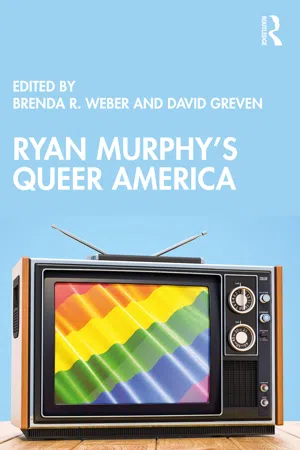
Ryan Murphy is a self-described "gay boy from Indiana," who has grown up to forge a media empire. With an extraordinary list of credits and successful television shows, movies, and documentaries to his name, Murphy can now boast one of the broadest and most successful careers in Hollywood. Serving as writer, producer, and director, his creative output includes limited-run dramas (such as Feud, Ratched, and Halston), procedural dramas (such as 9-1-1 and 9-1-1 Lonestar), anthology series (such as American Crime Story, American Horror Story, and American Horror Stories), sit-coms (such as The New Normal) and long-running serial narratives (such as Glee, Nip/Tuck, and Pose). Each of these is infused in different ways with a distinctive form of queer energy and erotics, animating their narratives with both campy excess and poignant longing and giving new meaning to the American story.
This collection takes up Murphy as auteur and showrunner, considering the gendered and sexual politics of Murphy's wide body of work. Using an intersectional framework throughout, an impressive list of well-known and emerging scholars engages with Murphy's diverse output, while also making the case for Murphy's version of a queer sensibility, a revised notion of queer time, cultural memory, and the contributions his own production company makes to a politics of LGBTQ+ representation and evolving gender identities.
This book is suitable for students of Gender and Media, LGBTQ+ Studies, Media Studies, and Communication Studies.
1 Posing as Normal? The Televisual and the Queer, The New Normal and Pose
Lynne Joyrich
DOI: 10.4324/9781003170358-3
Currents, Flows, and (Main) Streams, or, the Making and Unmaking of Queer TV and TV Studies
As a scholar in queer television studies, I start this chapter with a question, and then others in its wake: Does Ryan Murphy make or unmake queer television? What does that suggest about the very meaning, or perhaps undoing, of the terms “queer” and “television,” let alone the possible affinities and antagonisms in linking them into “queer television”? What identifications and disidentifications surround those terms and their associations, and how do those play out in Murphy’s work, or at least in some telling cases?
For decades, before Murphy entered the industry and throughout the time he’s been in it, television has been taken as the very determinant of “the mainstream,” and, even with the changes we’ve seen come to television, TV is still typically seen as the most ordinary, everyday, and commonplace of our media forms. Conversely, “queer” has been defined precisely as the subversion of the ordinary: as the strange, the non-normative, the irregular, which would seem to necessitate a disruption to “our regularly scheduled programming.” Does this then make the very notion of “queer television” (and, perhaps by extension, “queer television studies”) impossible, or does it make this nexus particularly productive, since the combination is itself defined in and as contradiction, making it necessarily queer?1 Might that implicit queerness then help to explain some of the recent shifts in TV, including the shift toward incorporating more LGBTQ+ characters, not to mention (and certainly not unrelated to) more LGBTQ+ producers? These questions emerge in intriguing ways in relation to Murphy’s work, since Murphy, more than any other queer producer, has “made it” in TV’s mainstream and yet also challenged what that “mainstream” might be. Or is it really not such a challenge? Might one even charge that the inclusion of LGBTQ+ folks in television, behind the camera and in the texts, is the opposite of “queer,” as it simply signals an acceptance of the normative TV model, a logic of, precisely, “incorporation” that just profits media corporations and brands (rather than benefitting those who historically have been branded for their corporeal acts)? In sum, when LGBTQ+ folks (like Murphy and many of his characters) “make it” on television, streamed into the dominant currents within televisual flow, are they no longer quite queer, that “mainstreaming” undoing the force of disruption and negativity that makes “queerness” to begin with?
Such an argument about the fatal compromising of queer negativity, as LGBTQ+ subjects become integrated into the televisual mainstream, may seem quite convincing. Yet before going too far with this, it’s useful to remember that, for television, that label of “mainstream” has been a source of aspersion, not approval. It has marked TV as banal, lacking both the stature of cinema and the sexiness of new digital forms. According to well-worn images, we’ve put the TV set on because it’s there, even if we haven’t done it with much excitement: we’ve tolerated what’s on as much as asked for tolerance from it, slumping in front of the set as antisocial couch potatoes who simply go with the flow – the mainstream current – rather than gearing up for a night out socializing (like dinner and a movie) or even for the social networking we do online. Television’s mainstream – or as it’s sometimes disparaged, “lamestream” – status has thus, in a curious reversal, worked as a badge of disdain and dismissal, yielding a kind of TV-bashing that has perhaps curiously aligned it with other bashed subjects.2
To be sure, many would state that these are old, retrograde images, and it’s no longer the case that TV can be so readily dismissed, rejected as a dull waste of (prime)time. Today, television is much more interesting (or, maybe more accurately, acknowledged as interesting) – more intriguing in concepts and politics, complex in story structures and visuals, multiple in address and mediations. Thus, at the same time that more queers are making it on television, television itself is being re-made, some say, as more queer: more eccentric and playful, more connective and transformative, with more stand-out strangeness than just stand-up straightness. Yet those textualities and sexualities need not – in fact, often do not – go together in quite that way. That is, the point that some televisual forms may be becoming, in a sense, more “queered” doesn’t necessarily mean that more “queers” appear in and through them – that “queering” as a verb (the process of playing, transforming, and making strange) lines up with “queer” as a noun (identifying people who are “recognizably” LGBTQ+). Indeed, considering television as a whole, usually such “recognizable” figures are in the most typically recognizable, ordinary of texts (a domestic sitcom, a sex-crime-filled police procedural, a fashion advice or competition show), while more unconventional, complex, and variously “fantastic” texts (and precisely because of that unconventionality, complexity, and fantasy) often have a dearth of those who are “identifiable” through the terms and types we commonly use as categories of recognition. Thus, we find ourselves back to the demand for more gay characters, producers, and plotlines, and then back to the critique of the conformity of that goal, and on and on and on in a sort of vicious circle (with the demand for “negativity” now being a positive requirement in queer theory/politics and the demand for “positive” representation now being treated as a negative, until these poles – both over-simple – recall, reverse, and repeat each other again and again).
Does this then just short-circuit the current of queer television and television studies? Or rather than a dead-end, might this be seen as a matrix of generative productivity? Of course, the very notion of a “generative productivity” must be treated carefully and with critique – a point taught by both queer and television theory. Much television scholarship has discussed how TV’s on-going textuality is based on a kind of endless generative productivity (whether a text generates storylines via series’ internal repetitions or serials’ expanding reverberations)3 – a productivity designed to yield profit for the industry via consuming/commodifying pleasure for viewers. Queer (and, I’d add, feminist) theory has its own critique of this kind of “generation,” interrogating not only how it ties pleasure to capital, and domestic relations to exploitative exchanges, but, even more central in queer theory, how it implies an entire logic of “reproductive futurism” – a logic of linearity that can only breed a hetero- (or homo-) normative vision centered around the privileged figure of the Child.4 Given television’s narrative and economic reliance on futurity and on reproducing itself – spurring ever more textual production to incite ever more viewing and consuming, with television’s endless worlds perpetuating television itself as a world without end – it’s important to think about how this implicates TV (not to mention the TV viewer, also often figured as Child, infantilized by television consumption).
Yet while television is certainly based institutionally on both particular modes of reproduction and particular modes of futurity (in its production of not only plots and profits but, importantly, new “offspring” in spin-offs, tie-in merchandising, convergent media content), these come together in unique and perhaps surprising ways. Indeed, televisual temporality and narrativity hardly adhere to a linear model of simply positive progression. Rather, television operates via restarts and reversals, iterations and inversions, branchings and braidings. Its imaginary is thus one of futurity without direct forward thinking, involving propagation without always measurable progress and generation without necessarily clear continuity. Thus, with both problems and potential, TV offers a model of proliferation – of multiplications, hybridizations, disseminations – beyond and besides teleological, Oedipal conceptions of a linear track from past to future. Just, then, as queer theory helps us interrogate television (with its typically still overly simple binary categories of gay/straight, masculine/feminine, normal/abnormal, us/them), might television help us think outside the binaries of queer theory itself – binaries like those of being too straightforward-looking or too stuck-in-the-past, too focused on the positive or too mired in negativity, too mainstream or too oppositional, too properly socialized or too anti-social, too commonsensical or too dismissive of the commons? In other words, can the odd operations of televisual logic – even if this logic is harnessed to the mainstream – give us hints about a queer logic, letting us think through the collisions and contradictions of queer TV in new ways? I hope that this strikes readers as a stimulating – though probably still vague – prospect. To make this a bit more concrete, let me turn to two cases from Ryan Murphy Productions.5
Normal Television?
The New Normal (created by Ryan Murphy and Alison Adler, with first run episodes on NBC from September 10, 2012 to April 2, 2013) is, I believe, an interesting (if problematic and short-lived) text to explore. Located at exactly the crossing of the queer and mainstream, the meeting of gay characters and straight-up television tradition, it highlights the connections and clashes of “reproductive futurism” and the “no future” that’s arguably inherent in old-school, repetitive sitcom form (which depends on a regular return to the defining “situation,” constituting an iterative practice that, with whatever hijinks, hilarities, and even relative changes to the character group ensue in weekly episodes, impedes the possibility of straightforward, linear movement ahead by its constant reversion to its premise) (Figure 1.1).
Figure1.1 Shania (Bebe Wood) as Little Edie in The New Normal
Of course, one might argue that The New Normal breaks with traditional “reset-to-zero” sitcom structure, given the development that distinguishes this particular narrative: its premise demanded that the characters prepare for a baby to be born, and the series ended (due to network cancellation, which some saw as untimely and others as only too perfect timed) in the season finale with that birth. But should this necessarily be seen as a genre-shifting change (from stasis to progress)? After all, this sitcom was always about family (like practically all sitcoms, whether focused on a nuclear, extended, or blended family or a “family” of friends or colleagues) with, therefore, family expansion already characterizing the program through the familial relationships that the show’s married gay male couple establishes with their “surrogate mother,” her child, and assorted other family members, friends, and co-workers.
It is this televisual repetition/revision of the meaning of “family” that, as stated above, puts this series right at the intersection of “queer” and “mainstream” – though, in many assessments, the program stands at these crossroads in the worst way. As Alex Doty wrote of the similarly “liberal” gay-inclusionary programs Modern Family (ABC, 2009–2020) and Glee (another Murphy show, co-created with Brad Falchuk and Ian Brennan), such programs “put the normative back into their homo(s),” highlighting “‘good’ gays who keep their ‘place at the table’ by striving to be just like their straight middle class counterparts, living in a monogamous relationship and building up a (mildly dysfunctional) family.”6 For all of its foibles, this is a family marked as “good” precisely by its spot-on mimicry of the standard heterosexual/sit-com-textual model, with proper class, race, and gender enactments that allow it to present itself as “just like everyone else’s” – by, of course, actually contrasting that family to less privileged others. While characters Bryan (Andrew Rannells) and David (Justin Bartha) maintain a standard “girly”/”boyish” gender polarity (evident in not only many of the series’ jokes but even its promotional image, in which David is pictured shaving while Bryan is doing his hair), they are marked as deserving parents precisely through their contrast to the heterosexual, yet “hick,” “low class,” and “white trash” failed couple of Goldie (the “surrogate mother” for Bryan and David’s baby, played by Georgia King) and her cheating husband Clay Clemmons (Jayson Blair). Rounding out The New Normal family is Goldie’s daughter Shania (Bebe Wood), who is sophisticated beyond what her age – and, the program suggests, her class and region – would lead us to expect; Goldie’s clichéd, bigoted, conservative grandmother Jane (Ellen Barkin); and Rocky Rhoades (NeNe Leakes), who works on Bryan’s diegetic (and reflexive in-joke Glee reference) TV show Sing. The function of the latter two characters, in terms of the program’s positioning of the white, upper-middle-class, gay, “normal” couple, is interesting: given her offensive quips, Jane serves as a site for locating (and urging us to condemn) racism and homophobia, thus inoculating the program as a whole from the critique that it is racist and sexually normative. Meanwhile, as the “sassy friend,” the African American Rocky is located in the place typically given to gay male characters, allowing the program to maintain yet disavow that sexist and racist trope as well.
Given these characters and characteristics, The New Normal may not seem like a very promising example of a text from which queer theory (or TV theory, for that matter) can learn anything, as it seems so banal, so assimilationist, so obsessed with familial reproduction, so “positively normal.” But it’s exactly that supreme – even extreme – normality, that obsession with “normalness,” that I find intriguing. In fact, I’m intrigued by all Ryan Murphy programs – or, more precisely, those that are discussed under the sign of his name, as, again, today’s most successful gay television screenwriter, director, and producer. For if TV textuality generally rejects linearity for other kinds of narrative forms (repetitive, interruptive, cyclical, branching), what seems to me to be most interesting about Murphy productions is that they almost eschew narrative entirely. They are commonly critiqued for having no clear character consistency or development; lacking logical motivation; being all shock and no story; and, in gen...
Table of contents
Cover Page
Endorsement Page
Half Title page
Title Page
Copyright Page
Dedication
Contents
List of Figures
Ryan Murphy Media as of March 2022
Acknowledgments
List of Contributors
Introduction: Touching Queerness: Ryan Murphy’s Queer America
Part I Queer Sensibilities
Part II What Was, Is, and Might Be
Part III Remembering Those Lost: HIV/AIDS and Cultural Memory
Part IV Ryan Murphy Productions
Bibliography
Index
Trusted by 375,005 students
Access to over 1.5 million titles for a fair monthly price.
Study more efficiently using our study tools.
Frequently asked questions
Yes, you can cancel anytime from the Subscription tab in your account settings on the Perlego website. Your subscription will stay active until the end of your current billing period. Learn how to cancel your subscription
No, books cannot be downloaded as external files, such as PDFs, for use outside of Perlego. However, you can download books within the Perlego app for offline reading on mobile or tablet. Learn how to download books offline
Perlego offers two plans: Essential and Complete
Essential is ideal for learners and professionals who enjoy exploring a wide range of subjects. Access the Essential Library with 800,000+ trusted titles and best-sellers across business, personal growth, and the humanities. Includes unlimited reading time and Standard Read Aloud voice.
Complete: Perfect for advanced learners and researchers needing full, unrestricted access. Unlock 1.5M+ books across hundreds of subjects, including academic and specialized titles. The Complete Plan also includes advanced features like Premium Read Aloud and Research Assistant.
Both plans are available with monthly, semester, or annual billing cycles.
We are an online textbook subscription service, where you can get access to an entire online library for less than the price of a single book per month. With over 1.5 million books across 990+ topics, we’ve got you covered! Learn about our mission
Look out for the read-aloud symbol on your next book to see if you can listen to it. The read-aloud tool reads text aloud for you, highlighting the text as it is being read. You can pause it, speed it up and slow it down. Learn more about Read Aloud
Yes! You can use the Perlego app on both iOS and Android devices to read anytime, anywhere — even offline. Perfect for commutes or when you’re on the go. Please note we cannot support devices running on iOS 13 and Android 7 or earlier. Learn more about using the app
Yes, you can access Ryan Murphy's Queer America by Brenda R. Weber, David Greven, Brenda R. Weber,David Greven in PDF and/or ePUB format, as well as other popular books in Social Sciences & Gender Studies. We have over 1.5 million books available in our catalogue for you to explore.