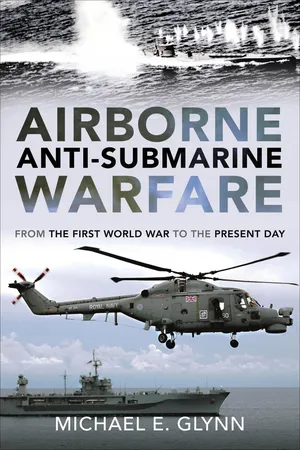
This military history explores more than a century of aerial submarine hunting, from WWI through the Cold War and beyond.
U. S. Navy veteran Michael Glynn served as a submarine hunting pilot. Now he chronicles the evolution of this unique combat role from the Great War through the Battle of the Atlantic in World War II and on to secret Cold War confrontations. He traces the parallel evolution of both aircraft and submarine as each side tries to gain advantage.
Through his expert analysis, Glynn distills complicated oceanography, operations analysis, and technical theory, helping the reader understand how complex weapons and sensors function. He also examines submarine hunts in action, showing how theory and practice work together to help aviators detected their targets.
eBook - ePub
Airborne Anti-Submarine Warfare
From the First World War to the Present Day
- 272 pages
- English
- ePUB (mobile friendly)
- Available on iOS & Android
eBook - ePub
About this book
Information
Subtopic
20th Century HistoryChapter 1
The Airplane’s Role in Anti-Submarine Warfare
Before we explore the history of airborne ASW and delve into how sensors and weapons are used to counter submarines, it is best to conceptualize the goals and aims of an ASW campaign. In doing so, we can understand the different roles that ASW aircraft play in such a conflict.
Modern submarines are versatile and powerful weapons. Their ability to hide themselves from observation allows them to enter defended areas and carry out missions unmolested. They often carry specialized intelligence-gathering equipment. The amount of combat power they bring to bear is highly disproportionate to their small size and relatively low cost. The submarine’s combat power is great, and therefore must be countered.
At its core, ASW is negative in its aims. The ultimate goal is to enable friendly units to accomplish their missions without interference from submarines. To accomplish this goal, ASW units focus on degrading the submarine’s ability to counter friendly forces. If enemy submarines are sunk during an ASW campaign, all the better. But it is crucial to keep in mind that the effectiveness of an ASW campaign is measured by how well friendly forces can accomplish their mission, not by how many hostile submarines are damaged or sunk.1
Rather than facing off against submarines in a symmetric, force-on-force fight, some nations have adopted strategies that attempt to attack the adversary’s submarine kill chain as a whole, rather than focusing on defensive operations and targeting individual submarines. At the time of writing, the U.S. Navy refers to this type of doctrine as Full Spectrum ASW (FSASW).2 It brings together many disparate military capabilities to attack and degrade the capabilities of submarines at every point in their journey from the pier to the point of firing a weapon.3
FSASW seeks to degrade the strengths of submarines and exacerbate their weaknesses. The doctrine calls for attacks against submarines in port, efforts to degrade command and control (C2) networks, strikes against land-based cueing sensors, and the use of denial and deception measures. The American FSASW concept is broken down into ten different threads, which are listed below:
Thread 1: Create Conditions Where an Adversary Chooses not to Employ Submarines
Thread 2: Defeat Submarines in Port
Thread 3: Defeat Shore-Based C2
Thread 4: Defeat Submarines near Port in Denied Areas
Thread 5: Defeat Submarines in Choke Points
Thread 6: Defeat Submarines in the Open Ocean
Thread 7: Draw Enemy Submarines into Kill Boxes
Thread 8: Mask Friendly Forces from Detection and Classification
Thread 9: Defeat Submarines in Close Battle
Thread 10: Defeat the Incoming Weapon
In the remainder of the chapter, let us examine each thread in detail and determine what role ASW aircraft play in each phase.4
Thread 1: Create Conditions Where an Adversary Chooses not to Employ Submarines
Submarines bring many benefits to the battlefield. They are by their nature small, stealthy, and difficult to detect. A diesel-electric submarine, well maintained and operated by a proficient crew, is extremely difficult to detect in shallow, noisy environments close to the coast. Armed with wake-homing torpedoes and anti-ship cruise missiles (ASCMs), they possess the sensors and weapons necessary to find and sink merchant ships or warships.
Modern submarines are relatively cheap. At the time of writing, any nation with US $500 million can purchase an extremely capable diesel-electric hunter killer submarine (SSK). This is an enormous amount of capability for a small capital investment.
Submarines are by their nature asymmetric weapons platforms. Traditionally, they have been the tools of weaker navies. They have frequently been built and operated by forces that cannot challenge their better-armed opponents in a decisive fleet action and thereby seek another solution. It was the power of the Royal Navy that led Germany to develop the first U-boats in the years before World War I. So too was it the strength of the U.S. Navy’s aircraft carriers and battle groups that drove the Soviet Navy to build its massive fleet of submarines during the Cold War.
To reduce the submarine threat before a conflict begins, leaders should work to convince potential adversaries that employing submarines will be futile during wartime and that doing so will strategically undermine the adversary’s goals. The adversary must be convinced that they have more to lose by deploying a submarine force than they have to gain. Themes should include that submarines are expensive, difficult to operate, challenging to maintain proficiency with, and easily countered by friendly ASW capabilities.
ASW aircraft can best contribute to this thread during peacetime by maintaining a high state of readiness and demonstrating the ability to search for and track friendly and foreign submarines. Commanders should highlight the proficiency of their aircrews during exercises or real-world submarine prosecutions.5 A strong ASW force serves as a powerful deterrent to would-be adversaries.
Thread 2: Defeat Submarines in Port
A submarine in port is usually far easier to locate than one that is underway. As such, the second thread of FSASW calls on commanders to attack boats while they are pierside, where their location is well known, they are readily observed, and may be attacked using general-purpose weapons rather than less numerous and more expensive specialized ASW weapons. Another facet of this effort is damaging or destroying submarine support infrastructure. This includes attacking headquarters buildings, maintenance facilities, weapons storage bunkers, and other support equipment. Because submarines are required to periodically return to port to resupply and rearm, degrading support infrastructure is useful to slow the resupply process. A less effective resupply and support capability gives friendly forces more time to locate and target boats in port. It also minimizes the amount of time a particular submarine is underway where it can attack friendly targets.
ASW aircraft may play a role in this thread. In the lead-up to conflict, they can help locate adversary submarines in port, using electro-optical (EO) sensors and radar. Once conflict has begun, they can utilize synthetic aperture radar (SAR) to locate boats pierside and provide targeting information to strike aircraft. Some patrol aircraft have been outfitted with land-attack cruise missiles, allowing them to strike submarines and port infrastructure. ASW aircraft may also be able to use EO and radar imagery to conduct bomb-damage assessment after a strike.
All of these missions are contingent on the strength and capabilities of adversary air defenses. Naval bases are valuable and are likely to be well defended. If hostile fighters or ground-based air defenses are active, modern fixed-wing ASW aircraft will have to remain far away due to their relatively slow speed, lack of maneuverability, and limited self-defense capabilities. The environment must be permissive for ASW aircraft to bring their sensors to bear and support attacks against port facilities.
Thread 3: Defeat Shore-Based C2
Submarines may be blessed with stealth, but this advantage comes at the price of a very limited ability to sense the tactical environment. Submarines are not very mobile when compared to surface ships or aircraft. Even nuclear submarines, with their unlimited endurance, mostly patrol at slow speeds to avoid generating large amounts of noise and becoming readily detectable. Operating slowly limits the search rates that a submarine can generate. This low search rate limits the number of targets a boat can detect and the size of the operating area it can sanitize.
Sensors such as radar or active sonar cover large areas and plot target locations rapidly and precisely. However, to remain hidden, submarines must eschew these active sensors and limit their emissions by primarily using passive sonar, visual observations, and passive electronic support measures (ESM) to orient themselves to the tactical environment. Compared to other sensors, passive sonar is ambiguous. Extensive interpretation and target motion analysis (TMA) is required to generate useful tracking data from passive sonar systems. Passive sonar may also have relatively short detection ranges, especially if the environment is very noisy or the target the submarine is searching for is quiet.
Submarines are also able to search relatively covertly by using visual means. However, because their periscopes reach only a short height above the waves, their visual detection range is limited due to line of sight. Boats can utilize ESM equipment to detect electronic signals of interest. However, this ESM equipment usually provides only directional information, not precise target location information. Since many radars and electronic signal emitters have similar signal parameters, ESM is also inherently ambiguous.
The limits of passive sonar, visual sensors, and ESM combined with the low speeds of most submarines mean that boats are limited in how rapidly and precisely they can observe the tactical environment. Captain William Toti, the author of the U.S. Navy’s FSASW doctrine, captures this reality very well in the following passage:
People generally think of submarines as having claustrophobic physical environments, and they do, but what they really have is claustrophobic sensory environments. They are very limited in what they can perceive. Using acoustics, they generally have a maximum detection range of less than 50 miles. They must be at periscope depth to use optical systems, but detection ranges are limited by a very low periscope height of eye, and so they are generally less than 15 miles. For real long-distance targeting they need intelligence or outside cueing, both of which can be denied to them by other means.6
The sensory capabilities and mobility of submarines make them highly reliant on shore-based C2 and sensor networks to deliver cueing information and guide them to their targets. As a result, ASW forces can greatly degrade the effectiveness of submarines by targeting C2 networks and their associated cueing sensors. Kinetic strikes, electronic warfare, cyber-attacks, and special operations raids are all methods that a determined attacker can use to degrade C2 systems.
ASW aircraft have a limited role to play in these efforts. If properly equipped, they may be able to detect the emissions of sensors that feed the C2 network. This location information can be used by intelligence services before a conflict to plan attacks or can be fed to strike aircraft for dynamic targeting during wartime. If equipped with land-attack weapons, patrol aircraft can launch kinetic strikes of their own. However, if an adversary has even limited air defenses, it is unlikely modern ASW aircraft will be involved in strike operations until air superiority has been established.
Thread 4: Defeat Submarines near Port in Denied Areas
This step takes the ASW fight close to the enemy shore. The open ocean is often a challenging place to locate a submarine due to the sheer size of the operating areas that ASW forces must sanitize as they hunt for a hostile boat. However, an ASW force can be reasonably sure that the waters near adversary submarine bases will offer numerous chances to detect and attack boats as they go to sea or return to port. The challenge, however, is overcoming hostile defenses in these areas.
Close to shore, an adversary is likely to have a significant concentration of air defenses, surface ships on patrol, and underwater sonar arrays. Each of these capabilities makes it challenging for ASW forces to lie in wait close to port and attack submarines. As a result, forces tasked for this thread are usually stealthy or expendable.
ASW forces have typically used mines or submarines to attack boats leaving or returning to port. Nuclear fast attack submarines (SSNs) can execute offensive patrols near ports. Mines are meant to either damage hostile submarines directly or force them to transit through mine-free areas that are well known to the ASW force. This funneling effect slows down deploying submarines and leaves them vulnerable to attacks by other forces.
While some ASW aircraft are capable of deploying air-dropped mines, the high threat environment near shore precludes modern patrol aircraft from mining close to most adversary naval bases. Recently, air-dropped mines that can be deployed from long range have been developed, but they are currently only carried by bombers rather than by ASW aircraft.7
Further out to sea, away from hostile air defenses, ASW aircraft can be tasked to hunt down boats as they come or go from port. Often, geography and bathymetry govern the routes that submarines must take as they travel from port to their patrol areas. If transit routes are well known, ASW aircraft can be tasked to patrol these areas and attack whatever boats they come across.
While discussing this thread, we should examine a concept known as “virtual attrition.” Recall that the goal of FSASW is to degrade the effectiveness of the submarine threat as a whole, not merely to sink submarines. Whatever actions ASW forces take to prevent a submarine from accomplishing its mission are ultimately beneficial. If a submarine is delayed or engaged in operations other than its primary mission, it cannot bring its weapons or sensors to bear.
Imagine an adversary that is in possession of a fleet of six submarines. Each boat has an endurance of 60 days, after which it must return to port. Resupplying, rearming, and maintenance take 30 days to complete. As such, four boats are typically at sea while two are in port. Assuming each boat takes five days to transit to its wartime operating...
Table of contents
- Cover
- Title
- Copyright
- Contents
- List of Illustrations
- Introduction
- List of Abbreviations
- Chapter 1 The Airplane’s Role in Anti-Submarine Warfare
- Chapter 2 Characteristics of the Airplane
- Chapter 3 Characteristics of the Submarine
- Chapter 4 Airborne ASW History: Genesis to World War II
- Chapter 5 Airborne ASW History: The Cold War to the Present
- Chapter 6 Airborne ASW Weapons
- Chapter 7 Airborne ASW Sensors
- Chapter 8 Tactical Oceanography and Environmental Analysis
- Chapter 9 Sound Propagation Analysis
- Chapter 10 Intelligence Gathering and Cueing
- Chapter 11 Crew Resource Management
- Chapter 12 Search
- Chapter 13 Localization
- Chapter 14 Tracking
- Chapter 15 Attack
- Plates section
Trusted by 375,005 students
Access to over 1.5 million titles for a fair monthly price.
Study more efficiently using our study tools.
Frequently asked questions
Yes, you can cancel anytime from the Subscription tab in your account settings on the Perlego website. Your subscription will stay active until the end of your current billing period. Learn how to cancel your subscription
No, books cannot be downloaded as external files, such as PDFs, for use outside of Perlego. However, you can download books within the Perlego app for offline reading on mobile or tablet. Learn how to download books offline
We are an online textbook subscription service, where you can get access to an entire online library for less than the price of a single book per month. With over 1.5 million books across 990+ topics, we’ve got you covered! Learn about our mission
Look out for the read-aloud symbol on your next book to see if you can listen to it. The read-aloud tool reads text aloud for you, highlighting the text as it is being read. You can pause it, speed it up and slow it down. Learn more about Read Aloud
Yes! You can use the Perlego app on both iOS and Android devices to read anytime, anywhere — even offline. Perfect for commutes or when you’re on the go.
Please note we cannot support devices running on iOS 13 and Android 7 or earlier. Learn more about using the app
Please note we cannot support devices running on iOS 13 and Android 7 or earlier. Learn more about using the app
Yes, you can access Airborne Anti-Submarine Warfare by Michael Glynn in PDF and/or ePUB format. We have over 1.5 million books available in our catalogue for you to explore.