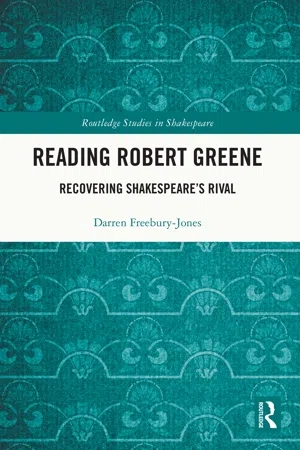
Robert Greene holds a significant place in our understanding of Elizabethan literature. This book offers the most rigorous attempt yet undertaken to determine the scope of the playwright's canon through analyses of Greene's verse style, vocabulary, rhyming habits, and the dramatist's phraseology in his attested plays and in comparison to four plays that have long been on the margins of Greene's corpus: Locrine, Selimus, George a Greene, and A Knack to Know a Knave. The book defines the ranges for Greene's stylistic habits for the very first time and proceeds to identify parallels of thought, language, and overall dramaturgy that reveal a single author's creative consciousness. This volume also casts light on Greene as a more collaborative dramatist than has hitherto been acknowledged. Through emphasizing the immediate surroundings in which Greene was writing – the flourishing of popular theatres in two compact areas of London, in which each theatre company and their dra-matists kept a close eye on what their competitors were producing – Greene emerges as an influential playwright, whose restored oeuvre enables us to establish new ways in which his dramatic methods impacted other writers of the period, including Shakespeare.
- 240 pages
- English
- ePUB (mobile friendly)
- Available on iOS & Android
eBook - ePub
About this book
Information
1 Situating Greene
DOI: 10.4324/9781003244011-2
To go to the source of the river from which Robert Greene’s dramatic reputation flows, we must travel back hundreds of years to the bustling London scene of Elizabethan commercial drama. It was a period in which, as Andy Kesson, Lucy Munro, and Callan Davies observe, ‘London was teeming with commercial playing spaces of all stripes’ and the term, ‘playhouses’, was ‘elastic’ and ‘meant simply a space (of any kind) for playing (in various ways)’.1 These spaces included the Red Lion, constructed by John Brayne in a farmhouse yard and situated in Mile End, where the company Leicester’s Men probably performed. There was also the outdoor amphitheatre with a title that might strike modern readers as less inventive and inspiring than the venue itself: the Theatre. Built by Brayne and James Burbage and located on Curtain Road in Shoreditch, it was the first of the polygonal playhouses. The Theatre opened its doors in 1576 and remained popular until its closure in 1598, when it was dismantled and ferried over the Thames to be reconstructed as the Globe in Southwark. There was also the rectangular Curtain Theatre, which opened its doors in 1577 in Curtain Close, Shoreditch, and was in use until the mid-1620s. Whereas the Theatre would have held around 800 people, archaeological investigations conducted by MOLA (Museum of London Archaeology) have revealed that ‘the Curtain would have actually held around 1,400 people at a time, a huge amount’.2 South of the Thames, situated in Surrey, was Newington Butts, constructed around 1575 by the actor Jerome Savage. Located a mile from the river near an archery-training field, plays were performed at this venue for about twenty years.3 Although Lord Strange’s Men complained to the Privy Council about the ‘tediousness’ of the journey to that venue in 1590,4 Laurie Johnson stresses that it is ‘possible to imagine a mobile audience making their way to the playhouses through the gates and out into the fields around the city, especially for a mandated activity like archery’.5 Another important playing venue was Strange’s Men’s preferred location, the Rose playhouse, which was built in 1587 by theatre impresario Philip Henslowe, was situated on Bankside, and had a capacity of around 1000 following its expansion in 1592. Other scholars have contended for a capacity of a little over 2000,6 while Peter Davison’s economic analysis puts the average Rose attendance at 870.7
There were also plenty of inns serving as performance spaces, some of which were licensed for dramatic performance in 1584, such as Bell Savage, located immediately outside the city gates on Ludgate Hill, where performances took place 1575–94, and the Bull in Bishopsgate Street, where plays were also staged during that period. Performances seem to have occurred in the outdoor courtyards of these two inns, whereas indoor performances appear to have taken place at the Bell off Gracechurch Street between 1576–94, and Cross Keys, located near Bell Inn Yard, where actors were performing by 1578.8 It was in 1594 that the Privy Council banned performances at city inns and allowed only the Lord Admiral’s and Lord Chamberlain’s Men to continue playing. Prior to this, several major companies performed at inns in London. For example, we know that the Queen’s Men, founded in 1583 at the express command of Queen Elizabeth herself, were granted ‘permission’ to ‘play at the Bull in Bishopsgate Street and the Bell in Gracious Street on holidays, Wednesdays, and Saturdays – but not on the Sabbath – between late November and Shrovetide’.9
Dramatists writing plays to be performed in these spaces were catering to eclectic audiences from all sorts of socio-economic backgrounds. M. J. Kidnie notes that early modern audiences consisted of ‘Members of the gentry, foreign ambassadors, butchers, tailors and leather workers, students being trained as lawyers at the Inns of Court, apprentices, shopkeepers and thieves’, while there ‘is also clear evidence that they were joined by women, whether ladies, citizens’ wives, or prostitutes’.10 Such audiences made up a considerable proportion of London citizens. The fundamental premise of drama was therefore to entice Londoners into playhouses during afternoon performances, and to engage and entertain them in order to make money. At its core, early modern theatre was a business enterprise. Importantly, while in ‘previous models of touring companies, the same small group of plays could be taken around the country to new audiences; now that companies were spending longer periods of time in London, the playhouse as a business model seemed to depend on the generation of fresh material’.11
We get a sense of the necessity for fresh material in letters kept by the Dulwich College Library, which were exchanged between Philip Henslowe and the dramatist and co-manager of the Children of the Queen’s Revels company, Robert Daborne, in 1613–14. Daborne agreed to supply Henslowe with instalments of a play titled Macchiavel and the Devil between 17 April and 17 May 1613, i.e., by the end of the ‘Easter’ law term. Daborne was paid £6 as an advance and ‘must have other £4 upon delivery in of three Acts, and other £10 upon delivery in of the last scene, perfected’,12 totalling £20 for the completed play. We learn here that Daborne was commissioned by acts and that Henslowe expected Daborne to transcribe his original drafts as a ‘perfect’ or ‘fair copy’, or at least commission a professional scribe himself. We also learn in Daborne’s letter dated 16 May that he was expected ‘to read’ his play ‘to the general company’,13 most likely Lady Elizabeth’s Men. This suggests that dramatists collaborated with actors during the composition of their plays and even when the plays were finished, and that they would likely need to take account of any criticisms or feedback that they received from the company of players. Grace Ioppolo points out that while actors ‘could and did suggest or make changes’ to play scripts, acting companies usually ‘relied’ on an author ‘to deal with changes to his own text’, while changes ‘made in rehearsal or performance were probably accepted, however reluctantly, by an author who participated in the staging of his own plays’.14 Unfortunately, Daborne kept delaying the submission of the ‘fair-copied’ play while asking Henslowe for more money, which agitated Henslowe so much that he threatened to bring a suit for ‘breach of promise’ on 13 November 1613.15 Daborne subsequently delivered an incomplete ‘fair copy’, along with a ‘sheet’ from his drafted or ‘foul’ papers, which he had been interrupted in the process of copying out by the very associate of Henslowe’s who had come to collect the completed play. Daborne promised to ‘write’ the ‘sheet’ of one or more pages ‘fair, and perfect the book’,16 sending the ‘sheet’ as assurance that work on the play was practically complete.
These letters suggest pressures for speediness when it came to dramatic composition, in order to keep theatre managers and their companies supplied with material.17 Indeed, Ioppolo notes that the ‘composition of a play took approximately six weeks’.18 But we could be forgiven for thinking of London play performances as static. However, Kesson, Munro, and Davies make the important point that ‘Even performances in London involved movement, as companies appear to have travelled between venues rather than basing themselves at one playhouse exclusively’, as we have seen through the Queen’s Men’s having performed in different spaces like the Bull and Bell: ‘They were therefore always on tour, both in and outside of London’.19 Dramatists thus needed to be mindful of the fact that any props required for a play would have to be transported and even hefted onto wagons for touring purposes. This perhaps accounts in part for why small, easily transferable props, such as money or letters, serve such important functions in many plays of the period. We should acknowledge that although, as Siobhan Keenan points out, ‘major playing companies’ in late Elizabethan London ‘had access to permanent, purpose-built theatres and larger audiences than any other town in the country could afford’, the tradition of touring, dating back to at least the fifteenth century, persisted,20 perhaps because of plague-induced playhouse closures; perhaps due to ‘fierceness of competition and/or declining fortunes in the capital’;21 or perhaps because London was not necessarily regarded as the capital of playing until the 1590s. In short, as Andrew Gurr observes, the tradition and indeed the necessity for ‘Travelling dictated all the early playing practices’.22
Nevertheless, playwrights would have also been deeply conscious of suiting their words to the possibilities of action afforded by the playing spaces themselves, although dramatists such as Greene sometimes appear to have wished ‘for a more spectacular effect than may indeed be possible’,23 and the spectacular nature of Greene’s stage directions will be explored in subsequent chapters. Elizabethan dramatists would have no doubt been mindful of the fact that their plays would be performed during the afternoon, often outdoors or in open-air theatres. Thus, it was necessary for playwrights to utilize language in order to work on an audience’s ‘imaginary forces’ (Prologue.18),24 as Shakespeare, a master of auditory techniques and imagistic verse, puts it in Henry V (1599). This could be achieved through descriptions of stars or moonlight, such as in the imperative in James IV, ‘Come under mine arm, sir, or get a footstool; or else, by the light of the moon, I must come to it’ (1.2),25 or stage directions calling for tapers, torches, and lanterns as signifiers that a scene is set at night. On the other hand, cognisant of many a dreary afternoon in London, dramatists might employ such vivid imagery as that found in A Looking-Glass for London and England: ‘Lo, how the sun’s inflamèd torch prevails, / Scorching the parchèd furrows of the earth!’ (5.3). It might be a particularly cold day in London, in which case a dramatist would need to persuade an audience of the ‘sunny heat’ (5.3) in the world of the play, a sensory description we once again encounter in A Looking-Glass for London and England. On the largely bare Elizabethan stage, it was through the power of language that dramatists and actors could transport London audiences to faraway, exotic locations. This process of close collaboration between playwright, actor, and audience is elucidated by Philip Sidney in his Defence of Poesy, or Apologie for Poetry, published posthumously in 1595:
you shall have Asia of the one side, and Afric of the other, and so many other under-kingdoms, that the player, when he comes in, must ever begin with telling where he is, or else the tale will not be conceived? Now you shall have three ladies walk to gather flowers, and then we must believe the stage to be a garden. By and by we hear news of shipwreck in the same place, then we are to blame if we accept it not for a rock.26
Alongside aiding his audience, a dramatist could help the actors in his plays, whose rehearsal time would have been necessarily limited,27 by incorporating stage directions in his dialogue, especially through imperatives like ‘Then give me some drink’ (4.2) in Orlando Furioso, which acts as a cue for the boy actor playing Melissa to hand Orlando a glass of wine. All of these elements emphasize the deeply collaborative nature of Elizabethan drama.
As for the ‘constituent elements of an Elizabethan playhouse’ itself, Michael Hattaway notes that ‘the evidence points to its having been rectangular and large’, and that raised ‘thrust’ or ‘apron’ stages meant that ‘for the Elizabethans’ the world of the theatre ‘was not a remote other place but a space on which men of their own t...
Table of contents
- Cover Page
- Half Title page
- Series Page
- Title Page
- Copyright Page
- Contents
- List of Tables
- Acknowledgements
- Introduction
- 1 Situating Greene
- 2 Defining Greene
- 3 Greene’s Acknowledged Plays
- 4 Collaborating with Greene
- 5 Greene’s Marginal Plays
- 6 Comparing Greene’s Marginal Plays
- 7 Recovering Greene
- Works Cited
- Appendix A Rhyme Combinations
- Appendix B Unique N-gram Figures
- Index
Trusted by 375,005 students
Access to over 1.5 million titles for a fair monthly price.
Study more efficiently using our study tools.
Frequently asked questions
Yes, you can cancel anytime from the Subscription tab in your account settings on the Perlego website. Your subscription will stay active until the end of your current billing period. Learn how to cancel your subscription
No, books cannot be downloaded as external files, such as PDFs, for use outside of Perlego. However, you can download books within the Perlego app for offline reading on mobile or tablet. Learn how to download books offline
Perlego offers two plans: Essential and Complete
- Essential is ideal for learners and professionals who enjoy exploring a wide range of subjects. Access the Essential Library with 800,000+ trusted titles and best-sellers across business, personal growth, and the humanities. Includes unlimited reading time and Standard Read Aloud voice.
- Complete: Perfect for advanced learners and researchers needing full, unrestricted access. Unlock 1.5M+ books across hundreds of subjects, including academic and specialized titles. The Complete Plan also includes advanced features like Premium Read Aloud and Research Assistant.
We are an online textbook subscription service, where you can get access to an entire online library for less than the price of a single book per month. With over 1.5 million books across 990+ topics, we’ve got you covered! Learn about our mission
Look out for the read-aloud symbol on your next book to see if you can listen to it. The read-aloud tool reads text aloud for you, highlighting the text as it is being read. You can pause it, speed it up and slow it down. Learn more about Read Aloud
Yes! You can use the Perlego app on both iOS and Android devices to read anytime, anywhere — even offline. Perfect for commutes or when you’re on the go.
Please note we cannot support devices running on iOS 13 and Android 7 or earlier. Learn more about using the app
Please note we cannot support devices running on iOS 13 and Android 7 or earlier. Learn more about using the app
Yes, you can access Reading Robert Greene by Darren Freebury-Jones in PDF and/or ePUB format, as well as other popular books in Literature & Shakespeare Drama. We have over 1.5 million books available in our catalogue for you to explore.