The first book of its kind, Decolonizing Geography offers an indispensable introductory guide to the origins, current state and implications of the decolonial project in geography.
Sarah A. Radcliffe recounts the influence of colonialism on the discipline of geography and introduces key decolonial ideas, explaining why they matter and how they change geography's understanding of people, environments and nature. She explores the international origins of decolonial ideas, through to current Indigenous thinking, coloniality-modernity, Black geographies and decolonial feminisms of colour. Throughout, she presents an original synthesis of wide-ranging literatures and offers a systematic decolonizing approach to space, place, nature, global-local relations, the Anthropocene and much more.
Decolonizing Geography is an essential resource for students and instructors aiming to broaden their understanding of the nature, origins and purpose of a geographical education.
The contemporary world witnesses relations of power, organization of space, priorities, and mindsets that are deeply influenced by patterns of hierarchy and domination that originated in modern forms of colonialism and empire. While not unchanged, these colonial relations, organizations and mindsets are present here and now, from Australia to Canada, Mexico to Finland. We call these patterns of power coloniality, a term that alerts us to the systematic exclusions and narrow interpretations that define early twenty-first-century modernity. Against this background, the process of decolonizing offers a multifaceted programme to identify and challenge coloniality’s material, institutional and ideological outcomes. Coloniality and decolonizing are intertwined dimensions of the modern world, found all around us in urban landscapes, universities, political arrangements, and ideas about nature.
This book provides an introduction to decolonizing geography. Geography here refers to the world in all its variation, as well as to the academic discipline that researches and teaches about that world. Decolonizing geography involves mapping configurations of coloniality as they touch down in a place, making it unique and connecting it with stretched out spatial structures, flows and mentalities. Coloniality is not the sole influence on geographies, but it has been largely taken for granted. Geographical scholarship has largely overlooked it because the discipline itself is steeped in coloniality. Many commentators argue that geography has a very long way to go before it can contribute to decolonizing – they are right, for reasons this chapter will explain. Yet the process of decolonizing geography’s communities and analytical lenses, the book suggests, has the potential to generate important insights into coloniality’s operations across space and the shaping of geographical imaginations and theorizations; indeed, in principle the discipline contains vital practices and agendas for real decolonizing change. This introductory chapter provides an entry point into understanding what coloniality is, why geographers should take it into account, and what decolonizing aims to achieve. We start with a case study, which demonstrates the operations of coloniality in a specific place. This, like the many other physical and human geography examples throughout the book, will show how coloniality operates and why and how decolonizing actions and thought challenge it.
Coloniality
Coloniality refers to mindsets, knowledges, identities and structures of power that have persisted over centuries. Coloniality became the modern globally dominant socio-spatial system from the late fifteenth century onwards. It comprises dynamic economic, political, social and cultural processes, which combine in various ways across time and space (see section 1.II).
Coloniality’s urban landscapes and decolonizing action
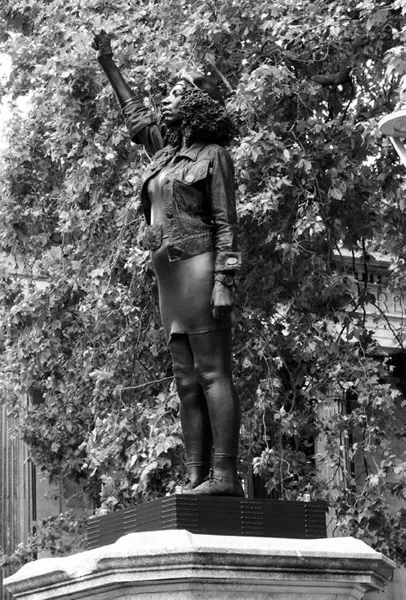
In July 2020, a black resin statue of Bristol resident Jen Reid appeared on a plinth where, until a month previously, a bronze figure of the slave-trader Edward Colston had stood for over a century (Figure 1.1). Prior to the appearance of the Jen Reid statue, protesters against the racist murder of George Floyd in Minneapolis had gathered in central Bristol in support of the Black Lives Matter movement. During these protests, the Colston statue was taken from its central city location and tipped into the harbour.1 Now ringed by art galleries, museums and new housing, the harbour had served for centuries as a major hub in the trans-Atlantic slave trade. Companies led by men like Colston had profited from the enslavement of Black Africans and from the international trade in human labour, tobacco, sugar and tropical fruit.
Figure 1.1 ‘A Surge of Power (Jen Reid)’, statue by Marc Quinn
Source: Wikimedia Commons
Edward Colston was a seventeenth-century Bristol merchant working for the Royal Africa Company, whose monopoly on West African trade in gold, slaves and ivory began in 1662. Between the sixteenth century and the nineteenth, British companies and traders like Colston controlled the mercantilist and then capitalist economic system, which accumulated bullion through trade and enslavement. Like Spanish colonialism in South America, the British traders’ pursuit of gold and silver was based on the enslavement of Africans. It is estimated that around half a million enslaved Africans were moved in Bristol ships over the period 1698–1807 (Bristol Black Archives Partnership undated: 3). In the age of mercantilism and imperial capitalism in the nineteenth century, only a small number of enslaved and free Africans (and later Afro-Caribbeans) lived in Bristol, but that situation changed in the 1940s.
After the Second World War, the British government invited people from what were then its colonies and dominions, including the Caribbean colonies of Jamaica, Barbados, St Kitts, Nevis and Dominica, to take up jobs in Britain. In the memorable phrase of the British-Sri Lankan intellectual Ambalavaner Sivanandan (1923–2018), ‘we [migrants from the former colonies, dominions and protectorates] are here [in the UK] because you [British colonizers] were there’. Today, Bristol is multiracial, reflecting colonial-modern economic structures, geopolitical ties across the world, migrant flows, and – underlying them in turn – a mindset that assumes certain groups and places serve the interests of a former colonial country. Colonial-modern relations thus very much exist in the present day, linking historic relations between places and people to entrenched patterns that embed themselves firmly in cities, interpersonal relations and the prevailing ‘common sense’. The British slave trade was ended in the early nineteenth century, and Bristol’s economy is now based on the aviation industry, tourism, media, information technology and financial services. Yet urban inequalities for Black residents are longstanding, and exist alongside the injustice of the city’s commemorations of colonialism and enslavement.
Imperialism
Imperialism is a type of geopolitical relation whereby one state (‘empire’) dominates the political authority of another state or territory through formal (including military and administrative) or informal (cultural, economic) means. Imperialism is a broad category that includes US post-war influence, direct colonization and diverse forms of colonialism.
Looking closely at coloniality raises critical questions about how Colston is lauded as a philanthropist, while Black residents of Bristol face stark inequalities and racism, with negative impacts on housing, jobs and policing. Focusing on colonial-modern economy, power and society also sheds light on the reasons behind the toppling of Colston’s statue in protests against the racist murder of George Floyd thousands of miles away. In further protests against police brutality in both the USA and the UK, the colonial structure of racism was also at issue. The two Bristol statues – of Jen Reid and Edward Colston – exemplify the relations of power in what the geographer Derek Gregory terms the ‘colonial present’. The colonial present consists, he argues, in the Anglo-American amnesia towards colonial pasts and a nostalgia for the British Empire, expressed through interventions to make Other (non-Anglo-American) people’s geographies serve their own purposes. The colonial present informed the military intervention in the Middle East after 9/11 (Gregory 2004), but it also applies to Bristol’s situation and elsewhere. Analysis of the Bristol statues’ contexts and meanings reveals the spatially situated workings of coloniality and of the struggles against it – key themes in decolonizing geography.
Decolonizing
Decolonizing refers to practices and processes that actively seek to delink from coloniality. Decolonizing comprises ‘a long-term process involving the bureaucratic, cultural, linguistic and psychological divesting of colonial power’ (Tuhiwai Smith 2012: 33).
Decolonizing action draws attention to the most enduring and exclusionary dynamics of power at work in the world today, and seeks ways to undo them. Precisely due to its shape-shifting over time and space, coloniality is not unchanging; it has been – and will continue to be – challenged and contested. Critical anti-racism and decolonial voices make visible enslavement’s consequences in unequal job opportunities, under-resourced neighbourhoods, and narratives of imperial greatness that ignore everyday racism. Bringing coloniality to light refuses complicity with it, and seeks to reorient institutions, practices and frameworks of understanding that fuel and legitimize coloniality. In this respect, decolonizing offers hopeful agendas for transformed futures (section 1.VI). In Bristol, after the toppling of the Colston statue, the mayor Marvin Rees called for action to ‘make the legacy of today about the future of our city, tackling racism and inequality. I call on everyone to challenge racism and inequality in every corner of our city, and wherever we see it.’2
As coloniality touches down in a place, so decolonizing futures are envisioned and constructed, resulting in diverse and vibrant action and thinking. As the Bristol case exemplifies, although colonialism is often imagined to be ‘over there’, coloniality and decolonizing are present here and now. Decolonizing is very much about geography, just as geography has a lot to say about decolonizing, as later chapters will show.
Entitled ‘A Surge of Power’, the statue of protestor Jen Reid (Figure 1.1) recreates and commemorates the moment she leapt onto the recently emptied Colston plinth. Colston’s statue had become an issue of concern for many Bristol residents. From the 1990s onwards, campaigners argued that the statue celebrated an oppressive and dehumanizing industry and petitioned for its removal. They challenged historical narratives that place slavery solely in ‘the past’, and drew attention to ongoing patterns of exclusion in Bristol and beyond. On Anti-Slavery Day in 2018, artist-activists placed figures identified with modern-day slavery jobs, including nail-bar staff and agricultural la...
Table of contents
Cover
Table of Contents
Series Title
Title Page
Copyright Page
Dedication
Author’s Note
Preface
Foreword: Decolonizing in a North–South Dialogue, by Rogério Haesbaert
Figures, Tables and Boxes
1 Why Decolonize Geography?
2 Postcolonialism and Decoloniality
3 Decolonizing Geographies
4 Decolonizing Geographical Concepts
5 Decolonizing Geography’s Curriculum
6 Decolonizing Geographical Research Practice
Glossary
Bibliography
Index
End User License Agreement
Trusted by 375,005 students
Access to over 1.5 million titles for a fair monthly price.
Study more efficiently using our study tools.
Frequently asked questions
Yes, you can cancel anytime from the Subscription tab in your account settings on the Perlego website. Your subscription will stay active until the end of your current billing period. Learn how to cancel your subscription
No, books cannot be downloaded as external files, such as PDFs, for use outside of Perlego. However, you can download books within the Perlego app for offline reading on mobile or tablet. Learn how to download books offline
Perlego offers two plans: Essential and Complete
Essential is ideal for learners and professionals who enjoy exploring a wide range of subjects. Access the Essential Library with 800,000+ trusted titles and best-sellers across business, personal growth, and the humanities. Includes unlimited reading time and Standard Read Aloud voice.
Complete: Perfect for advanced learners and researchers needing full, unrestricted access. Unlock 1.5M+ books across hundreds of subjects, including academic and specialized titles. The Complete Plan also includes advanced features like Premium Read Aloud and Research Assistant.
Both plans are available with monthly, semester, or annual billing cycles.
We are an online textbook subscription service, where you can get access to an entire online library for less than the price of a single book per month. With over 1.5 million books across 990+ topics, we’ve got you covered! Learn about our mission
Look out for the read-aloud symbol on your next book to see if you can listen to it. The read-aloud tool reads text aloud for you, highlighting the text as it is being read. You can pause it, speed it up and slow it down. Learn more about Read Aloud
Yes! You can use the Perlego app on both iOS and Android devices to read anytime, anywhere — even offline. Perfect for commutes or when you’re on the go. Please note we cannot support devices running on iOS 13 and Android 7 or earlier. Learn more about using the app
Yes, you can access Decolonizing Geography by Sarah A. Radcliffe in PDF and/or ePUB format, as well as other popular books in Physical Sciences & Geography. We have over 1.5 million books available in our catalogue for you to explore.