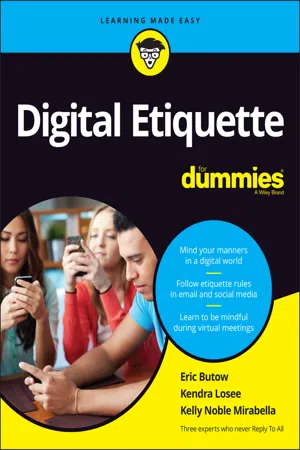
Digital Etiquette For Dummies
eBook - ePub

Digital Etiquette For Dummies

  1. English
  2. ePUB (mobile friendly)
  3. Available on iOS & Android
eBook - ePub

Digital Etiquette For Dummies

About this book

Mind your online P's and Q's with this expert digital manners guide

Conducting yourself online can be challenging. It sometimes seems like the web and social media is tailor-made to cause upset and anger. But, with the right guide, anyone can learn how to be a beacon of civility and politeness online. In Digital Etiquette For Dummies, a team of online communication experts share their combined insights into improving your presence on social media, writing emails that exude positivity and clarity, behaving correctly in virtual meetings, and much more. You'll become a paragon of politeness as you learn to apply the timeless rules of etiquette to the unique environment of the web, social media, email, Zoom, and smartphones.

In this book, you'll also:

  • Learn near-universal etiquette rules for email, social media, cellphones, and more
  • Discover ways to make sure that your polite attitude isn't being lost in the text-only context of a business email
  • Avoid common social media pitfalls and digital faux pas that can trip up even the most careful communicators

A great handbook for anyone who uses digital communication in business or in their personal life (so, pretty much everyone), Digital Etiquette For Dummies also belongs on the reading lists of those trying to improve their online interactions on social media.

Information

Publisher
Wiley
Year
2022
Print ISBN
9781119869801
Edition
1
eBook ISBN
9781119870043
Part 1

Etiquette Guidelines

IN THIS PART …
See how etiquette has changed in the digital age
Know the online ramifications of online behavior
Recognize the importance of minding your manners
Chapter 1

Defining Etiquette in the Digital Age

IN THIS CHAPTER
Bullet
Learning some definitions
Bullet
Gauging when etiquette considerations are called for
It’s easy enough to define etiquette, isn’t it? Just be kind to one another.
That’s all, folks — thank for reading!
Of course, you know that’s not the whole story or else you wouldn’t be reading this book. It’s hard enough to know what etiquette is when you’re dealing with other people face-to-face. But now communications devices have added many more rules for communicating not only with video cameras, which are ubiquitous on computers and phones, but also in situations where you don't even see the other person (and you may have noticed that makes people seem less considerate, to put it mildly).
Before we can talk about how to apply etiquette to the digital age in which everyone now finds themselves, we need to review some definitions. Once we do that, I’ll discuss how you can apply etiquette in different situations, including social, small group, and business environments.

Coming Up with Some Definitions

Let’s start with the obvious question: What is digital etiquette, anyway?
You may also have heard digital etiquette referred to by the portmanteau netiquette — that scrunching together of the words Internet and etiquette. No matter which term you’ve heard, the same definition applies: You should follow these basic rules of behavior whenever you interact with others on the Internet or use electronic devices like smartphones. And by Internet, we mean all kinds of online communication, including email, forums, and social networking websites.

Netiquette

Let’s start a deeper dive by talking about the term netiquette, which may be the most familiar to you. This term predates the modern Internet by quite a few years — 1983, specifically. This was the era when bulletin board systems, or BBSs, were the primary means of communicating online.
The acronym BBS doesn’t ring a bell, huh? Maybe the national services CompuServe, The Source, and America Online can help you (not so fondly) remember the days when you had to save up for a faster modem — such as 56Kbps or even (gasp!) ISDN.
The two prominent dictionaries have slightly different definitions of netiquette, but it’s useful to keep both in mind:
  • The Oxford English Dictionary defines netiquette as “the correct or acceptable way of communicating on the Internet.”
  • Merriam-Webster (http://m-w.com) defines netiquette as “etiquette governing communication on the Internet.”
Remember
Netiquette rules vary, depending on the forum you’re in. For example, email rules are different from when you’re chatting in a live forum. We go into more detail about those differences later in this chapter.

Etiquette versus online ethics

In trying to wrap your mind around the notion of etiquette, you need to be able to distinguish between ethics and etiquette. You may have heard both terms used interchangeably when people talk about online behavior. If you think they’re the same, lose that thought like you lose the TV remote.
The term etiquette is the code, at times unspoken, that indicates the polite way to behave in a society. Ethics is a set of moral principles that tells you what’s good and what’s bad. In a movie, you may have seen a character who you know is a bad guy but who acts politely toward everyone in the film; the perfect manners don’t fool you, because you know that the bad guy is still a villain who is naturally immoral.
Some behaviors also fall under the definition of bad ethics, which may help explain why people confuse the terms. For example, someone who lies and cheats to get what they want, no matter whether it happens in person or online, displays behavior that belies a deeper problem — we’re talking about someone who cannot think ethically.
Tip
If you want to read more about the differences between ethics and etiquette, the Pediaa site has a good overview at https://pediaa.com/difference-between-ethics-and-etiquette.

Seeing Which Situations Call for Etiquette

Certain rules of etiquette apply all the time, such as sneezing into your arm or elbow. (That’s polite behavior no matter whether you’re in a pandemic.) Other rules apply to specific situations, such as chatting with others in an online meeting.
Remember
How you behave ethically online can impact your ability to make a living. It’s now standard procedure for an employer to examine your social media profiles before deciding whether to accept your application, let alone contact you about an interview. If you want to keep certain information private, change the privacy settings on your profiles to show them only to specific connections, such as people on your friends list.
General rules of etiquette are in effect all the time, and others are specific to each situation. You must know the basics of good manners online, and this opening chapter offers the perfect opportunity to give you a 30,000-foot overview of how to apply etiquette online.
Warning
Before you forge ahead, stop for a moment and remember that what you do can also affect you legally. Have you ever heard anyone say, “What’s on the Internet stays on the Internet”? Though it’s unclear whether that statement will remain true over time, it is certainly true now. So, with your behavior recorded for others to find, do you doubt that you need online etiquette? (By the way, we delve into the legal issues of online behavior in Chapter 2.)

Social: Chatting with others

Social situations have rules in place that you’re probably familiar with, such as not saying things that you know would be hurtful to another person. Without standing physically in front of someone, though, it’s easier for us to forget that we’re actually talking to a real person, even if they aren’t physically present.
So, whenever you’re chatting with friends online, take the opportunity to review what you should be doing in social conversations — what passes for good etiquette, in other words. As you read, think about whether and how you’re following these rules so that you can train yourself to chat with others more effectively.

Hold a good conversation

Just as in a face-to-face chat, learn how you can hold a back-and-forth dialogue online. If you monopolize a discussion where you’re the one saying most everything, don’t be surprised if you’re called a troll — a person who is intentionally harmful to gain attention and/or cause trouble. It won’t be long before people start finding ways to avoid you.

Avoid gossip at all costs

It’s easy on social media to succumb to the urge to gossip, especially if the person you’re gossiping about isn’t included in the group of people you’re talking with. Don’t let yourself believe that private online groups are safe, though, because — just as with in-person gossip — online gossip finds a way to get back to the person you’re talking about. Then, like all gossip, it boomerangs on you.

Engage

Social media and other forms of online communication make it easy for you to ignore everything that other people write. After all, no one knows whether you’re actually paying attention, right?
If you’ve posted something, however, you may get some feedback on those posts from your friends and other people who can see your posts. It’s good form to respond to people with a personal thank-you message or a clicked Like icon — or both.
Even if you don’t want to type anything in response, clicking the Like icon next to the comment lets the commenter know that they’ve been recognized and that their comment is valuable. And, you may not know it, but you’ve improved your social standing with as little effort as a click or tap. If you see this person offline, your real-life social standing grows a little, too.

Connect positively

If you find a comment that you want to talk about, don’t be afraid to express your opinion by typing your own comment in response. Before you start typing, though, shift into the right mindset and make sure that it’s a healthy conversation.
In online discussions, you’re likely talking to a real person. So, if you think that ...

Table of contents

  1. Cover
  2. Title Page
  3. Table of Contents
  4. Introduction
  5. Part 1: Etiquette Guidelines
  6. Part 2: Social Media Etiquette
  7. Part 3: Email Courtesies
  8. Part 4: Virtual Meeting Manners
  9. Part 5: Mobile Mien
  10. Part 6: The Part of Tens
  11. Index
  12. About the Authors
  13. Connect with Dummies
  14. End User License Agreement

Trusted by 375,005 students

Access to over 1.5 million titles for a fair monthly price.

Study more efficiently using our study tools.

Frequently asked questions

Yes, you can cancel anytime from the Subscription tab in your account settings on the Perlego website. Your subscription will stay active until the end of your current billing period. Learn how to cancel your subscription
No, books cannot be downloaded as external files, such as PDFs, for use outside of Perlego. However, you can download books within the Perlego app for offline reading on mobile or tablet. Learn how to download books offline
We are an online textbook subscription service, where you can get access to an entire online library for less than the price of a single book per month. With over 1.5 million books across 990+ topics, we’ve got you covered! Learn about our mission
Look out for the read-aloud symbol on your next book to see if you can listen to it. The read-aloud tool reads text aloud for you, highlighting the text as it is being read. You can pause it, speed it up and slow it down. Learn more about Read Aloud
Yes! You can use the Perlego app on both iOS and Android devices to read anytime, anywhere — even offline. Perfect for commutes or when you’re on the go.
Please note we cannot support devices running on iOS 13 and Android 7 or earlier. Learn more about using the app
Yes, you can access Digital Etiquette For Dummies by Eric Butow,Kendra Losee,Kelly Noble Mirabella in PDF and/or ePUB format, as well as other popular books in Business & Business Etiquette. We have over 1.5 million books available in our catalogue for you to explore.