The extremely positive response to the first edition of The CMO of People from both practitioners and educators spoke of the value of fresh ideas along with specific steps on how to execute them. This second edition of Peter Navin and David Creelman's pathbreaking book, with new sections including industry leaders' insights from Nike, UKG, and DocuSign, corroborates the approach that sees the CMO of People as a business focused people function that utilizes the proven tools of the marketing function and creates a predictable and immersive employee experience that drives productivity and performance.
If the human resources function in your talent-centric organization is not bringing the excitement and business impact it should, you need a new mental model that approaches getting the best from people with the same mindset marketing uses to get the best results with customers. Just as the Chief Marketing Officer curates an experience to get the best lifetime value from customers, the head of HR, the CMO of People, can curate an experience to get the best lifetime value from employees.
This unique book discusses:
What it takes to change the character and intensity of an organization
How to run HR so that it has impact
Why we need to structure the HR department differently
How to find unconventional people to staff this unconventional model
How to create a predictable and immersive end-to-end experience for employees
How a CMO of People can overcome barriers and drive performance
There is a different way to envision your HR function—and it can be great.
Organizations can improve their performance by changing how they manage people. If you are going to change how you manage people, you are going to want to change how you run HR.
The CMO of People concept is a way of framing how we think about the impact HR can have on an organization. We all know what Chief Marketing Officers do: they work to draw in customers, they aim to get the value out of customers, and to do so they seek to create a great customer experience. We should see HR through the same lens: drawing in talent, getting the most value from talent, and doing so on the basis of a great employee experience.
When you map out the duties of a CMO against the duties of a CMO of People (i.e., the head of HR)—as shown in Table 1.1—the analogous nature of the roles is obvious.
Table 1.1:What a CMO Does vs What a CMO of People Does.
CMO
CMO of People
Marketing & customer analytics
People analytics
Brand, PR & creative
Employment brand
Customer acquisition
Talent acquisition
Marketing communications
Internal communications
Customer retention
Talent management
Pricing and packaging, marketing strategy
Total rewards
Enablement
Talent operations
Events and PR
Real estate/workplace services
In the companies I’ve worked for, growth and profitability were critically dependent on having our talent outperform our competitors’ talent. The challenge was especially poignant during times of high growth when we had to implement excellent talent management at a breakneck pace. Conceptualizing the HR leader as “CMO of People” helped guide me in my role as head of HR in a fast-growing company and provided a metaphor that the leadership team found fresh, easy to understand, and compelling.
Whereas marketing works the customer funnel, in HR we manage a talent funnel, depicted in Figure 1.1, which begins with different channels (including job boards, recruitment agencies, and our career website) that pull candidates into the funnel. Once the candidates are in the funnel, they go through various screening processes to the ultimate transaction: hiring them.
Figure 1.1: The Talent Funnel.
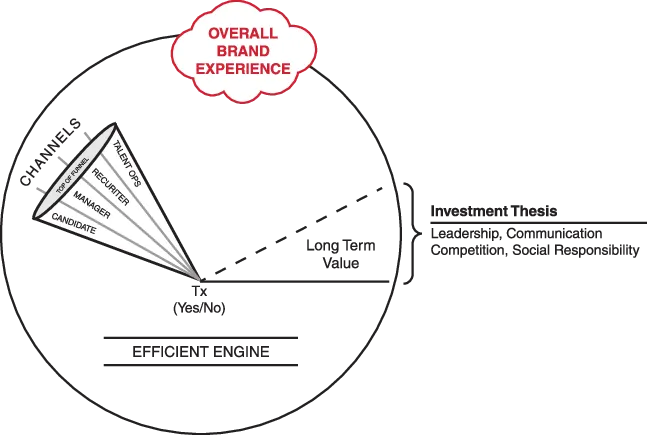
Similarly, just as with the concept of a funnel, other marketing concepts like “brand” and “customer’s lifetime value” can be translated to HR. In fact, the whole CMO of People concept fits nicely on a napkin and I have used this diagram many times with senior leaders to explain this way of thinking about HR.
Here’s how I explain the napkin to a CEO:
On the left you see the talent funnel as explained in Figure 1.1. The process starts by drawing in a pool of candidates at the top; the hire is complete at the bottom of the funnel and the entire process ends when the person retires or leaves the company. HR’s mission is to do a better job than competitors of bringing talent in through the funnel and a better job of enabling employees to add value through their lifetime with the firm.
After the hire we seek to maximize the “lifetime value” an employee brings to the company over the years they work there. This is analogous to marketing’s concept of a “customer’s lifetime value” which is all the value a customer brings by buying products and services for all the years they remain a customer. HR’s mission is to enable employees to give their best.
The foundation for a good talent funnel and exceptional employee lifetime value is an “efficient engine” of HR processes supported by the right technology and analytics. The mission of HR is to be sure this engine (that gets the transactional work done) is efficient, so HR can spend time on strategic work.
Finally, just as all of marketing is surrounded by the ideas of “customer experience” and “brand,” so too, all of HR is surrounded by the ideas of “employee experience” and the “employment brand.”
This single diagram guides us toward acquiring the best people and enabling them to perform at their best by creating an immersive and predictable employee experience that improves productivity and drives performance. There’s a lot packed into that one sentence and it points toward a new way for leading HR.
How to Increase the Employee’s Lifetime Value (eLTV)
Exceptional execution in four areas will improve eLTV:
Leadership. People want to be inspired, motivated, and aligned with great executives. Leaders build great teams, and great teams build great companies.
Competition. People want to be on winning teams internally and externally; to build an organization filled with respectful, talented, high performers; and to drive results.
Communication. People want to know what’s important to their work; aligning people consistently and continuously with the mission, and priorities, pays massive dividends in the long run.
Social Responsibility. Being proud of yourself, your team, and your company is essential; serving others is the best way to achieve pride.
How do you acquire the best people and enable them to perform better than they have anywhere else? The answer lies in having a solid foundation for the entire model: the employee experience. HR needs to develop an immersive and predictable employee experience to improve productivity and drive performance. There’s a lot packed into that one sentence and it points toward a new framework for leading HR.I almost hesitate to use the term HR. It brings to mind a department that only delivers services like training and recruiting, as well as personnel administration and labor law compliance. Yes, an elevated HR function does those things too, but it’s not the mission—the mission is to create a competitive advantage through better and more effective talent.
When the mission of HR is framed in this way, the job of the head of HR begins to sound a lot like a CMO. That’s why I decided to title this book The CMO of People. I’ve played this role, if not necessarily sporting that title, at three successful organizations. For me, it was the best way to understand the mission, communicate the mission, and establish a framework that enabled us to execute the mission.
The Mission of HR
HR is the group within a company that has expertise in talent. It knows how to find, motivate, and develop talent. It is responsible for a range of different talent processes from recruiting to training to compensation. The mission for HR is to use its expertise and its ownership of talent processes to create competitive advantage that will help the organization achieve its mission.
Being Serious about the Concept of Brand
The nature of the employee experience is captured in the concept of employment brand. Many people talk about the employment brand. It’s a popular topic. However, too often people think of the brand in terms of a glitzy image. If you are serious about the employment brand, then it will reflect each employees’ daily reality. If the brand says that the organization is fun, then employees should be having fun. If the brand says that the organization is dynamic, that should be apparent as soon as you walk in the door.
In the CMO of People concept, the brand is brought to life through an immersive and predictable employee experience that drives productivity and performance. It’s a real thing, not an aspiration. It’s everywhere (immersive) and every-when (predictable). It should be as real to employees as Disney’s brand is to theme park visitors or as Starbucks’ brand is to coffee lovers.
One of the biggest differences between the CMO of People approach and more common approaches to HR is the absolute obsession with bringing the employment brand to life.
What Makes Up the Employment Brand?
Like corporate brands, an employment brand defines the value proposition the company offers to prospective, current, and alumni employees. It’s a core part of the overall communication hierarchy of a company that includes vision, mission, and values, and it enables people to better understand what to expect from an employment experience. Values and employment brand work very closely together to paint a realistic picture of what life is like in the four walls each day.
The Link from Employee Experience to Productivity and Performance
All the organizations I’ve worked in have faced intense competitive pressures. The CEO supported HR’s obsession with the employee experience for one reason: that experience brought the best people through the talent funnel and delivered the best lifetime value. The experience naturally had to be a good one for employees, but its success was not measured by employees’ happiness—it was measured by the business’s growth and profitability.
How do you design an immersive and predictable employment experience that improves productivity and drives performance? You start by looking at each interaction an employee has with an HR process (i.e., each touchpoint). What should onboarding do? It should be laser-focused on getting people up to speed quickly and instill the cultural values they’ll need to perform. What should workplace services deliver? They should deliver services that remove distractions that harm productivity and should create an environment that the best workers won’t want to leave behind. Linking the employee experience to productivity at each touchpoint is not rocket science; it requires focus and discipline.
This intense focus on productivity and performance implies an equally intense focus on data. For example, onboarding isn’t assessed simply on whether it appears to support the employ...
Table of contents
Title Page
Copyright
Contents
Acknowledgments
Chapter 1 What Is a “CMO of People”?
Chapter 2 Impacting the Business as a CMO of People
Chapter 3 How a CMO of People Designs the End-to-End Employee Experience
Chapter 4 New Points of Leverage
Chapter 5 Why Analytics Comes First
Chapter 6 Case Study on a Mosaic of Measures
Chapter 7 How We Handled HR Technology and Processes
Chapter 8 Unconventional HR Leaders and the Role of the CEO
Chapter 9 How to Build an Unconventional HR Team
Chapter 10 Contrasting Models for the Future of HR
Chapter 11 Conclusions
Index
Trusted by 375,005 students
Access to over 1.5 million titles for a fair monthly price.
Study more efficiently using our study tools.
Frequently asked questions
Yes, you can cancel anytime from the Subscription tab in your account settings on the Perlego website. Your subscription will stay active until the end of your current billing period. Learn how to cancel your subscription
No, books cannot be downloaded as external files, such as PDFs, for use outside of Perlego. However, you can download books within the Perlego app for offline reading on mobile or tablet. Learn how to download books offline
Perlego offers two plans: Essential and Complete
Essential is ideal for learners and professionals who enjoy exploring a wide range of subjects. Access the Essential Library with 800,000+ trusted titles and best-sellers across business, personal growth, and the humanities. Includes unlimited reading time and Standard Read Aloud voice.
Complete: Perfect for advanced learners and researchers needing full, unrestricted access. Unlock 1.5M+ books across hundreds of subjects, including academic and specialized titles. The Complete Plan also includes advanced features like Premium Read Aloud and Research Assistant.
Both plans are available with monthly, semester, or annual billing cycles.
We are an online textbook subscription service, where you can get access to an entire online library for less than the price of a single book per month. With over 1.5 million books across 990+ topics, we’ve got you covered! Learn about our mission
Look out for the read-aloud symbol on your next book to see if you can listen to it. The read-aloud tool reads text aloud for you, highlighting the text as it is being read. You can pause it, speed it up and slow it down. Learn more about Read Aloud
Yes! You can use the Perlego app on both iOS and Android devices to read anytime, anywhere — even offline. Perfect for commutes or when you’re on the go. Please note we cannot support devices running on iOS 13 and Android 7 or earlier. Learn more about using the app
Yes, you can access The CMO of People by Peter Navin,David Creelman in PDF and/or ePUB format, as well as other popular books in Business & Human Resource Management. We have over 1.5 million books available in our catalogue for you to explore.