A provocative and challenging new conceptual framework for the study of images
This book builds on the groundbreaking theoretical framework established in Whitney Davis's acclaimed previous book, A General Theory of Visual Culture, in which he shows how certain culturally constituted aspects of artifacts and pictures are visible to informed viewers. Here, Davis uses revealing archaeological and historical case studies to further develop his theory, presenting an exacting new account of the interaction that occurs when a viewer looks at a picture.
Davis argues that pictoriality—the depiction intended by its maker to be seen—emerges at a particular standpoint in space and time. Reconstruction of this standpoint is the first step of the art historian's craft. Because standpoints are inherently mutable and mobile, pictoriality constantly shifts in form and possible meaning. To capture this complexity, Davis develops new concepts of radical pictorial ambiguity, including "bivisibility" (the fact that pictures can always be seen in ways other than intended), pictorial naturalism, and the behavior of pictures under changing angles of view. He then applies these concepts to four cases—Paleolithic cave painting; ancient Egyptian tomb decoration; classical Greek architectural sculpture, with a focus on the Parthenon frieze; and Renaissance perspective as invented by Brunelleschi.
A profound new theory of the work of both makers and viewers by one of the discipline's most esteemed and engaged thinkers, Visuality and Virtuality is essential reading for art historians, architects, archaeologists, and philosophers of art and visual theory.
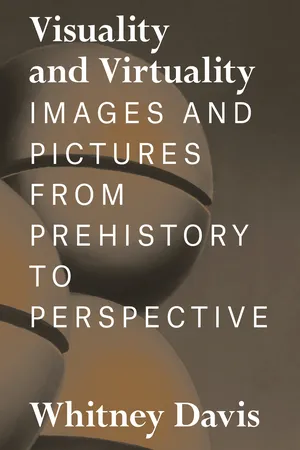
eBook - ePub
Visuality and Virtuality
Images and Pictures from Prehistory to Perspective
- 368 pages
- English
- ePUB (mobile friendly)
- Available on iOS & Android
eBook - ePub
About this book
Information
Topic
ArteSubtopic
Arte generaleTable of contents
- Cover Page
- Title Page
- Contents
- Preface
- A Note on Notations and Abbreviations
- Introduction: Images and Pictures
- Part One: Analytics of Imaging Pictures in Visual Space
- Part Two: Bivisibility, Bivirtuality, and Birotationality
- Part Three: Pictorial Successions of Virtual Coordinate Space
- Notes
- Index
- Illustration Credits
- Copyright Page
Trusted by 375,005 students
Access to over 1.5 million titles for a fair monthly price.
Study more efficiently using our study tools.
Frequently asked questions
Yes, you can cancel anytime from the Subscription tab in your account settings on the Perlego website. Your subscription will stay active until the end of your current billing period. Learn how to cancel your subscription
No, books cannot be downloaded as external files, such as PDFs, for use outside of Perlego. However, you can download books within the Perlego app for offline reading on mobile or tablet. Learn how to download books offline
Perlego offers two plans: Essential and Complete
- Essential is ideal for learners and professionals who enjoy exploring a wide range of subjects. Access the Essential Library with 800,000+ trusted titles and best-sellers across business, personal growth, and the humanities. Includes unlimited reading time and Standard Read Aloud voice.
- Complete: Perfect for advanced learners and researchers needing full, unrestricted access. Unlock 1.5M+ books across hundreds of subjects, including academic and specialized titles. The Complete Plan also includes advanced features like Premium Read Aloud and Research Assistant.
We are an online textbook subscription service, where you can get access to an entire online library for less than the price of a single book per month. With over 1.5 million books across 990+ topics, we’ve got you covered! Learn about our mission
Look out for the read-aloud symbol on your next book to see if you can listen to it. The read-aloud tool reads text aloud for you, highlighting the text as it is being read. You can pause it, speed it up and slow it down. Learn more about Read Aloud
Yes! You can use the Perlego app on both iOS and Android devices to read anytime, anywhere — even offline. Perfect for commutes or when you’re on the go.
Please note we cannot support devices running on iOS 13 and Android 7 or earlier. Learn more about using the app
Please note we cannot support devices running on iOS 13 and Android 7 or earlier. Learn more about using the app
Yes, you can access Visuality and Virtuality by Whitney Davis in PDF and/or ePUB format, as well as other popular books in Arte & Arte generale. We have over 1.5 million books available in our catalogue for you to explore.