Cities in Asia and the Pacific are expanding rapidly. With this growth, persons with disabilities, older persons, women, and children face significant challenges in accessing urban services and fully participating in city life. To address such barriers, inclusive environments are needed wherein infrastructure and services are built considering the different needs of everyone. The inclusive cities guidelines provide universal design solutions, accessibility standards, and case studies on inclusive urban development to help create a barrier-free built environment and public space. These guidelines adopt both international standards and national standards in Georgia to provide support to urban practitioners and planners in ensuring old and new developments can adapt and contribute toward the creation of inclusive and livable cities.
- 140 pages
- English
- ePUB (mobile friendly)
- Available on iOS & Android
eBook - ePub
About this book
Information
1 INTRODUCTION
Inclusive Cities: Urban Area Guidelines aims to support government officials, urban planners, architects, developers, and service delivery providers in the urban development and tourism sectors and beyond, in understanding the value of and in delivering accessible built environment, places, and services.
Inclusive cities support the urban population by creating more welcoming and intuitive places that help increase the quality of life and create a more positive experience of the built environment and public spaces for everyone. This is especially important in supporting a vibrant and dynamic tourism industry, which is a key revenue generator for Georgia and other countries in Central and West Asia.
Inclusive cities address the needs of persons with disabilities (PWDs) ensuring equal access to all urban services.1 ADB’s developing member countries (DMCs) should be increasingly aware of the needs of PWDs and the elderly.2 The inclusive urban area guidelines will help create a barrier-free, accessible, and inclusive city with a better quality of life for all its inhabitants, including PWDs, the elderly, women, and children. Though the focus is on Georgia, the guidelines are also relevant to all countries in the Central and West Asia region and the wider DMCs moving toward the creation of inclusive cities through the adoption and implementation of universal design practice.
Policies pertaining to access to education, employment, urban services, and the built environment are still in their nascent stage in most developing countries. Hence, it is important to draw from the learning experience of progressive nations to create an inclusive built environment that supports all members of society, regardless of ability, age, sex, or religion.
Tourism is a fast growing industry and a key driver of Georgia’s economic growth, accounting for 26.3% of the country’s gross domestic product in 2019. Tourism is an important source of employment, contributing to 27.7% of total employment in 2019 in Georgia, the highest in the Central and West Asia region. International visitors increased by 345% between 2010 and 2019 and totaled about 7.7 million in 2019, generating $3.2 billion in receipts. The majority of trips (76.3% or 5.5 million) were from neighboring countries, while only 23.7% (1.7 million) were from other countries. Despite a high number of visitors, associated tourism revenues lag behind. The low visitor spending is a result of a shortage of high-quality tourism experiences and the skills deficiencies to manage and market the tourism assets.
The Georgia National Tourism Strategy 2025 aims to create unique, high-quality visitor experiences based on the country’s inherent natural and cultural assets. Despite a promising prospect, basic urban services and associated tourism infrastructure in Georgia have become outdated and are only partially functioning. Integrated investments in inclusive urban services and accessible tourism infrastructure will significantly improve not only the visitor experience for tourists, but also the livability for all citizens including PWDs, the elderly, women, and families with young children. In doing so, Georgia will be well placed to meet the needs of its citizens and the increasing demand for quality tourism, unlocking the economic potential of its towns and cities.3
Urban Planning Context
People’s daily functioning and well-being greatly depend on the quality and sustainability of the infrastructure they live and work in. Such infrastructure is important for ensuring equal opportunities and easy access to public services for all the citizens, regardless of their abilities, gender, and age.
In tackling Georgia’s contemporary built environment and urban planning, it is necessary to consider the existing heritage of Soviet city planning. Soviet architecture provided limited support to children, women, PWDs, and other marginalized groups.4 Some groups were marginalized to the extent of criminal prosecution, while others, such as children with disabilities, remained under permanent threat of institutionalization. Gender equality was mostly limited to labor rights, often sidelining other human rights.5 Moreover, the notion of mainstreaming equality for all was eliminated from the needs list. There was no demand for services for women, sexual minorities, children, and PWDs because of the legislative, environmental, physical, and attitudinal regulations that existed for much of the 20th century. These had a significant impact on the design of Georgia’s post-Soviet urban infrastructure.
Ensuring accessibility of existing facilities and services as well as introducing inclusive services and environments will contribute to the inclusion of PWDs, the elderly, women, and children in society. These developments will allow them to exercise their fundamental human rights, providing access to equal opportunities and participation for all.
Universal Design
An inclusive environment is the first step toward fulfilling the rights of PWDs to participate in all areas of community life. One way to help achieve this is by introducing universal design standards. According to a report by the United Kingdom’s Department for International Development, inclusive design of the built environment through universal design is one of the six priority areas for infrastructure development that is inclusive of PWDs (footnote 5).
The definition of standards and approaches for an inclusive built environment varies globally—from universal design to inclusive design to design for all. However, what they all have in common is they go beyond the minimum technical standards for accessibility. While an accessible environment might provide step-free access, a genuinely inclusive environment will provide equality of experience for everyone.
Inclusive environments embrace diversity and flexibility, understanding that everyone has different needs, and those needs are constantly changing.6 The way in which an inclusively designed built environment can embrace and celebrate different cultures has huge potential for growing an inclusive tourism sector.7
To effectively deliver inclusive environments, implementing universal design and accessibility standards from the beginning of new construction projects is essential. It is much more cost-effective to introduce these measures during the planning and design stage, where the added cost of integrating accessibility requirements is far less (typically 1% or less of the total construction budget) than when applied later in the design process, and during or after construction.8 For cities that depend on tourism and aim to attract more visitors, considering that inaccessible environments contribute to a decrease in global market share of 15%–20%, the economic advantage of early and strategic application of universal design standards is clear.9
Accessible Tourism
Striving for the economic development of its regions, the Government of Georgia places high priority on conserving and protecting cultural and historical heritage and improving employment and livelihood opportunities for the local population through the development of tourism infrastructure.
The government pays particular attention to the possibilities that accessible tourism development can bring to the country. Accessible tourism is one of the important driving forces for the development of cities in accordance with the UN’s Sustainable Development Goals (SDGs), and in particular, SDG 11 (Make cities and human settlements inclusive, safe, resilient, and sustainable). Accessibility and sustainable mobility, a diverse and resilient local economy, vibrant public spaces, and affordability are some of the fundamental aspects of livable cities. By 2050, it is expected that about 6.25 billion of the world’s population, 15% of them PWDs, will be living in urban areas.10 Inclusive and sustainable urban development planning, therefore, ensures full and active inclusion of PWDs, the elderly, women, and children.
Restored travel destinations, ancient cities, health resorts, and newly constructed hotels and concert halls are already popular with thousands of inbound tourists across Georgia. However, a significant opportunity remains to sustainably increase the number of visitors by making these travel destinations accessible for all. Although Georgia has already taken important steps to protect the rights of PWDs, many tourist destinations do not yet support visitors with disabilities. Tourism sector personnel also require appropriate awareness education and skills training in regard to disability equality. The development of inclusive services for all customers will help protect their human rights and further support the creation of accessible environments.
Accessible tourism and universal design are integral to the philosophy of independent living for PWDs and other individuals with specific access needs. The application of these approaches will enable them to participate in tourism and civil activities and cultural life of society. Universal design helps remove barriers and increase participation, which in turn reduces stigma. Evidence shows that PWDs associate the inaccessibility of infrastructure and services with the experience of stigma,11 highlighting the importance of designing an inclusive physical environment.
International Context
Equality of access and mobility are concepts set out in international agreements. Every person, regardless of their physical, cognitive, or sensory impairment, should have an equal right to enjoy barrier-free mobility and travel services. This right was specified by the United Nations General Assembly in the Convention on the Rights of Persons with Disabilities (UNCRPD), adopted on 13 December 2006 and signed by 163 countries, including Georgia.12 Georgia ratified the Convention and it officially came into force on 12 April 2014. Article 30 of the Convention refers to ensuring the right to equal opportunity to participate in leisure, tourism, and sports.13
The Association Agreement between Georgia and the European Union (EU) was signed and ratified in 2014 and includes a deep and comprehensive free trade agreement.14 The Association Agreement includes “cooperation in the field of tourism, with the aim of strengthening the development of a competitive and sustainable tourism industry as a generator of economic growth and empowerment, employment and international exchange.” This highlights the importance of fostering more inclusive labor markets and social systems that integrate disadvantaged people, including PWDs and people from other minority groups.
Figure 1: Strategic Context and Regulatory Framework
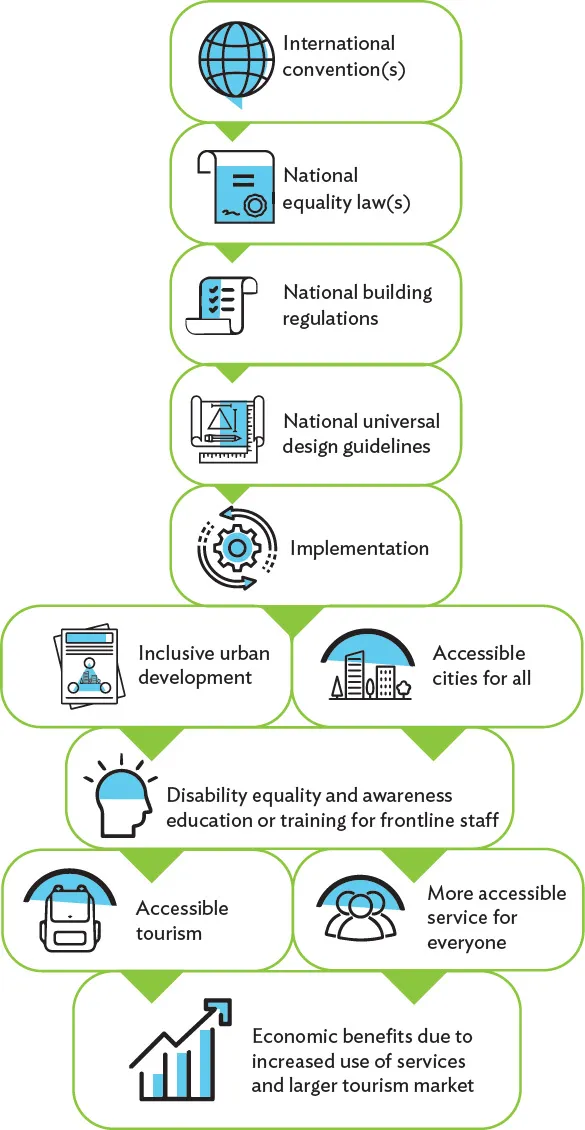
Source: Asian Development Bank.
2 SOCIAL AND POLICY CONTEXT
Inclusive Urban Development
Creating Cities for All
An inclusive built environment and accessible tourism in Georgia requires all sectors and stakeholders to mainstream equality for all groups that experience exclusion, including persons with disabilities (PWDs), women, children, the elderly, as well as sexual, religious, and other minorities. Mainstreaming equality means creating cities for all, cities that are inclusive and represent human dignity and equality. Cities should demonstrate leadership in progress toward inclusion; and inclusive city frameworks complemented by universal design approaches and practical guidelines can support this.
The Disability Inclusive and Accessible Urban Development Network (DIAUD), World Enabled, and Christian Blind Mission (CBM) define an inclusive city as “a place where everyone, regardless of their economic means, gender, ethnicity, disability, age or religion, is enabled and empowered to fully participate in the social, economic, cultural and political opportunities that cities have to offer.”15
“Inclusive cities” is a major policy focus for achieving the SDGs. As the global population continues to urbanize, cities are becoming more instrumental centers for sustainable development. Urbanization has historically been considered a cause of poverty and exclusion, with an increasing urban population linked to rising inequality. Evidence shows that inequality in cities is rising.16 Habitat III and the launch of the New Urban Agenda represented a policy shift toward thinking about the opportunities offered in and by cities rather than focusing on the barriers and challenges. “Inclusive cities” is one of the agendas that represents this focus toward engaging and involving historically excluded groups in decision-making that shapes the cities they live in.17
Inclusive cities require commitment and vision by all stakeholders that play a role in shaping the built environment including
• government stakeholders who shape policies and decisions o...
Table of contents
- Front Cover
- Title Page
- Copyright Page
- Contents
- Tables, Figures, and Boxes
- Foreword
- Acknowledgments
- Authors and Contributors
- Abbreviations
- Executive Summary
- 1 Introduction
- 2 Social and Policy Context
- 3 Universal Design Standards
- 4 Case Studies and Examples
- 5 Conclusion
- References
- Footnotes
- Back Cover
Trusted by 375,005 students
Access to over 1.5 million titles for a fair monthly price.
Study more efficiently using our study tools.
Frequently asked questions
Yes, you can cancel anytime from the Subscription tab in your account settings on the Perlego website. Your subscription will stay active until the end of your current billing period. Learn how to cancel your subscription
No, books cannot be downloaded as external files, such as PDFs, for use outside of Perlego. However, you can download books within the Perlego app for offline reading on mobile or tablet. Learn how to download books offline
Perlego offers two plans: Essential and Complete
- Essential is ideal for learners and professionals who enjoy exploring a wide range of subjects. Access the Essential Library with 800,000+ trusted titles and best-sellers across business, personal growth, and the humanities. Includes unlimited reading time and Standard Read Aloud voice.
- Complete: Perfect for advanced learners and researchers needing full, unrestricted access. Unlock 1.5M+ books across hundreds of subjects, including academic and specialized titles. The Complete Plan also includes advanced features like Premium Read Aloud and Research Assistant.
We are an online textbook subscription service, where you can get access to an entire online library for less than the price of a single book per month. With over 1.5 million books across 990+ topics, we’ve got you covered! Learn about our mission
Look out for the read-aloud symbol on your next book to see if you can listen to it. The read-aloud tool reads text aloud for you, highlighting the text as it is being read. You can pause it, speed it up and slow it down. Learn more about Read Aloud
Yes! You can use the Perlego app on both iOS and Android devices to read anytime, anywhere — even offline. Perfect for commutes or when you’re on the go.
Please note we cannot support devices running on iOS 13 and Android 7 or earlier. Learn more about using the app
Please note we cannot support devices running on iOS 13 and Android 7 or earlier. Learn more about using the app
Yes, you can access Inclusive Cities by in PDF and/or ePUB format, as well as other popular books in Politics & International Relations & Urban Planning & Landscaping. We have over 1.5 million books available in our catalogue for you to explore.