- 448 pages
- English
- ePUB (mobile friendly)
- Available on iOS & Android
eBook - ePub
About this book
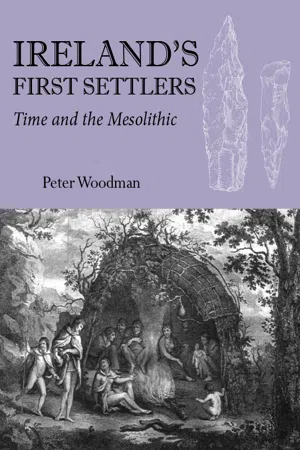
Searching for Ireland's First Settlers tells the story of the archaeology and history of the first continuous phase of Ireland's human settlement. It combines centuries of search and speculation about human antiquity in Ireland with a review of what is known today about the Irish Mesolithic. This is, in part, provided in the context of the author's 50 years of personal experience searching to make sense of what initially appeared to be little more than a collection of beach rolled and battered flint tools. The story is embedded in how the island of Ireland, its position, distinct landscape and ecology impacted on when and how Ireland was colonised. It also explores how these first settlers evolved their technologies and lifeways to suit the narrow range of abundant resources that were available. The volume concludes with discussions on how the landscape should be searched for the often ephemeral traces of these early settlers and how sites should be excavated. It asks what we really know about the thoughts and life of the people themselves and what happened to them as farming began to be introduced.
Information
Subtopic
Ancient HistoryIndex
Social SciencesPart I
IN THE BEGINNING
Chapter 1
Why?
When I first started to write this book a few years ago it was with the very simple intention of providing an easy, and hopefully accessible, introduction to many of the issues associated with the Irish Mesolithic. In part it was a frustrated reaction to decades-old interpretations of the Mesolithic period in Ireland and was intended to reach the archaeological profession in general. That profession, which existed some years ago at the height of the “Tiger Economy”, is, however, no longer there! As I continued to write and think about why I still wanted to proceed with the project, I realised that, although I was in part writing it for myself, there were in fact multiple reasons to write the book. The archaeological profession, or perhaps the broader archaeological community, has always changed. Old misinterpretations will always be replaced by new ones. It has also provided an opportunity to reflect on the many ways in which “the doing of archaeology” has changed in my lifetime.
Almost exactly 50 years ago, just before I started to study Archaeology at “Queen’s” and after an enthusiastic visit to the then Belfast Municipal Museum, I had rushed down to the Kinnegar in Holywood in search of “prehistory”. The Kinnegar is a large ridge of sand on the shores of Belfast Lough, which runs in a south-westerly direction from the town. I would like to say that this resulted in initial discoveries of flint tools and that, ever since, I have been on a straight track attempting to elucidate the problems of Ireland’s first settlers. In reality and ironically, even before my visit I had made that classic “First Year” mistake of thinking I was looking for Megaliths rather than “Mesoliths”. This was compounded by the fact that everything I found consisted of natural fragments of flint nodules, so it was not until my first practical class with Arthur Apsimon that I discovered what I really should be looking for.
Shortly afterwards I was introduced to Hallam Movius’s The Irish Stone Age. This book, with its combination of a detailed environmental history of Ireland, along with the battered and rolled bits of flint that made up the “Irish Larnian” left me wondering, is that all there was to the Irish Mesolithic and where were the traces of the settlement sites on which they lived? I had an early desire to be an Egyptologist, which was followed by a plan to work on the Palaeolithic, especially in North Africa, but the initial experiences on the Kinnegar had left me with both an abiding interest in the Irish Mesolithic and an awareness of how easy it was for amateurs to not quite understand what they had found. Having worked for 17 years in the Ulster Museum I was also very conscious that this meant both informing people of the importance of what they had found and, at the same time, trying to gently explain to someone that the bit of stone that “fitted so neatly into your hand” was more likely to be a fortuitous natural accident. I have always maintained that working as a curator in a museum is one of the best archaeological educations available. It also reinforced a belief that the interested amateur is just as important as the professional archaeologist. Similarly, I have never regretted the move to University College Cork at the other end of the island.
What has changed
In some ways, it would be simple to write an account of how many of our views on the Mesolithic period in Ireland have changed. It was apparent, however, that what was needed was more than either a retrospect or archaeological Canon or Lexicon to provide guidance.
In many ways, even though there were often local solutions, many of the problems that European Archaeology has faced throughout the last 50 years are similar. Not least of these has been the loss of the archaeological record. As economies grew, particularly from the 1960s onwards and with the changes in agricultural practices, especially within what was to become the EU, there was a growing concern over what was being lost. There has also been the consequent growth of the archaeological profession, which includes a shift from archaeological field activity being the domain of public bodies to being carried out by private companies with public authorities becoming the monitors of all aspects of activity.
In Ireland, in 1961, the year I started as a student in Queen’s University Belfast, there were fewer than 25 people professionally employed as working archaeologists in Ireland. It is remarkable that in Ireland in the early 1960s there were, for a population of only 4,000,000, four university departments teaching archaeology at an undergraduate level. In Great Britain, with a population of over 50 million, there were also only four university departments teaching undergraduate courses in archaeology, with an additional two, Oxford University and the Institute of Archaeology at University College London, offering graduate training and research.
Some ten years later, as numbers began to rise, one of the debates in the early days of the then recently founded Irish Association of Professional Archaeologists (IAPA) was whether to allow those in less “tenured” positions, i.e. those employed on short-term contracts, some of whom were working in a virtual full-time capacity, to become members of the association. The assumption was that the association would provide a forum for academic debate and, indeed, it was understood that all the members should publish articles that demonstrated grounding in the broader implications of the topic, site, monument or artefact, on which they were working at the time. It was only in the mid-1980s that the first commercial companies began to appear in Ireland. Even then, archaeologists in the employment of public bodies were still in the majority. Subsequently, two interlinked economic and sociological factors were to change this ratio. These were the growing numbers of students of archaeology graduating at BA and MA level, as well as significant economic changes. Throughout this period graduate’s foci changed, moving away from research topics based on catalogues of artefacts, to a concentration on field survey. This was in part due to the impact of investment by the EC/EEC/EU which, in turn, put pressure on monuments and therefore required survey and stocktaking of what survived. A few years later, by the late 1990s, the explosion of property, industrial and road developments, required a shift to impact surveys and salvage excavation. The archaeological profession was inexorably changing. The number of people working as archaeologists in Ireland had risen to over 1700 by 2007, a number which included graduates from many other countries.
Perhaps I look on some of these changes through “rose-tinted glasses” that had been coloured from an earlier time. As a student in Queen’s University Belfast in the early 1960s, the Archaeology Department, and what was known as the Archaeological Survey, were all based in one house in University Square. Here, in spite of various tensions, there was a major overlap in interests, but even more so most of those working in University Square were expected to be “multitaskers”. This was particularly true of Pat Collins, Dudley Waterman and Peter Addyman or Arthur Apsimon and the same could be said for others, such as Brian O’Kelly in Cork or the staff of the two museums, the National Museum of Ireland in Dublin and the Ulster Museum in Belfast. These were people who knew the artefactual material and could excavate as well as survey and who were fairly well acquainted with the archaeological literature.
The emergence of specialists in everything from lithics or post-medieval pottery to bones and plants had strength but also a danger of losing an overview approach. In the emergence of the unfortunately termed principle “Polluter Pays”, the supernovae of salvage excavations, first in urban contexts and then more generally in roads, housing developments and elsewhere, created a deluge of information that was in danger of drowning us. The shift can, perhaps, at best be illustrated not only by the number of excavations undertaken but more by the purpose of those excavations. In 1970, when the first Excavations Bulletin was collated on the floor of my flat, there were fewer than 50 excavations taking place per annum, while in 2006, at the height of the “building boom”, there were well over 2000. The most significant change, however, was that in 1970 the majority of excavations that took place were research driven, while 35 years later, fewer than ten sites were being explored primarily as research excavations. There was a shift in expectation, from an understanding that sooner or later there would be a published report issued, to a world where the highest priority was where the next project would be. Indeed, the work of many of the field archaeologists operating during this time is to be complimented, but a perusal of many of the reports also left one with the feeling that emphasis was placed on a product that needed to show “value for money”. Yes, many amazing discoveries have been made and in particular the National Roads Authority must be given credit for its scheme monographs and many useful regional and thematic compilations that are still in the process of being published. The impact of sites such as Raystown with its eight water mills in Co. Meath or the revelations of the long sought for Early Bronze Age settlement sites is immense but these and other “OMG” sites are only part of the story. What about sites recovered during other forms of large infrastructural projects, such as gas and water pipelines, major industrial developments and large-scale housing developments? Despite INSTAR (Irish National Strategic Archaeological Research programme funded by the Heritage Council of Ireland) having made inroads into turning the fine-grained detail into coherent and accessible stories, the recent downturn may have left us with a legacy in our stores that could become reminiscent of the backlog created by collectors gathering material from agriculture, industrial and infrastructural developments that took place at various times in the 19th century.
Naturally, over the years, new methodologies have emerged, as have new ways of looking at the evidence. Explanations have altered from the “Invasionist” perspectives of the post-war era to the search for more local rationalisations. The environmental-led views, along with the assumption of humans as little more than “walking stomachs” whose lives could be mathematically and rationally modelled, were found to be wanting, and so were replaced by schools of thought that belonged more to the postmodernist intellectual era. Hopefully, these approaches will merge as a collage rather than a series of mutually exclusive alternatives.
Many of the issues have been outlined by Zvelebil (2009), who evaluated the strengths and weakness of various schools of thought, ranging from the sometimes failed promises of certain “scientifically rigorous tested conclusions” of Processual and New Archaeology to the “paradigmatic prejudices … And the Nihilism” of some post-modernist practitioners.
There are, at the local level, certain worries. In the context of what has just been discussed, more and more often, undergraduate and post-graduate papers refer to the impossibility of an entirely objective understanding of what we are exploring. This has to be a valid critique of earlier, perhaps naive expectations, but at the same time there appears to be a distancing by many from an engagement with the monuments, artefacts and excavations that form the core of our discipline.
Have the universities, which have the privilege of standing back from the day-to-day commercial world of excavation and to some extent post-excavation, been able to provide the lead in bridging the gap between Practice and Theory, or rather, between the important tasks of salvage that produces data and explaining its broader significance?
There is always the idea that getting a large grant means a major insight into new areas of research. As Feynman (1999, 214–15), in Cargo Cults Science; Some remarks on Science, Pseudo-science and learning on how not to fool yourself notes, throughout many disciplines, it seemed more important to get a big result that would draw in a further grant than search for a more satisfactory explanation of the problem being investigated. Incidentally, in spite of the date of publication, this is not an observation made during the last two decades! It was instead made in 1974 at “Caltech as a Commencement Address”. The emphasis on requiring staff to produce articles for international “Peer Reviewed Journals” is also laudable and important to show the quality of work being undertaken here in Ireland. There appears, sometimes amongst those that evaluate our research, even here in Ireland, a lack of appreciation in the fact that there can be a difference in the meaning of the phrase “International Work”, being elsewhere in the world, which is one way of looking at it, but equally, if not more importantly, the standards and the consequences of work carried out in Ireland can also be of “International Significance”. The number crunching and documenting of large assemblages, or the production of a coherent report on a complex site, can also take years before they make a major contribution of new knowledge and even new insights, but they often do not fit within the timetable required for the next Quality Review or Research Assessment Exercise.
In spite of these issues, it is imperative for Irish archaeology that we can demonstrate to our peers and colleagues the quality of the Irish archaeological record and our research. This necessitates that our work is published in “International Peer Reviewed Journals”.
Does the broader archaeological community read these journals? There is a need to publish or communicate our work in forms that will also be more accessible on a local level. There is, therefore, a need for a book like Ireland’s First Settlers.
This part of the introduction is written not so much as a critique but rather derives from a series of concerns. Virtually all of the Royal Irish Academy funded research excavations of the last 75 years or more have been published. Some of them have taken a long time to appear, indeed, in some cases a very very long time! It is apparent that, for any excavation, the longer time goes on the greater the risk of non-publication. This can be due to many factors, ranging from personal circumstances such as a change of jobs and illness to accidents to the assemblages and field notes. In our case, given the collapse of the “Celtic Tiger” we do not always need massive reports, but rather we require good, relative brief descriptions of ...
Table of contents
- Cover
- Dedication
- Title Page
- Copyright
- Contents
- Acknowledgements
- Part I: In the Beginning
- Part II: Laying the Foundations
- Part III: Often an Island Too Far
- Part IV: Lifeways
- Part V: Where to Now
- Bibliography
- Plates
Trusted by 375,005 students
Access to over 1.5 million titles for a fair monthly price.
Study more efficiently using our study tools.
Frequently asked questions
Yes, you can cancel anytime from the Subscription tab in your account settings on the Perlego website. Your subscription will stay active until the end of your current billing period. Learn how to cancel your subscription
No, books cannot be downloaded as external files, such as PDFs, for use outside of Perlego. However, you can download books within the Perlego app for offline reading on mobile or tablet. Learn how to download books offline
Perlego offers two plans: Essential and Complete
- Essential is ideal for learners and professionals who enjoy exploring a wide range of subjects. Access the Essential Library with 800,000+ trusted titles and best-sellers across business, personal growth, and the humanities. Includes unlimited reading time and Standard Read Aloud voice.
- Complete: Perfect for advanced learners and researchers needing full, unrestricted access. Unlock 1.5M+ books across hundreds of subjects, including academic and specialized titles. The Complete Plan also includes advanced features like Premium Read Aloud and Research Assistant.
We are an online textbook subscription service, where you can get access to an entire online library for less than the price of a single book per month. With over 1.5 million books across 990+ topics, we’ve got you covered! Learn about our mission
Look out for the read-aloud symbol on your next book to see if you can listen to it. The read-aloud tool reads text aloud for you, highlighting the text as it is being read. You can pause it, speed it up and slow it down. Learn more about Read Aloud
Yes! You can use the Perlego app on both iOS and Android devices to read anytime, anywhere — even offline. Perfect for commutes or when you’re on the go.
Please note we cannot support devices running on iOS 13 and Android 7 or earlier. Learn more about using the app
Please note we cannot support devices running on iOS 13 and Android 7 or earlier. Learn more about using the app
Yes, you can access Ireland's First Settlers by Peter Woodman in PDF and/or ePUB format, as well as other popular books in Social Sciences & Ancient History. We have over 1.5 million books available in our catalogue for you to explore.