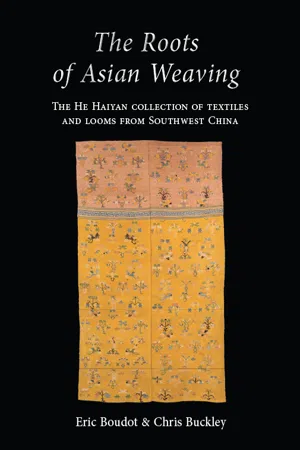
This ground-breaking book documents the weaving traditions and textiles of one of Asia’s most ethnically diverse areas, placing them in a regional context. Based on more than a decade of first-hand study in the field, the authors record the traditions of Miao, Yao, Buyi, Dong, Zhuang, Maonan, Dai and Li weavers from Guizhou to Hainan Island. They describe the looms and techniques of these groups, including diagrams, descriptions and photographs of the weaving processes and woven structures. Each tradition is illustrated with outstanding examples of textiles, drawn from the He Haiyan collection in Beijing, including many 19th century examples.
The authors present a novel analysis of loom technology across the Asian mainland, using techniques derived from linguistics and biology. They use these to chart the evolutionary history of looms in Asia, demonstrating that all the major traditions are related in spite of their apparent diversity. The results have far-reaching implications, for example shedding light on the development of the Chinese Drawloom and showing how key patterning features were derived from Tai-Kadai looms.
The book is a visual delight as well as a resource for scholars, collectors and curators. The fieldwork in this book is a primary, while the looms and techniques will be essential reading for those interested in weaving and textile history, as well as contemporary weavers and designers wishing to learn how to reproduce traditional patterns and methods. The account of the development and links between weaving cultures will be a revelation for those interested in cultural evolution and the diversity of mankind.
- 480 pages
- English
- ePUB (mobile friendly)
- Available on iOS & Android
eBook - ePub
The Roots of Asian Weaving
About this book
Information
Subtopic
Asian HistoryIndex
Social SciencesTable of contents
- Cover
- Title Page
- Copyright
- Contents
- Acknowledgments
- Preliminary note
- Foreword
- Part I: Background
- Part II: Field Research
- Part III: Analysis
- Appendices
- Glossaries of loom and weaving terms
- Bibliography
Trusted by 375,005 students
Access to over 1.5 million titles for a fair monthly price.
Study more efficiently using our study tools.
Frequently asked questions
Yes, you can cancel anytime from the Subscription tab in your account settings on the Perlego website. Your subscription will stay active until the end of your current billing period. Learn how to cancel your subscription
No, books cannot be downloaded as external files, such as PDFs, for use outside of Perlego. However, you can download books within the Perlego app for offline reading on mobile or tablet. Learn how to download books offline
We are an online textbook subscription service, where you can get access to an entire online library for less than the price of a single book per month. With over 1.5 million books across 990+ topics, we’ve got you covered! Learn about our mission
Look out for the read-aloud symbol on your next book to see if you can listen to it. The read-aloud tool reads text aloud for you, highlighting the text as it is being read. You can pause it, speed it up and slow it down. Learn more about Read Aloud
Yes! You can use the Perlego app on both iOS and Android devices to read anytime, anywhere — even offline. Perfect for commutes or when you’re on the go.
Please note we cannot support devices running on iOS 13 and Android 7 or earlier. Learn more about using the app
Please note we cannot support devices running on iOS 13 and Android 7 or earlier. Learn more about using the app
Yes, you can access The Roots of Asian Weaving by Eric Boudot,Chris Buckley, Chris Buckley in PDF and/or ePUB format, as well as other popular books in Social Sciences & Asian History. We have over 1.5 million books available in our catalogue for you to explore.