Persulfate-based Oxidation Processes in Environmental Remediation
eBook - ePub

Persulfate-based Oxidation Processes in Environmental Remediation

  1. 350 pages
  2. English
  3. ePUB (mobile friendly)
  4. Available on iOS & Android
eBook - ePub

Persulfate-based Oxidation Processes in Environmental Remediation

About this book

Advanced oxidation processes (AOPs) use chemical treatment to remove contaminants from water by oxidation with hydroxyl radicals. These hydroxyl radicals can be produced using UV light, ozone or hydrogen peroxide, but recently reactions have been developed that use persulfates as the radical source. Persulfates are strong oxidants with flexible in situ activation characteristics, including activation with heat, alkali conditions, electricity, ultrasonic treatment, transition metals, carbon and even organics. Persulfate activation can generate sulfate radicals as well as other reactive species. These reactive species, especially the sulfate radical, can degrade most organic pollutants making them valuable in the fields of water purification, soil remediation, disinfection, sludge dewatering, and other important applications in environmental systems.

Describing recent developments in persulfate-based AOPs, this book aims to provide a summary of environmental applications for persulfate-based AOPs and to guide the reader, in a comprehensive way, through various advanced oxidation processes in environmental applications. Topics include new activation methods, activation mechanisms, and advanced materials for use in activating persulfate-based AOPs for different environmental applications.

Frequently asked questions

Yes, you can cancel anytime from the Subscription tab in your account settings on the Perlego website. Your subscription will stay active until the end of your current billing period. Learn how to cancel your subscription.
No, books cannot be downloaded as external files, such as PDFs, for use outside of Perlego. However, you can download books within the Perlego app for offline reading on mobile or tablet. Learn more here.
Perlego offers two plans: Essential and Complete
  • Essential is ideal for learners and professionals who enjoy exploring a wide range of subjects. Access the Essential Library with 800,000+ trusted titles and best-sellers across business, personal growth, and the humanities. Includes unlimited reading time and Standard Read Aloud voice.
  • Complete: Perfect for advanced learners and researchers needing full, unrestricted access. Unlock 1.4M+ books across hundreds of subjects, including academic and specialized titles. The Complete Plan also includes advanced features like Premium Read Aloud and Research Assistant.
Both plans are available with monthly, semester, or annual billing cycles.
We are an online textbook subscription service, where you can get access to an entire online library for less than the price of a single book per month. With over 1 million books across 1000+ topics, we’ve got you covered! Learn more here.
Look out for the read-aloud symbol on your next book to see if you can listen to it. The read-aloud tool reads text aloud for you, highlighting the text as it is being read. You can pause it, speed it up and slow it down. Learn more here.
Yes! You can use the Perlego app on both iOS or Android devices to read anytime, anywhere — even offline. Perfect for commutes or when you’re on the go.
Please note we cannot support devices running on iOS 13 and Android 7 or earlier. Learn more about using the app.
Yes, you can access Persulfate-based Oxidation Processes in Environmental Remediation by Mingshan Zhu, Zhenfeng Bian, Chun Zhao, Mingshan Zhu,Zhenfeng Bian,Chun Zhao in PDF and/or ePUB format, as well as other popular books in Physical Sciences & Environmental Science. We have over one million books available in our catalogue for you to explore.

Information

Chapter 1
Methods of Persulfate Activation for the Degradation of Pollutants: Fundamentals and Influencing Parameters
J. Saiena and F. Jafari1a
a Department of Applied Chemistry, Bu-Ali Sina University, Hamedan 65174, Iran, Email: [email protected]; [email protected]; [email protected]

1.1 Introduction

Rapid economic growth and industrialization continue to result in ubiquitous contamination of the environment and serious problems all over the world. A number of technologies have been demonstrated to protect human health, maintain ecological balance, and improve sustainability. Advanced oxidation processes (AOPs), based on radical reactions, have been the most important development methods in recent decades and involve the degradation of contaminants with reactive radical species. Sulfate radical-based AOPs have gained much success in water and wastewater treatment and are usually preferred over the other AOPs. This is because the sulfate radical anion has a higher redox potential (E0 = 2.5–3.1 VNHE compared to 1.9–2.7 VNHE for HO˙), a longer half-life (30–40 μs versus 20 ns for HO˙) and high selectivity to electron-rich compounds. Furthermore, sulfate radicals are more stable and diffuse further to contact pollutants and readily react with organic compounds resulting in complete or partial degradation of pollutants.
The conventional sources for generating sulfate radicals are persulfate (S2O82−) and peroxymonosulfate (HSO5) species with symmetrical and asymmetrical structures, respectively. Among three persulfate salts of sodium, potassium and ammonia, sodium persulfate salt (Na2S2O8) with a high-water solubility is the most conventional salt for in situ degradation of pollutants. Meanwhile, K2S2O8 is also used with a lower price despite its much lower water solubility but is adequate for the desired concentrations. The salt form of peroxymonosulfate as potassium peroxymonosulfate, which is also called Oxone (2KHSO5, KHSO4, K2SO4) has good potential applicability due to its high solubility in water and is safe to handle. It is noteworthy that peroxymonosulfate requires more energy to produce sulfate radicals compared to persulfate because of the shorter length of the peroxide bond and higher dissociation energy.
Considering the difficult reaction of persulfate or peroxymonosulfate with organic pollutants, utilizing an activation method is essential to generate sulfate radicals by (1) imparting energy to the persulfate anion resulting in cleavage of a peroxide bond and forming two sulfate radicals, and (2) accepting one electron from an electron donor generating a single sulfate radical. Generally, activation methods based on utilizing synergy between multifunctional phenomena provide improved degradation.
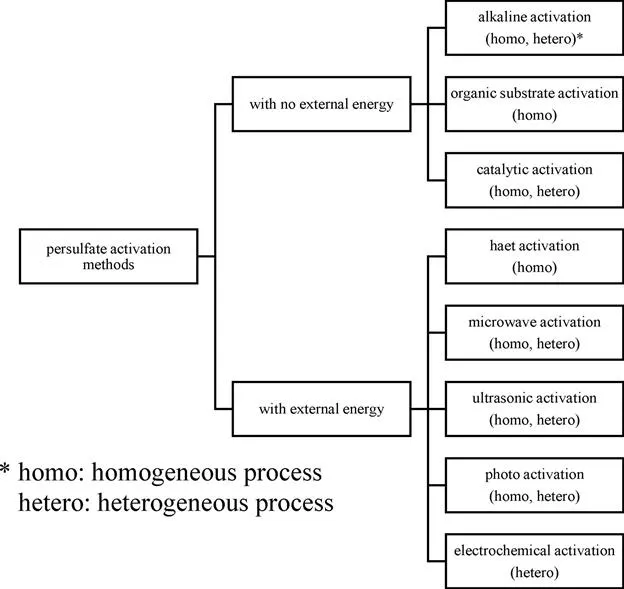
The persulfate (or peroxymonosulfate) can be activated with no external energy through alkaline, organic substrate, or catalytic activation or with external energy such as heat, microwave, or ultrasound, as well as with photo- and electrochemical techniques. The present chapter aims to offer an extensive survey of the main theories and applications relevant to persulfate activation. The basic concepts, dominant mechanisms, as well as influencing parameters, particularly persulfate concentration, pH, temperature, involved materials and reactor configuration are discussed for each technique. Comprehensive comparison of the activation methods provides essential knowledge to select a reaction and design a suitable reactor with the aim of boosting degradation efficiency.
Based on the outline above, the content is organized into different sections. The first section focuses on persulfate activation methods with no external energy. The subsequent sections concern utilizing external energy as well as combination with a catalyst if relevant. Each process in this classification can be considered as a homogeneous or heterogeneous operation depending on the presence of solid-state reagents, catalysts, and/or electrodes. Figure 1.1 illustrates a schematic of this chapter content, organized in the order of this classification. The influence of relevant operating parameters and employed reactors are also discussed in each section.
image
Figure 1.1 Schematic outline of the content of this chapter.

1.2 Alkaline Activation

1.2.1 Basic Concepts

Alkaline activation of persulfate, as a low cost and high-efficiency method, has been widely used for degradation of organic pollutants. The mechanism of sulfate radical generation from alkaline activation is based on the catalyzed hydrolysis of persulfate to hydroperoxide anion and sulfate ion (eqn (1.1)). Subsequently, another persulfate molecule is reduced with a hydroperoxide ion and sulfate radical and superoxide radical (O2˙) are generated:1
image
1.1
S2O82− + HOO → SO4˙ + SO42− + O2˙ + H+1.2
Meanwhile, effective hydroxyl radicals are rapidly produced from a sulfate radical and hydroxide ion as
SO4˙ + OH → SO42− + HO˙1.3
Activation of peroxymonosulfate under alkaline conditions has also been introduced.2 Base-catalyzed hydrolysis of peroxymonosulfate to a sulfate anion and hydrogen peroxide is the initial step of the proposed mechanism (eqn (1.4)). Then, the generated hydrogen peroxide reacts with excessive hydrogen peroxide to produce a superoxide anion radical according to eqn (1.5)(1.7)). Highly reactive singlet oxygen is then generated through two possible pathways: (1) reaction of a superoxide anion with a hydroxyl radical (eqn (1.8)), and (2) reaction of the superoxide with itself (eqn (1.9)):
image
1.4
H2O2 → 2HO˙1.5
HO˙ + H2O2 → HO2˙ + H2O1.6
HO2˙ → H+ + O2˙1.7
O2˙ + HO˙ → 1O2 + OH1.8
2O2˙ + 2H+ → H2O2 + 1O21.9
It is worth mentioning that although alkaline activation of persulfate has extensive applications in pollutant degradation, the main drawback of this technique is the consumption of large amounts of an alkaline which may potentially cause undesirable effects. Indeed, considering the generation of H+ during persulfate activation (eqn (1.1)(1.2)), there is a significant demand for OH to maintain the alkaline conditions.3

1.2.2 Application of a Catalyst

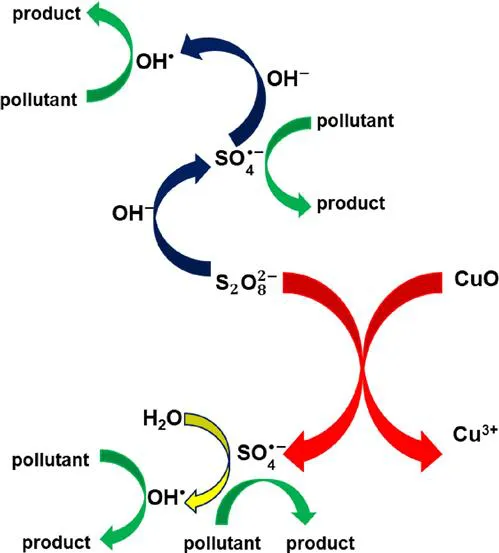
The use of a catalyst under alkaline conditions has been proven to be beneficial for both alkaline and catalytic activations. In this regard, the efficiency of supported copper oxidate (CuO) for activation of persulfate under alkaline conditions has been confirmed. It has to be mentioned that under strong alkaline conditions, the promoted degradation is attributed to the reaction of sulfate radicals with hydroxide ions leading to the generation of hydroxyl radicals with a higher redox potential compared to sulfate radicals.4 The proposed mechanism for alkaline activation of persulfate in the presence of a copper oxide catalyst is illustrated in Figure 1.2.
image
Figure 1.2 The proposed mechanism for alkaline activation of persulfate in the presence of a copper oxide catalyst. Reproduced from ref. 4 with permission from Elsevier, Copyright 2012.

1.2.3 Influence of Operating Conditions

1.2.3.1 Persulfate Concentration

Persulfate concentration has a significant influence on the performance of the alkaline activation process. By increasing the persulfate concentration, degradation efficiency is initially improved but further increases after the optimum conc...

Table of contents

  1. Cover
  2. Title
  3. Copyright
  4. Contents
  5. Chapter 1 Methods of Persulfate Activation for the Degradation of Pollutants: Fundamentals and Influencing Parameters
  6. Chapter 2 Photo-activated Persulfate-based Advanced Oxidation for Water Treatment
  7. Chapter 3 Electrochemical Activation of Persulfate for Organic Pollution Control in Water
  8. Chapter 4 Reactive Oxygen Species in Catalytically Activated Peroxydisulfate
  9. Chapter 5 Heterogeneous Activation of Persulfate Using Metal and Metal Oxides
  10. Chapter 6 Metal-free Carbocatalysis for Persulfate Activation Toward Organic Oxidation
  11. Chapter 7 Persulfate-based Advanced Oxidation Processes in Environmental Remediation: Theoretical Chemistry Study
  12. Chapter 8 Sulfate Radical-based Advanced Oxidation Processes for Water and Wastewater Disinfection
  13. Chapter 9 Inactivation of Pathogenic Microorganisms with Sulfate Radical-based Advanced Oxidation Processes
  14. Chapter 10 Persulfate Application for Landfill Leachate Treatment: Current Status and Challenges
  15. Chapter 11 Novel Strategy for Soil Remediation of Contaminated Sites Using Persulfate-based Advanced Oxidation Technologies
  16. Chapter 12 Persulfate-based Advanced Oxidation Processes in Other Applications
  17. Subject Index