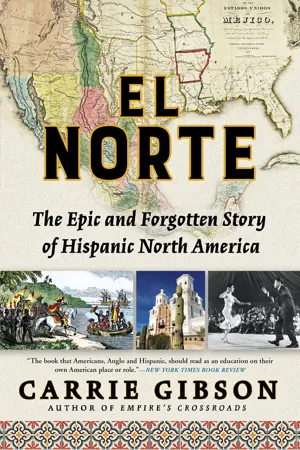
- 577 pages
- English
- ePUB (mobile friendly)
- Available on iOS & Android
eBook - ePub
About this book
A sweeping saga of the Spanish history and influence in North America over five centuries, from the acclaimed author of Empire's Crossroads.
Because of our shared English language, as well as the celebrated origin tales of the Mayflower and the rebellion of the British colonies, the United States has prized its Anglo heritage above all others. However, as Carrie Gibson explains with great depth and clarity in El Norte, the nation has much older Spanish roots?ones that have long been unacknowledged or marginalized. The Hispanic past of the United States predates the arrival of the Pilgrims by a century, and has been every bit as important in shaping the nation as it exists today.
El Norte chronicles the dramatic history of Hispanic North America from the arrival of the Spanish in the early 16th century to the present?from Ponce de Leon's initial landing in Florida in 1513 to Spanish control of the vast Louisiana territory in 1762 to the Mexican-American War in 1846 and up to the more recent tragedy of post-hurricane Puerto Rico and the ongoing border acrimony with Mexico. Interwoven in this narrative of events and people are cultural issues that have been there from the start but which are unresolved to this day: language, belonging, community, race, and nationality. Seeing them play out over centuries provides vital perspective at a time when it is urgently needed.
In 1883, Walt Whitman meditated on his country's Spanish past: "We Americans have yet to really learn our own antecedents, and sort them, to unify them," predicting that "to that composite American identity of the future, Spanish character will supply some of the most needed parts." That future is here, and El Norte, a stirring and eventful history in its own right, will make a powerful impact on our national understanding.
"This history debunks the myth of American exceptionalism by revisiting a past that is not British and Protestant but Hispanic and Catholic. Gibson begins with the arrival of Spaniards in La Florida, in 1513, discusses Mexico's ceding of territory to the U.S., in 1848, and concludes with Trump's nativist fixations. Along the way, she explains how California came to be named after a fictional island in a book by a Castilian Renaissance writer and asks why we ignore a chapter of our history that began long before the Pilgrims arrived. At a time when the building of walls occupies so much attention, Gibson makes a case for the blurring of boundaries." — New Yorker
"A sweeping and accessible survey of the Hispanic history of the U.S. that illuminates the integral impact of the Spanish and their descendants on the U.S.'s social and cultural development. . . . This unusual and insightful work provides a welcome and thought-provoking angle on the country's history, and should be widely appreciated." — Publishers Weekly, starred review, PW Pick
Information
Notes
Author’s Note
1“Walt Whitman to the Tertio-Millennial Anniversary Association,” Santa Fe, New Mexico, July 20, 1883, in Ted Genoways (ed.), The Correspondence (Iowa City: University of Iowa Press, 2004). Available at Walt Whitman Archive, http://whitmanarchive.org/biography/correspondence/tei/med.00660.html (accessed November 7, 2016).
Introduction: Nogales, Arizona
1Rachel St. John, Line in the Sand: A History of the Western U.S.-Mexico Border (Princeton, N.J.: Princeton University Press, 2011), p. 95.
2Juan Poblete, “Americanism/o: Intercultural Border Zones in Postsocial Times,” in Marisa Belausteguigoitia, Ben. Sifuentes-Jáuregui, and Yolanda Martínez-San Miguel (eds.), Critical Terms in Caribbean and Latin American Thought: Historical and Institutional Trajectories (London: Palgrave Macmillan, 2016), p. 47.
3Octavio Paz, “Mexico and the United States,” in Rachel Philips Belash, Yara Milos, and Lysander Kemp (trans.), The Labyrinth of Solitude and Other Writings (New York: Grove Press, 1985), p. 357.
4Gloria Anzaldúa, Borderlands/La Frontera: The New Mestiza (San Francisco: Aunt Lute Books, 2012), p. 25.
5José Luis Abellán, La idea de América: Origen y evolución (Madrid: Iberoamericana, 2009), p. 25.
6Felipe Fernández-Armesto, Our America: A Hispanic History of the United States (New York: W. W. Norton, 2014), Kindle Edition, p. 330.
7G. Cristina Mora, Making Hispanics: How Activists, Bureaucrats, and Media Constructed a New American (Chicago: University of Chicago Press, 2014), p. 169.
8Jens Manuel Krogstad and Mark Hugo Lopez, “Use of Spanish Declines Among Latinos in Major U.S. Metros,” Pew Research Center FactTank, October 31, 2017, http://www.pewresearch.org/fact-tank/2017/10/31/use-of-spanish-declines-among-latinos-in-major-u-s-metros/ (accessed March 22, 2018).
9Michel-Rolph Trouillot, Silencing the Past: Power and the Production of History (Boston: Beacon Press, 1995), p. xxiii.
10On the development of race and social control, see, for instance, Patrick Wolfe, “Land, Labor, and Difference: Elementary Structures of Race,” American Historical Review 106, no. 3 (2001): 866–905.
11Nell Irvin Painter, The History of White People (New York: W. W. Norton, 2010), loc. 88, Kindle.
12Michael Omi and Howard Winant, Racial Formation in the United States (London: Routledge, 2014), pp. 105–11.
13On Mexico, see, for instance, Mónica G. Moreno Figueroa and Emiko Saldívar Tanaka, “Comics, Dolls and the Disavowal of Racism: Learning from Mexican Mestizaje,” in Encarnación Gutiérrez Rodríguez and Shirley Anne Tate (eds.), Creolizing Europe: Legacies and Transformations (Liverpool: Liverpool University Press, 2015); on the Dominican Republic, see David John Howard, Coloring the Nation: Race and Ethnicity in the Dominican Republic (Boulder, Colo.: L. Rienner, 2001).
14Richard Rodriguez, Brown: The Last Discovery of America (New York: Penguin, 2002), pp. xi–xii.
15Alan Gallay, The Indian Slave Trade: The Rise of the English Empire in the American South, 1670–1717 (New Haven, Conn.: Yale University Press, 2002), p. 9.
16George J. Sánchez, Becoming Mexican American: Ethnicity, Culture, and Identity in Chicano Los Angeles, 1900–45 (Oxford: Oxford University Press, 1993), p. 1.
17Carey McWilliams and Matt S. Meier (ed.), North from Mexico: The Spanish-Speaking People of the United States (New York: Praeger, 1990), p. 8.
18Mae N. Ngai, Impossible Subjects: Illegal Aliens and the Making of Modern America (Princeton, N.J.: Princeton University Press, 2004), p. 2.
19Quoted in Simon Schama, The American Future: A History (New York: Ecco, 2009), p. 240.
20Gordon S. Wood, The Purpose of the Past: Reflections on the Uses of History (New York: Penguin, 2009), p. 244.
21Quoted in Schama, The American Future, p. 242. For more on the creation and imagining of national identity, see the classic Benedict Anderson, Imagined Communities: Reflections on the Origin and Spread of Nationalism (New York: Verso Books, 1991).
22J. Hector St. John de Crèvecoeur, Letters from an American Farmer and Sketches of Eighteenth-Century America (New York: Penguin Classics, 1981), pp. 68, 70.
23Eliga Gould, “Entangled Histories, Entangled Worlds: The English-Speaking Atlantic as a Spanish Periphery,” American Historical Review 112, no. 3 (2007): 764-786.
24For more on Columbus and the early settlement of the Caribbean, with references and suggestions for further reading, see the first two chapters of Carrie Gibson, Empire’s Crossroads: A History of the Caribbean from Co...
Table of contents
- Cover
- Also by Carrie Gibson
- Title Page
- Copyright
- Dedication
- Epigraph
- Contents
- Maps
- Author’s Note: The Search for El Norte
- Introduction: Nogales, Arizona
- Chapter 01: Santa Elena, South Carolina, ca. 1492–1550
- Chapter 02: St. Johns River, Florida, ca. 1550–1700
- Chapter 03: Alcade, New Mexico, ca. 1540–1720
- Chapter 04: Fort Mose, Florida, ca. 1600–1760
- Chapter 05: New Madrid, Missouri, ca. 1760–90
- Chapter 06: Nootka Sound, Canada, ca. 1760s–1789
- Chapter 07: New Orleans, Louisiana, ca. 1790–1804
- Chapter 08: Sabine River, ca. 1804–23
- Chapter 09: San Antonio de Béxar, Texas, ca. 1820–48
- Chapter 10: Mesilla, New Mexico, ca. 1850–77
- Chapter 11: Ybor City, Florida, ca. 1870–98
- Chapter 12: Del Rio, Texas, ca. 1910–40
- Chapter 13: New York, ca. 1920s–’60s
- Chapter 14: Los Angeles, California ca. 1920s–’70s
- Chapter 15: Miami, Florida, ca. 1960–80
- Chapter 16: Tucson, Arizona, ca. 1994–2018
- Epilogue: Dalton, Georgia, 2014
- Photo Insert
- Time Line of Key Events
- Acknowledgments
- Selected Bibliography
- Notes
- Index
- Back Cover
Trusted by 375,005 students
Access to over 1.5 million titles for a fair monthly price.
Study more efficiently using our study tools.
Frequently asked questions
Yes, you can cancel anytime from the Subscription tab in your account settings on the Perlego website. Your subscription will stay active until the end of your current billing period. Learn how to cancel your subscription
No, books cannot be downloaded as external files, such as PDFs, for use outside of Perlego. However, you can download books within the Perlego app for offline reading on mobile or tablet. Learn how to download books offline
Perlego offers two plans: Essential and Complete
- Essential is ideal for learners and professionals who enjoy exploring a wide range of subjects. Access the Essential Library with 800,000+ trusted titles and best-sellers across business, personal growth, and the humanities. Includes unlimited reading time and Standard Read Aloud voice.
- Complete: Perfect for advanced learners and researchers needing full, unrestricted access. Unlock 1.5M+ books across hundreds of subjects, including academic and specialized titles. The Complete Plan also includes advanced features like Premium Read Aloud and Research Assistant.
We are an online textbook subscription service, where you can get access to an entire online library for less than the price of a single book per month. With over 1.5 million books across 990+ topics, we’ve got you covered! Learn about our mission
Look out for the read-aloud symbol on your next book to see if you can listen to it. The read-aloud tool reads text aloud for you, highlighting the text as it is being read. You can pause it, speed it up and slow it down. Learn more about Read Aloud
Yes! You can use the Perlego app on both iOS and Android devices to read anytime, anywhere — even offline. Perfect for commutes or when you’re on the go.
Please note we cannot support devices running on iOS 13 and Android 7 or earlier. Learn more about using the app
Please note we cannot support devices running on iOS 13 and Android 7 or earlier. Learn more about using the app
Yes, you can access El Norte by Carrie Gibson in PDF and/or ePUB format, as well as other popular books in History & Latin American & Caribbean History. We have over 1.5 million books available in our catalogue for you to explore.