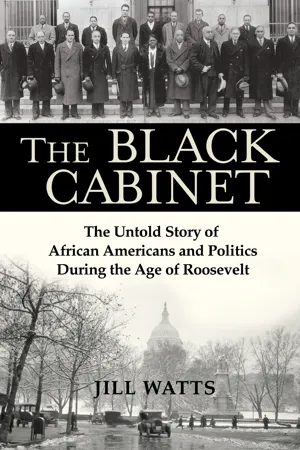
An in-depth history exploring the evolution, impact, and ultimate demise of what was known in the 1930s and '40s as FDR's Black Cabinet.
In 1932 in the midst of the Great Depression, Franklin Delano Roosevelt won the presidency with the help of key African American defectors from the Republican Party. At the time, most African Americans lived in poverty, denied citizenship rights and terrorized by white violence. As the New Deal began, a "black Brain Trust" joined the administration and began documenting and addressing the economic hardship and systemic inequalities African Americans faced. They became known as the Black Cabinet, but the environment they faced was reluctant, often hostile, to change.
"Will the New Deal be a square deal for the Negro?" The black press wondered. The Black Cabinet set out to devise solutions to the widespread exclusion of black people from its programs, whether by inventing tools to measure discrimination or by calling attention to the administration's failures. Led by Mary McLeod Bethune, an educator and friend of Eleanor Roosevelt, they were instrumental to Roosevelt's continued success with black voters. Operating mostly behind the scenes, they helped push Roosevelt to sign an executive order that outlawed discrimination in the defense industry. They saw victories?jobs and collective agriculture programs that lifted many from poverty?and defeats?the bulldozing of black neighborhoods to build public housing reserved only for whites; Roosevelt's refusal to get behind federal anti-lynching legislation. The Black Cabinet never won official recognition from the president, and with his death, it disappeared from view. But it had changed history. Eventually, one of its members would go on to be the first African American Cabinet secretary; another, the first African American federal judge and mentor to Thurgood Marshall.
Masterfully researched and dramatically told,
The Black Cabinet brings to life a forgotten generation of leaders who fought post-Reconstruction racial apartheid and whose work served as a bridge that Civil Rights activists traveled to achieve the victories of the 1950s and '60s.
Praise for
The Black Cabinet
"A dramatic piece of nonfiction that recovers the history of a generation of leaders that helped create the environment for the civil rights battles in decades that followed Roosevelt's death." —
Library Journal
"Fascinating . . . revealing the hidden figures of a 'brain trust' that lobbied, hectored and strong-armed President Franklin Roosevelt to cut African Americans in on the New Deal. . . . Meticulously researched and elegantly written,
The Black Cabinet is sprawling and epic, and Watts deftly re-creates whole scenes from archival material." —
Minneapolis Star Tribune
eBook - ePub
The Black Cabinet
The Untold Story of African Americans and Politics During the Age of Roosevelt
- 804 pages
- English
- ePUB (mobile friendly)
- Available on iOS & Android
eBook - ePub
The Black Cabinet
The Untold Story of African Americans and Politics During the Age of Roosevelt
About this book
Information
Table of contents
- Cover
- Also by Jill Watts
- Title Page
- Copyright
- Dedication
- In Memoriam
- Contents
- Note to Reader
- Prologue
- Part One: Of People and Politics, 1908–1932
- Part Two: Called to Washington, 1933–1935
- Part Three: Thinking and Planning Together, 1935–1939
- Part Four: Fighting on Two Fronts, 1940–1944
- Part Five: Vanishing Figures
- Photo Insert
- Notes
- Bibliography
- Acknowledgments
- Index
- Back Cover
Trusted by 375,005 students
Access to over 1.5 million titles for a fair monthly price.
Study more efficiently using our study tools.
Frequently asked questions
Yes, you can cancel anytime from the Subscription tab in your account settings on the Perlego website. Your subscription will stay active until the end of your current billing period. Learn how to cancel your subscription
No, books cannot be downloaded as external files, such as PDFs, for use outside of Perlego. However, you can download books within the Perlego app for offline reading on mobile or tablet. Learn how to download books offline
Perlego offers two plans: Essential and Complete
- Essential is ideal for learners and professionals who enjoy exploring a wide range of subjects. Access the Essential Library with 800,000+ trusted titles and best-sellers across business, personal growth, and the humanities. Includes unlimited reading time and Standard Read Aloud voice.
- Complete: Perfect for advanced learners and researchers needing full, unrestricted access. Unlock 1.5M+ books across hundreds of subjects, including academic and specialized titles. The Complete Plan also includes advanced features like Premium Read Aloud and Research Assistant.
We are an online textbook subscription service, where you can get access to an entire online library for less than the price of a single book per month. With over 1.5 million books across 990+ topics, we’ve got you covered! Learn about our mission
Look out for the read-aloud symbol on your next book to see if you can listen to it. The read-aloud tool reads text aloud for you, highlighting the text as it is being read. You can pause it, speed it up and slow it down. Learn more about Read Aloud
Yes! You can use the Perlego app on both iOS and Android devices to read anytime, anywhere — even offline. Perfect for commutes or when you’re on the go.
Please note we cannot support devices running on iOS 13 and Android 7 or earlier. Learn more about using the app
Please note we cannot support devices running on iOS 13 and Android 7 or earlier. Learn more about using the app
Yes, you can access The Black Cabinet by Jill Watts in PDF and/or ePUB format, as well as other popular books in History & African American History. We have over 1.5 million books available in our catalogue for you to explore.