The first-ever collection of essays by one of our most distinguished poets, the Pulitzer Prize–winner and former Poet Laureate of the United States.
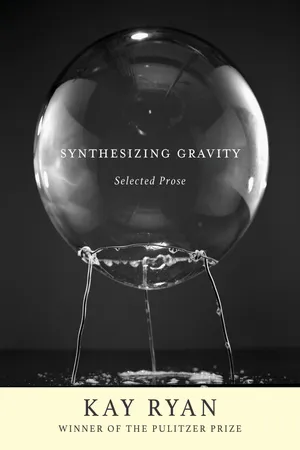
Synthesizing Gravity gathers for the first time a thirty-year selection of Kay Ryan's probings into aesthetics, poetics, and the mind in pursuit of art.
A bracing collection of critical prose, book reviews, and her private previously unpublished soundings of poems and poets—including Robert Frost, Stevie Smith, Marianne Moore, William Bronk, and Emily Dickinson—
Synthesizing Gravity bristles with Ryan's crisp wit, her keen off-kilter insights, and her appetite and appreciation for the genuine. Among essays like "Radiantly Indefensible," "Notes on the Danger of Notebooks," and "The Abrasion of Loneliness," are piquant pieces on the virtues of emptiness, forgetfulness and other under-loved concepts. Edited and with an introduction by Christian Wiman, this generous collection of Ryan's distinctive thinking gives us a surprising look into the mind of an American master.
"
Synthesizing Gravity is a delight, if a tart and idiosyncratic one . . . If Ryan gives us a view through a keyhole, it's a view often made richer by its constraints." —
The New York Times Book Review
"Reading Ryan's writing will charge and recharge the mind . . . a wonderful entry point to her work." —
San Francisco Chronicle
"Brilliant . . . For poetry enthusiasts and skeptics alike, this will be an inviting portal into the mind of one of America's greatest living writers." —
Publishers Weekly (starred review)
"Damn fine prose . . . What a wonderful voice [Ryan] displays." —John Freeman, "Lit Hub's Most Anticipated Books of 2020"
- 208 pages
- English
- ePUB (mobile friendly)
- Available on iOS & Android
eBook - ePub
About this book
Information
A Consideration of Poetry
I: POETRY IS FUNNY
I have always felt that much of the best poetry was funny. Who can read Hopkins’s “The Windhover,” for instance, and not feel welling up inside a kind of giddiness indistinguishable from the impulse to laugh? I suppose there has got to be some line where one might say about a poem, “That’s too much nonsense,” but I think it is a line worth tempting. I am sure that there is a giggly aquifer under poetry, it so often makes me want to laugh.
Right now I am thinking of something unlikely that I saw a few days ago, the morning after my town had experienced a major winter flood. In the middle of a residential street, a cast-iron manhole cover was dancing in its iron collar, driven up three or four inches by such an excess of underground water that it balanced above the street, tipping and bobbing like a flower, occasionally producing a bell-like chime as it touched against the metal ring. This has much to say about poetry.
For I do not want to suggest in any way that this aquifer under poetry is something silly or undangerous; it is great and a causer of every sort of damage. And I do not want to say either that the poem that prompts me to laughter is silly or light; no, it can be as heavy as a manhole cover, but it is forced up. You can see it would take an exquisite set of circumstances to ever get this right.
I would like to offer as an illustration a poem that has always elicited from me one of those involuntary ha!s that jump out when you’ve witnessed a wonderful magic trick. You might say that isn’t funny; you might say you’d just been punched in a way that had exacted a ha! Maybe that ha! is the body’s natural response to perfection: a perfect trick (one has been utterly deceived) or a perfect poem (one has been utterly deceived).
In any case, here is the poem, Robert Frost’s “Nothing Gold Can Stay”:
Nature’s first green is gold,
Her hardest hue to hold.
Her early leaf’s a flower;
But only so an hour.
Then leaf subsides to leaf.
So Eden sank to grief,
So dawn goes down to day.
Nothing gold can stay.
Where is the laughter? you ask. Well, don’t ask yet. For now please settle for a more generalized sense of amusement, of the high-toned T. S. Eliot variety (The Sacred Wood):
Poetry is a superior amusement. I do not mean an amusement for superior people. I call it an amusement, an amusement pour distraire les honnêtes gens, not because that is a true definition, but because if you call it anything else you are likely to call it something still more false. If we think of the nature of amusement, then poetry is not amusing; but if we think of anything else that poetry may seem to be, we are led into far greater difficulties.
I love two things about Eliot’s definition. First, the bedrock, indefensible truth of it: that poetry is a superior amusement. Second, Eliot’s mess of an attempt to explain what he means. I am heartened in my own efforts when I see his bluster. I am reminded by him that though we cannot be exactly precise or complete, that is no reason not to make gigantic statements, for there is great enjoyment in gigantic statements.
But to return to Frost’s poem. I have chosen it because it’s about as funny as the Farmer’s Almanac. Had I chosen “The Windhover,” there would be the obvious near gibberish that comes from Hopkins’s supersaturated rhyming and his strange bulging liberties with sense, but Frost’s poem couldn’t be less gibberishy or less apparently nonsensical.
What could be more straightforward? The title is repeated as the last line—as though this little stack of an eight-line poem were a bitter sandwich with a filling compounded of evidence that nothing gold can stay. The gold that precedes green in new plants? Pfft! The way little new leaf clusters on trees look like flowers? Again, pfft! And notice that by the second couplet we have already moved away from the literal “gold” that exists briefly before the “first green” and are beginning our relentless slide into metaphorical gold—in the sense of something precious—with the flower’s superiority to the later leaf. Now things speed up geometrically, as “leaf subsides to leaf.” There is no doubt of Frost’s meaning here: the early, the delicate, the golden—all go down, buried under the grosser, heartier, darker, more leathery giant repulsive leaves of maturity and stink.
But that’s just in the natural world; how about humankind? Another pfft!: “So Eden sank to grief”—another ring of maturity and stink. Look at how Frost intensifies the sensation of falling (or being overcome) with his choice of verbs: first that unnerving “subsides” among the leaves, now full-out “sank” for man: something is always pulling the plug and draining the gold.
Well, so it goes for nature, and for humanity, but there’s still the planet; how about it? Pfft!: “So dawn goes down to day.” It is odd, this thought of dawn (a kind of gold) defeated by day. We usually say, “day breaks,” or “the sun comes up,” something to suggest a beginning, an opening, a rising and spreading. Not here; here day is a corrupter, a violence that drives dawn down. No trick in this poem: nothing gold can stay.
Except wait a minute! Has gold ever been more manifest than in this poem? Nothing makes us treasure something like feeling we’re right then losing it. This poem is all trick; Frost spreads before us (like a magician’s deck) the gold of the first green, the early flower, Eden, and dawn, one after another, snatches them away, and still the gold remains; it’s suspended within the poem shivering between being and being palmed.
And that’s poetry, this impossible pang, which seen another way is a tremendous bullying job to which we submitted before we knew it. We’re done for so fast we can’t stop to think, “Who SAYS leaf subsides—rather than advances—to leaf, or that dawn goes down—rather than expands—to day?” Too late; we’re stuck in Frost’s little house, shingled in with the overlapping arguments; nailed down with the tidy rhymed couplets. It’s the strangest thing; the poem is a trap—that is a release. It’s a small door to a room full of gold that we can have any time we go through the door, but that we can’t take away.
Ha!
At about nine months, a baby starts to laugh when something is suddenly taken away from her. One of a baby’s first games is peek-a-boo, where someone repeatedly disappears and reappears (the enjoyment of which is, incidentally, considered a key indicator of later language acquisition skills). Frost’s poem could be thought of as a kind of peek-a-boo. The rhythm of its repeated take-aways may go all the way back to our deep early enjoyment of loss, which we register with laughter.
If this strikes you as nonsense, it is. Something nonsensical in the heart of poetry is the very reason why one can’t call poetry “useful.” Sense is useful; you can apply things that make sense to other circumstances; you can take something away. But nonsense you can only revisit; its satisfactions exist in it, and not in applications. This is why Auden and others can say with such confidence that poetry makes nothing happen. That’s the relief of it. And the reason why nothing can substitute for it.
II: GOSKY PATTIES
Now would be a good time to think more about the elements of nonsense when it sails under its own colors. And where better to look for them than in a small nonsense recipe by Edward Lear:
TO MAKE GOSKY PATTIES
Take a Pig, three or four years of age, and tie him by the off-hind leg to a post. Place 5 pounds of currants, 3 of sugar, 2 pecks of peas, 18 roast chestnuts, a candle, and six bushels of turnips, within his reach; if he eats these, constantly provide him with more.
Then procure some cream, some slices of Cheshire cheese, four quires of foolscap paper, and a packet of black pins. Work the whole into a paste, and spread it out to dry on a sheet of clean brown water-proof linen.
When the paste is perfectly dry, but not before, proceed to beat the Pig violently, with the handle of a large broom. If he squeals, beat him again.
Visit the paste and beat the Pig alternately for some days, and ascertain if at the end of that period the whole is about to turn into Gosky Patties.
If it does not then, it never will; and in that case the Pig may be let loose, and the whole process may be considered as finished.
—The Complete Nonsense of Edward Lear
(Dover, 1951)
Many of the nonsense elements that animate Gosky Patties animate poetry as well:
1. AN INVENTED GOAL. Nobody, previously, wanted Gosky Patties made, just as no one wants a poem made. There is the occasional requirement of poets laureate to memorialize a bridge but that hardly counts. In general, one does not “find a need and fill it,” as Henry Ford urged inventors to do. There is no need which precedes either nonsense or a poem. The creator is entertaining him or herself.
2. COWBIRD TECHNIQUE. Just as the cowbird lays her eggs in another bird’s nest, nonsense is built inside the nest of some traditional form. It isn’t just shapeless. Here, in “Gosky Patties,” Lear takes over the recipe. Sometimes it’s a botany or an alphabet. Or, on a smaller scale, a nonsense word may be fitted into the nest of perfectly good sense. Take “Gosky Patties” here, or, in “The Owl and the Pussycat,” “runcible spoons.” Nonsense’s habit of taking up residence in something formal creates a feeling of order and propriety. Similarly, the poet occupies some sort of form. This may be the traditional form the poem takes, a sonnet or a villanelle, or simply a rhyme scheme. Or it may be a type of poem—say an epithalamium. Or it may be something else, perhaps a definition, or a list, or a claim to explain something. (I myself like to write “how-something-works” poems.) These things lend order and propriety. Form gives us confidence that we are not wasting our time on shapeless nonsense. (That’s a joke of course; nonsense is always shaped. You can distinguish real nonsense from garbage because nonsense is shaped and tense.)
3. EXACTNESS. The nonsense writer is exact about things that only become important because he is exact about them: “Take a Pig, three or four years of age, and tie him by the off-hind leg.” There is little slop here. Similarly, the exactness of a poem’s distinctions makes us feel that the distinctions matter. We suddenly care, for example, when Marianne Moore describes the shell of the paper nautilus in her poem by that name, with its “wasp-nest flaws / of white on white.” We just feel that something precise is something important.
4. INCONGRUITY. Nonsense revels in working incompatible elements “into a paste.” For example, “some cream, some slices of Cheshire cheese, four quires of foolscap paper, and a packet of black pins.” The poet too feels that things which bear no outward relationship to one another must nonetheless be brought into proximity. Think of Marianne Moore’s connection of “mussels” to “injured fans” in “The Fish.” Or simply think of “injured fans”; that’s great enough.
5. A SENSE OF IMMINENCE. Lear’s instructions contain the faith that something is about to happen: “ascertain if … the whole is about to turn into Gosky Patties.” Things are on the verge of coming together—which is more exciting than things having actually come together, of course. A poem, for both the writer and reader, must have this same buildup, as to a sneeze. Nonsense is not directionless, any more than a poem is; both must have the feeling of going someplace. Nonsense, like poetry, is a kind of game, with rules or requirements. Neither is pointless, endless play, like that endless horsies whinnying and prancing thing girls do, or that strange martial arts sequence by which small boys advance through rooms. Play assumes that there is no end. Game (nonsense and poetry) assumes there is—if only for the sake of seeing it thwarted.
6. A HIGHLY PERSONAL IDEA OF CAUSE AND EFFECT. Lear insists that there is a relationship between the pig, the pig’s placement, the pig’s diet, the beating of the pig, and the paste, which may bring about Gosky Patties, although then again it may not. We must accept all this on faith for we know nothing about such things. We simply know that there is cause and effect in nonsense, as we know it in a poem—some interior machinery that must strike and tap and rotate in a particular sequence to get something to happen, beknownst only to the author. As readers, we like this. It’s nice not to be in charge of cause and effect all the time, as we feel we are in “real life.”
7. THE READER IS MADE INTO A CO-CONSPIRATOR. This is in contradiction to the previous point, which is not a problem. We are treated both peremptorily and as equals. It is assumed—wrongly, of course—that the reader shares the knowledge of what Gosky Patties would be if they were to become themselves. There is this sense of shared delicate sensibility between reader and author about this: the reader must use judgment equal to the author’s: “Visit the paste and beat t...
Table of contents
- Cover
- Also by Kay Ryan
- Title Page
- Copyright
- Credits
- Dedication
- Contents
- Introduction by Christian Wiman
- I
- II
- III
- IV
- Acknowledgments
- Back Cover
Trusted by 375,005 students
Access to over 1.5 million titles for a fair monthly price.
Study more efficiently using our study tools.
Frequently asked questions
Yes, you can cancel anytime from the Subscription tab in your account settings on the Perlego website. Your subscription will stay active until the end of your current billing period. Learn how to cancel your subscription
No, books cannot be downloaded as external files, such as PDFs, for use outside of Perlego. However, you can download books within the Perlego app for offline reading on mobile or tablet. Learn how to download books offline
Perlego offers two plans: Essential and Complete
- Essential is ideal for learners and professionals who enjoy exploring a wide range of subjects. Access the Essential Library with 800,000+ trusted titles and best-sellers across business, personal growth, and the humanities. Includes unlimited reading time and Standard Read Aloud voice.
- Complete: Perfect for advanced learners and researchers needing full, unrestricted access. Unlock 1.5M+ books across hundreds of subjects, including academic and specialized titles. The Complete Plan also includes advanced features like Premium Read Aloud and Research Assistant.
We are an online textbook subscription service, where you can get access to an entire online library for less than the price of a single book per month. With over 1.5 million books across 990+ topics, we’ve got you covered! Learn about our mission
Look out for the read-aloud symbol on your next book to see if you can listen to it. The read-aloud tool reads text aloud for you, highlighting the text as it is being read. You can pause it, speed it up and slow it down. Learn more about Read Aloud
Yes! You can use the Perlego app on both iOS and Android devices to read anytime, anywhere — even offline. Perfect for commutes or when you’re on the go.
Please note we cannot support devices running on iOS 13 and Android 7 or earlier. Learn more about using the app
Please note we cannot support devices running on iOS 13 and Android 7 or earlier. Learn more about using the app
Yes, you can access Synthesizing Gravity by Kay Ryan in PDF and/or ePUB format, as well as other popular books in Literature & Literary Essays. We have over 1.5 million books available in our catalogue for you to explore.