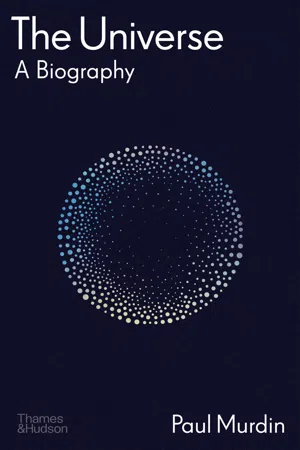
We have entered a new age of exploration and discovery, enabling us to probe ever more distant reaches of space and greatly advance our knowledge of the Universe. Today, telescopes peer not only into outer space, but also into the deep past. Paul Murdin takes us on an original and breathtaking journey across the lifetime of the Universe, from the first milliseconds of the Big Bang right up to our present moment and even beyond. Murdin draws on the latest discoveries in astronomy to describe the most important characters and events in the life of our Universe: the most powerful explosions, the most curious planets, and the most spectacular celestial bodies. He charts our developing understanding of the cosmos, showing how thinkers have deduced profound truths from even the simplest observations everyone can see that it is dark at night, but only recently have we understood this as proof that the Universe has not been the same forever. Since then, the Universe has grown up from childhood: astronomers have tracked it as it passed through maturity and as it now moves into middle age. Murdin shows how our own lives were seeded from the Big Bang, galaxies, stars and planets. He considers some of the key questions: how did structures like galaxies and ourselves emerge from the dense maelstrom of the Universes birth? How did the dark matter that we cant even see speed up the development of galaxies, and how does dark energy work to speed up the expansion of the Universe? Why hasnt the Universe collapsed in on itself and will it one day? And finally, he offers a glimpse into the future old age of our Universe, and what it means for us all.
- 304 pages
- English
- ePUB (mobile friendly)
- Available on iOS & Android
eBook - ePub
About this book
Information
Topic
StoriaSubtopic
Storia mondiale1
The Questions That Revealed the Universe was Born
The Universe was born about 13.8 billion years ago. If it had not been born, and if, therefore, it has existed for ever, this book could not have been written as a biography. There would have been no progression or development of the Universe over time and everything would always remain the same. But, gazing into the far distances of space, astronomers can see changes laid out in a timeline and this book is an attempt to put what they see into words, like a biography.

In the Big Bang, a soup of fundamental particles condensed into the matter that we see today, and dark matter that hides from us. After a period of darkness, stars and galaxies emerged into the Cosmic Dawn.
Why is the sky dark at night?
The dramatic birth of the Universe was a small, dense, hot explosion, the fireball of which is still visible as radiation everywhere. Galaxies condensed out of the outrushing material, a phenomenon that we see as the expansion of the Universe. Somewhere in that event and that material lie our own origins.
There is a simple fact that justifies the analogy between the history of the Universe and a human life, which ages after starting at birth: it is dark at night. In daytime, when we look up, our line of sight goes up to the sky. It may zoom straight out into space, but it may reach an air molecule and its direction may then be changed. The line of sight might end up on the Sun’s surface – it forms a route via the sky that links our eye and the Sun. As a result, the sky is bright. At night, our line of sight may also zoom directly into space; again, it may reach air molecules and be diverted, but the molecules will not be illuminated by sunlight. The line of sight will not then turn towards the Sun, but will extend out into space to end up somewhere far away in the Universe. Sometimes it will end up on the surface of a galaxy or star, but mostly it heads into nothing and, as a result, the night sky is dark.
If the Universe was infinite in extent and fully populated with stars, the line of sight would always end up on a star. If you stand in a large forest, surrounded by trees, no matter in which direction you look, eventually your line of sight ends up on a tree trunk. Likewise, in an infinite Universe populated by stars, your sight-line would always end up on the surface of a star and the night sky would be as bright as the surface of the Sun. Manifestly this is not so.
This contradiction is known as Olbers’ paradox, after the early nineteenth-century German astronomer Heinrich Wilhelm Olbers (1758–1840), who was not only a prominent doctor in Bremen, but also a keen amateur astronomer. As a student, he studied both medicine and mathematics, and it was said that he developed a new way to calculate the orbits of comets while sitting at the bedside of a sick patient. He installed a telescope in an upper room of his house, from which he observed comets. He survived on only four hours sleep at night and was thus able to pursue two careers: a busy professional life as a doctor and his passion as an astronomer. He has been called the greatest of amateur astronomers (and his work as a doctor seems to have been respected, too).
Bremen is a port in northwest Germany between Denmark and the Netherlands, near to the North Sea. Its climate is not ideal for astronomy, and it might have been while he waited for the clouds to clear that Olbers wrote an influential article in 1823, still important and the subject of much discussion in modern times, on the paradox of why the night sky is dark. His article brought attention to the paradox, although the question has a much older history, with a number of distinguished scientists having discussed it before him. Its importance as a help in appreciating the birth of the Universe was not rediscovered until 1960.
Olbers formulated the paradox as if the Universe was more or less uniformly populated by an infinite galaxy of stars, which was the common belief at that time. We now know that our Galaxy only extends to a distance of about 200,000 light years, but the Universe is more or less uniformly populated by galaxies out to a much further distance; the change from stars to galaxies does not change the essentials of Olbers’ argument. The solution to the paradox is that there must be long gaps between galaxies, sight-lines that pick their way through the galaxies like corridors so that we can see through the gaps to the empty region that is beyond them all. This is as if the trees, in the analogy above, were actually grouped in a small wood and between some tree trunks we could look out into the open countryside beyond.
What Olbers’ paradox implies is that at night, through the gaps that make sight-lines through the galaxies, we can see to the boundary of the Universe. There are no galaxies or stars beyond that boundary. So, the majority of sight-lines head towards nothing at all and that is why it is dark at night. This explanation is couched in terms that are easy to visualize, and the essence of it is true enough, but not the detail, because the Universe is not a collection of galaxies isolated in otherwise empty space. It is a curved and finite region that in its total has a large volume entirely filled with galaxies.
Olbers was limited by not knowing about the curvature of space because he lived a century before Albert Einstein, but he put together the important argument that the Universe is limited in its size. This has an even more significant consequence – the Universe must therefore also be limited in time because the limitation in size is set by its age. As our line of sight extends into the distance, it also penetrates back into the past because light travels at a certain speed. We see the image of the past carried to us by that light. Because the Universe was born, no light can reach us from a time before its birth – the age of the Universe sets a horizon in our view of space, beyond which we cannot see. The boundary of the Universe is at a distance corresponding to the distance that light has travelled since the birth of the Universe. The darkness of the night sky, as an observation interpreted with the speed of light in mind, compellingly puts forward the proposition that the Universe was born.
In general, the entire biography of the Universe is laid out backwards along a line of sight through space from here on Earth outwards – out to a certain, limited distance and back to a certain, limited time. Astronomers can witness the sequence of events over the time since the Universe was born by looking into the distance. In principle, if astronomers can view the entire Universe, they can view its entire lifetime. Of course, the earlier events are further away and less distinct than the nearby ones, so the more distant history is less clear than the nearer history. But that is true of all history. Moreover, the events witnessed out there in the past are not the actual predecessors of the events taking place nearby now. They are, however, events like the predecessors of events nearby.
The goal of having the lifetime of the Universe laid out like a timeline in large part explains why astronomers are obsessed with building ever larger telescopes. Everyone knows astronomers use telescopes to peer into distant space, but they also use them as machines to look back in time. The bigger the telescope, the further it can see, not only into space but also into time past (pl. II).
Why doesn’t the Universe collapse?
The Universe is a collection of galaxies spread out over space. They all attract each other by the force of gravity. Finding the solution to the obvious question – why do the galaxies not pile up into a big heap in the middle? – eventually led to the discovery that the Universe is expanding and therefore must have a starting point.
This question of collapse is one that worried the English physicist Isaac Newton (1642–1727), who discovered the force of gravity and realized that it was a force by which everything attracted everything else, no matter the distance by which they were separated. The story is that in 1665–66 an outbreak of the plague began to spread from London to cities and villages elsewhere in Britain, including Cambridge, where the young Newton was studying at Trinity College. The university locked down to reduce the exposure of its students and teachers to the epidemic. Newton left his rooms in college and returned to his home to self-isolate in a bubble with his family in the country, on a farm in Woolsthorpe in Lincolnshire, not far geographically from Cambridge but far enough from the contagion in the city. There he had time to think. According to an account given about 1727–28 by John Conduitt, a colleague and relative by marriage, Newton described the event that, at the age of twenty-three, inspired his thoughts on gravity:
In the year [1666] he retired again from Cambridge on account of the plague to his mother in Lincolnshire & whilst he was musing in a garden it came into his thought that the same power of gravity (which made an apple fall from the tree to the ground) was not limited to a certain distance from the earth but must extend much farther than was usually thought – Why not as high as the Moon said he to himself & if so that must influence her motion & perhaps retain her in her orbit, whereupon he fell a calculating what would be the effect of that supposition.
The apple tree, or more likely a descendant of the tree, is still there in Woolsthorpe, outside the farmhouse door.
Newton had realized that gravity might be a force that pervaded – indeed, dominated – the entire Universe. It kept the Moon in its orbit around the Earth, the planets in their orbits around the Sun – and presumably the stars in orbits around each other. It was a big thought to have been provoked by a falling apple, even if Conduitt’s story is not entirely reliable as a historical account, perhaps much improved by being retold repeatedly by Newton himself as he grew older. The French journalist Voltaire popularized the story of the falling apple and the Moon, which he had learnt from Conduitt himself, as a successful everyday image that conveys Newton’s ideas about the universal attraction of gravity.
In Newton’s greatest work, a book first published in 1687 and known as The Principia, he identified how the force of gravity between two attracting objects depends not only on their masses (the more massive each one is, the greater the force) but also on the distance separating them (the gravitational force lessens as objects get farther apart, diminishing according to the square of the distance between them). This is called the inverse square law.
Newton soon realized that his concept of gravitation created a problem for the sustainability of the Universe. If the Universe was some sort of container filled with (as he thought) stars (we would say galaxies), it would be unstable. It would soon collapse, gathered together by the mutual attraction of everything for everything else. Newton exchanged correspondence on the subject with Richard Bentley, a theologian with strong scientific interests, a controversial and tyrannical Master of Trinity College, Cambridge, with whom Newton formed an alliance (it was Bentley who took The Principia through the Cambridge University press). Newton wrote in a letter to Bentley in 1692:
As to your first Query, it seems to me that if the matter of our Sun & Planets & all the matter in the Universe was eavenly scattered throughout all the heavens, & every particle had an innate gravity towards all the rest & the whole space throughout which this matter was scattered, was but finite: the matter on the outside of this space would by its gravity tend towards all the matter on the inside & by consequence fall down to the middle of the whole space & there compose one great spherical mass.
Newton went on to sketch out one of his most prescient speculations, which we will see later came to describe the origin of galaxies in the outrushing material of the Big Bang:
But if the matter was eavenly diffused through an infinite space, it would never convene into one mass but some of it convene into one mass & some into another so as to make an infinite number of great masses scattered at great distances from one another throughout all that infinite space.
Today we call this process ‘gravitational collapse’, and it is a concept that, as we will see, is one of the most important ways that cosmic history developed.
Newton’s law of gravitation had other problems that made it difficult to understand – gravitational collapse was only one. Think for a moment about the inherent implausibility of the proposition that a force can be transmitted from one body to another through space, through nothing at all. Nevertheless, Newton’s law was amazingly successful in describing the motion of the planets, so it seemed to be right, or, at least, to do the right things. Even now, Newton’s discoveries are used to control the orbits of spacecraft through the solar system from one planet to another. Newton turned aside from the difficulties with his theory of gravity with the famous remark Hypotheses non fingo (‘I make no hypotheses’), published in some reflections that he added in the second (1713) edition of the Principia. He took an empirical view: his theory worked, even if he did not understand everything about it.
The difficult issue of why the Universe did not collapse was marked as an open question for two hundred years. Then in 1916, German-born physicist Albert Einstein (1879–1955) published his general theory of relativity, which was essentially a new theory of gravity, a refinement of Newton’s. However, when applied to the entire Universe, it produced the same result as Newton’s theory: the Universe collapsed. Einstein was bolder than Newton: he did make a hypothesis. He suggested in 1917 that there might be a kind of negative gravity that propped the Universe up, so that it was stable and could last indefinitely. Like Newton, Einstein did not say exactly what the force was, but instead worked out some of what would result if that was so, introducing an entirely empirical factor into his equations symbolized by the Greek capital letter lambda (Λ), which he called the cosmological constant.
Einstein’s solution to the problem of gravitational collapse was built on some incomplete mathematics, as was shown by the Russian mathematician Alexander Friedmann (see page 41). Clever though he was, Einstein had failed to map out all the possible outcomes of his own general theory. There was a way forward that avoided the outcome that the Universe collapsed and did not last forever without requiring the prop of the imagined cosmological constant Λ. Indeed, the new idea would have worked for Newton, too. The correction gave birth to the idea of an expanding universe. At first Einstein rejected the correction, but he came to accept it, and then reject it again. In reminiscing about these developments, he later came to regard his own idea about the prop as the ‘biggest blunder he ever made in his life’. For about a century afterwards, cosmologists worked out their theories of cosmology using the cosmol...
Table of contents
- Cover
- Title Page
- About the Author
- Other titles of interest
- Contents
- Preface
- 1 The Questions That Revealed the Universe was Born
- 2 The Big Bang: The Birth of It All
- 3 Randomness Becomes Structure: The Formation of the First Galaxies
- Plates Section One
- 4 The Dark Ages and the Emerging Cosmic Dawn
- 5 Our Galaxy: Birth and Cannibalism
- 6 Ancestors, Siblings and Children: The Stars and the Sun
- 7 The Sun: A Star in Its Maturity
- 8 Stars that Die: The Biggest Bangs since the Big Bang
- 9 The Birth of the Solar System
- 10 Chaos and Collisions in the Solar System
- 11 The Earth: A World of Difference
- Plates Section Two
- 12 Sequel: The Future Life of the Universe
- 13 Prequel: What Caused the Big Bang Expansion?
- Glossary
- Picture Credits
- Index
- Copyright
Trusted by 375,005 students
Access to over 1.5 million titles for a fair monthly price.
Study more efficiently using our study tools.
Frequently asked questions
Yes, you can cancel anytime from the Subscription tab in your account settings on the Perlego website. Your subscription will stay active until the end of your current billing period. Learn how to cancel your subscription
No, books cannot be downloaded as external files, such as PDFs, for use outside of Perlego. However, you can download books within the Perlego app for offline reading on mobile or tablet. Learn how to download books offline
Perlego offers two plans: Essential and Complete
- Essential is ideal for learners and professionals who enjoy exploring a wide range of subjects. Access the Essential Library with 800,000+ trusted titles and best-sellers across business, personal growth, and the humanities. Includes unlimited reading time and Standard Read Aloud voice.
- Complete: Perfect for advanced learners and researchers needing full, unrestricted access. Unlock 1.5M+ books across hundreds of subjects, including academic and specialized titles. The Complete Plan also includes advanced features like Premium Read Aloud and Research Assistant.
We are an online textbook subscription service, where you can get access to an entire online library for less than the price of a single book per month. With over 1.5 million books across 990+ topics, we’ve got you covered! Learn about our mission
Look out for the read-aloud symbol on your next book to see if you can listen to it. The read-aloud tool reads text aloud for you, highlighting the text as it is being read. You can pause it, speed it up and slow it down. Learn more about Read Aloud
Yes! You can use the Perlego app on both iOS and Android devices to read anytime, anywhere — even offline. Perfect for commutes or when you’re on the go.
Please note we cannot support devices running on iOS 13 and Android 7 or earlier. Learn more about using the app
Please note we cannot support devices running on iOS 13 and Android 7 or earlier. Learn more about using the app
Yes, you can access The Universe by Paul Murdin in PDF and/or ePUB format, as well as other popular books in Storia & Storia mondiale. We have over 1.5 million books available in our catalogue for you to explore.