The Routledge Handbook of Archaeothanatology spans the gap between archaeology and biological anthropology, the field and laboratory, and between francophone and anglophone funerary archaeological approaches to the remains of the dead and the understanding of societies, past and present.
Interest in archaeothanatology has grown considerably in recent years in English-language scholarship. This timely publication moves away from anecdotal case studies to offer syntheses of archaeothanatological approaches with an eye to higher-level inferences about funerary behaviour and its meaning in the past. Written by francophone scholars who have contributed to the development of the field and anglophone scholars inspired by the approach, this volume offers detailed insight into the background and development of archaeothanatology, its theory, methods, applications, and its most recent advances, with a lexicon of related vocabulary.
This volume is a key source for archaeo-anthropologists and bioarchaeologists. It will benefit researchers, lecturers, practitioners and students in biological anthropology, archaeology, taphonomy and forensic science. Given the interdisciplinary nature of these disciplines, and the emphasis placed on analysis in situ, this book will also be of interest to specialists in entomology, (micro)biology and soil science.
PART IArchaeothanatology – methodological guidelines
1METHODOLOGICAL GUIDELINES FOR ARCHAEOTHANATOLOGICAL PRACTICE
Frédérique Blaizot
HALMA, HISTOIRE, ARCHÉOLOGIE ET LITTÉRATURE DES MONDES ANCIENS, UMR 8164, UNIVERSITÉ DE LILLE, LILLE, FRANCE
DOI: 10.4324/9781351030625-3
Introduction
By restoring the invisible, archaeothanatology contributes to the reconstruction of more complete funerary contexts (Duday, 1978, 2005, 2009) and offers additional tools for addressing social relations and cultural identities among past populations (Blaizot, 2017). The interpretation of the original arrangement, organisation and architecture1 of burials represents the fundamental primary information on which to construct a typo-chronology of burials, to define funerary practices from a cultural (identity of human groups) and social (mechanisms of differentiation within groups) perspective in order to exploit what is known or partly known of funerary practices from other sources, such as texts for historic periods, as well as to reveal diachronic changes in these practices.
The aim of this chapter is not to repeat the methodological procedures related to the identification of the conditions in which bodies decompose (in a void or in a filled space), nor to the demonstration of vanished furnishings, nor to the understanding of actions behind funerary behaviour through time, as in secondary deposit analysis. These analytical principles have previously been published (Duday, 2006, 2009; Duday, Le Mort and Tillier, 2014), in addition to several case studies (Blaizot, 2014; Castex and Blaizot, 2017). Rather, this contribution reviews the conditions necessary for the application of archaeothanatology and emphasises that the method is based upon a detailed analysis of taphonomic anomalies. Interpretation of anomalies is not based on a simple established fact, or even on the analysis of isolated facts where one observation would be equal to a particular event, but on latent data which must be identified and synthesised, and the relevance of which must be examined in each case.
________
1 The original French terms are ‘appareil funéraire’ and ‘dispositif funéraire’, words that cannot be translated as a strict, single-word English equivalent. These have been translated as ‘burial arrangement, organisation and architecture’, which are close conceptual equivalents.
Principles and conditions of application
When the cadaver becomes a skeleton, modifications produced by the disarticulation of the joints of the body occur. The extent of such modifications varies according to the conditions of decomposition. Archaeothanatology consists of a reverse journey through the taphonomic events observed in the field and the correlation of these events with one another. With the archaeological evidence from the burial, for example, the form of the pit in plan and cross-section, the nature of the sediment, preserved items such as stones or nails, the collapse of grave pit walls, among others, aid to establish a hypothetical interpretation of the method and manner of deposition that fits the set of observations revealed by such an analysis.
To implement this method solid training is required – not only in the interpretation and recording of archaeological evidence but also in a thorough knowledge of human anatomy and the various articulations that determine movements of skeletal elements. It is therefore essential to understand the manner in which bones are displaced during different movement events, as well as the conditions under which disarticulation of the various joints occurs and their relative timing. A ‘taphonomic anomaly’ arises when the position, orientation, or placement of a bone or set of bones does not correspond to that expected in a given situation (as determined by the overall position of the remains of the skeleton). Taphonomic anomalies are defined by reference to theoretical knowledge concerning the decomposition stages of cadavers and are founded on two premises: the first is when certain events, which should occur, do not occur, and the second is when certain events, which should not have occurred, do indeed occur.
It is these anomalies that are recorded in the field and subsequently analysed in their archaeological context. The excavation must be meticulous, the articulations well-exposed, all pieces of bone left in place, with the exact position of the bones and the state of the articulations recorded in detail (Duday, 1978). The analysis of these anomalies will not only be used to define the initial or original position of the body, but also to identify the depositional environment in which decomposition took place (Duday, 1990), followed by determining the constraints exerted on the cadaver by the burial environment – both natural and humanly conceived – during decomposition in order to reconstruct them. The simplest example is that of the rotation of the head: anatomically, when the head pivots only the first cervical vertebra follows its movement. If a skeleton is found on its back (supine) with the cranium in lateral view and the atlas in frontal view, or with the atlas and the axis, or even the lower cervical vertebrae, in lateral view, the bones have rotated secondarily – after deposition. When the skeleton lies on a flat-bottomed surface away from the walls of the grave pit, this movement, which is produced by the effect of gravity and determined by the shape of the cranium, is normal; on the other hand, if the cranium has remained in an unstable (unsupported) position resting on its occipital bone, or if it is just inclined to the side, then this movement will have been prevented or halted by an object that has disappeared through decomposition. Interpreting these constraints represents the beginning of the analysis, which consists of correlations of taphonomic events with one another and with the tangible elements of the grave structure.
The need to correlate archaeological and anatomical evidence and taphonomic events with one another
The first question addressed is that of the depositional environment in which decomposition took place, whether the burial occurred in a void or a filled space (Duday, 1990, 2009: 32–40). This determination will guide the analysis, the aim of which is to restore the original burial arrangement. As explained by Duday (1990, 2009), the evidence for decomposition in a void is based on ‘positive’ evidence: movements and displacements produced outside the initial space occupied by the body, whereas evidence for decomposition in a filled space is based on ‘negative’ evidence: the lack of movement or displacement outside of the initial space occupied by the body. In fact, decomposition in a filled space may be difficult to demonstrate as it depends on the nature of the sediment: for example, very gravelly sediment of fluvio-glacial origin does not produce the same effect as looser, fine-grained sediment. In the first case, the sediment will cover small bone elements and articulations as and when the soft tissue decomposes, producing an effect of delayed infilling of the initial space occupied by the body contingent upon the (variable) length of time the body takes to decompose (Duday, 1990), a process to which it is very difficult to attribute a taphonomic signature.
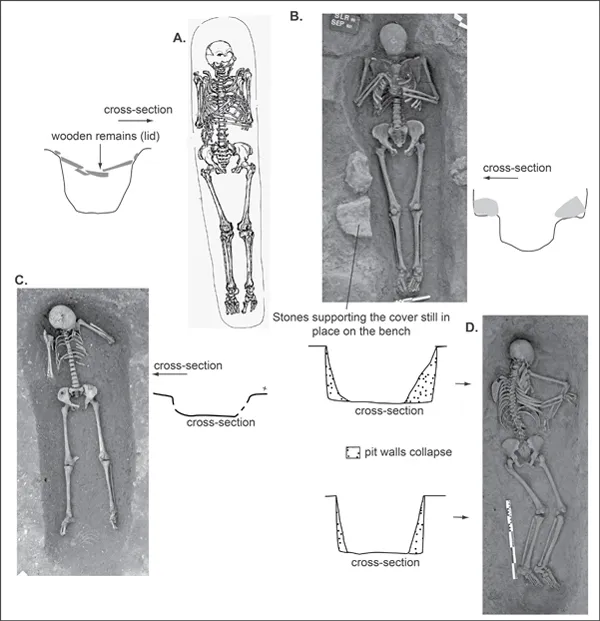
Although decomposition in a filled space is produced when the body is covered with earth during decomposition, it is important to resist convenient interpretations. Indeed, certain factors may contribute to the modification of the decompositional environment, such as intentional mummification prior to burial (Maureille and Sellier, 1996), low permeability of a coffin lid combined with very loose sediment, or the direct deposition of a body in a narrow grave pit with a concave floor (Castex and Blaizot, 2017: 278–281). Figures 1.1A and 1.1B illustrate these phenomena; in both cases the articulations are well-maintained, the initial space occupied by the body is preserved, notably the torso as indicated by the positions and appearance of the ribs, and the hands remain in anatomical connection in an unsupported and unstable position on the ribs. The two skeletons demonstrate a progressive infilling of the initial space occupied by the cadaver, but this cannot be attributed to the immediate covering of the body in the grave by sediment because traces of a lid, or of its presence exist. The narrowness of the grave pit, the grain size of the sediment and the permeable lid made from juxtaposed planks and branches (Blaizot, 1999) explain the rapidity of the infilling of the grave of skeleton A (Figure 1.1). In the second case, individual B, the grooved profile of the pit floor has allowed the initial space occupied by the body to be preserved and has also prevented small bones from rolling outside of that initial space (for further information, cf. Duday, 2009; Castex and Blaizot, 2017).
Figure1.1A. Signs of decomposition in a filled space of the skeleton of an individual buried directly in a pit dug in powdery wind-borne soil and closed with a lid (Porsuk, Ulukɩs, la, Turkey, 11th–12th centuries AD); B. The same signs of decomposition in a filled space in a narrow pit with a concave floor, closed with a lid held in place with blocks on a ‘bench’ (Les Ruelles, Serris, France, 10th century AD); C and D. Immediate infilling of the pit after burial (C: Grange-Rouge, near Louhans, France, 16th century AD) and (D) with pit wall collapse (Quincieux, Rhône, Les Forgettes, 8th–9th centuries AD) (Images: F. Blaizot).
On the other hand, burials C and D in Figure 1.1 present characteristics which suggest immediate infilling of the grave pit. Skeleton C shows no signs of decomposition as reflected in the disarticulation of the skeleton in a void. The disarticulation of the cervical vertebrae is not significant because this has occurred beneath the cranium, which, due to its leaning against the wall of the pit, provided an underlying void. The position of the upper limbs, although leaning against the walls of the grave pit, are anomalous: for the right upper limb, even the bones of the hand are in an unsupported position, and for the left side, the distal end of the forearm is raised. Also, although the floor of the pit is flat, the three-dimensional space (the ‘volume’) occupied by the pelvis is preserved. As for skeleton D, the bones which abut the walls of the pit argue against the presence of a container, whereas all the movements recorded seem to have taken place within the initial space occupied by the body, but the sections made in the field reveal the collapse of the walls of the grave. The position of the cranium, the foot phalanges, the shoulders and the raised left ...
Table of contents
Cover Page
Half-Title Page
Title Page
Copyright Page
Contents
List of figures
List of tables
List of contributors
Foreword I
Foreword II
Acknowledgements
Introduction Archaeothanatology, funerary archaeology and bioarchaeology: perspectives on the long view of death and the dead
PART I Archaeothanatology – methodological guidelines
PART II Period-specific applications
PART III Archaeothanatology of associated remains
PART IV Applied sciences, experiments and legal considerations
PART V Lexicon of archaeothanatological terms
Index
Trusted by 375,005 students
Access to over 1.5 million titles for a fair monthly price.
Study more efficiently using our study tools.
Frequently asked questions
Yes, you can cancel anytime from the Subscription tab in your account settings on the Perlego website. Your subscription will stay active until the end of your current billing period. Learn how to cancel your subscription
No, books cannot be downloaded as external files, such as PDFs, for use outside of Perlego. However, you can download books within the Perlego app for offline reading on mobile or tablet. Learn how to download books offline
Perlego offers two plans: Essential and Complete
Essential is ideal for learners and professionals who enjoy exploring a wide range of subjects. Access the Essential Library with 800,000+ trusted titles and best-sellers across business, personal growth, and the humanities. Includes unlimited reading time and Standard Read Aloud voice.
Complete: Perfect for advanced learners and researchers needing full, unrestricted access. Unlock 1.5M+ books across hundreds of subjects, including academic and specialized titles. The Complete Plan also includes advanced features like Premium Read Aloud and Research Assistant.
Both plans are available with monthly, semester, or annual billing cycles.
We are an online textbook subscription service, where you can get access to an entire online library for less than the price of a single book per month. With over 1.5 million books across 990+ topics, we’ve got you covered! Learn about our mission
Look out for the read-aloud symbol on your next book to see if you can listen to it. The read-aloud tool reads text aloud for you, highlighting the text as it is being read. You can pause it, speed it up and slow it down. Learn more about Read Aloud
Yes! You can use the Perlego app on both iOS and Android devices to read anytime, anywhere — even offline. Perfect for commutes or when you’re on the go. Please note we cannot support devices running on iOS 13 and Android 7 or earlier. Learn more about using the app
Yes, you can access The Routledge Handbook of Archaeothanatology by Christopher J. Knüsel, Eline M. J. Schotsmans, Christopher J. Knüsel,Eline M. J. Schotsmans in PDF and/or ePUB format, as well as other popular books in Social Sciences & Archaeology. We have over 1.5 million books available in our catalogue for you to explore.