This book examines the contribution of archaeology to the study of the social, economic, religious, and other developments in England from the end of the Roman period at the start of the fifth century to the beginnings of the Renaissance at the end of the fifteenth century.
The first edition of the book was published in 1990, and remains the only synthesis of the whole spectrum of medieval archaeology. This new edition is completely rewritten and extended, but uses the same chronological approach to investigate how society and economy evolved. It draws on a wide range of new data, derived from excavation, investigation of buildings, metal-detection, and scientific techniques. It examines the social customs, economic pressures, and environmental constraints within which people functioned; the technology available to them; and how they expressed themselves, for example in their houses, their burial customs, their costume, and their material possessions such as pottery. Their adaptation to new circumstances, whether caused by human factors such as the re-emergence of towns or changing taxation requirements, or by external ones such as volcanic activity or the Black Death, is explored throughout each chapter.
The new edition of Archaeology, Economy, and Society will be essential reading for students and researchers of the archaeology of Medieval England.
Anyone living in Britain in A.D. 400 who had any information about what was happening beyond their immediate neighbourhood, or who knew how much the province had changed during the previous century, would probably have been very worried about the future. With barbarians within the Empire and repeated struggles for the imperial title, occasional episodes of stability must have seemed something to be hoped for rather than expected. An observer could have seen how towns were losing their temples and grand houses, how defensive walls had become necessary as raiders from outside the Empire – from modern Ireland, Germany, and Scotland – took slaves and property because garrisons were insufficient for protection, and how opulent villas were becoming grain-processing and industrial centres. The new religion, christianity, may have promised salvation in the next world but could not offer it in the living one.1
Social and economic changes in the fifth century are signalled as much by what ceases to be present in the archaeological record as by what is actually found. In particular, the large towns reveal very little sign of urban use: streets and buildings were not maintained; butchered bones and broken pots were not being discarded; build-up of ‘dark earth’ layers may have resulted from silt overflowing from uncleared drains and from rotting straw roofs, or might contain soil spread over streets and building rubble so that some sort of market-gardening could take place, but anyone living within the old towns was not leading an urban life, and they were not building houses that could be identified. A few people were being buried within the walls, however, a sign of the breakdown of control, for such burial had been strictly forbidden by the Empire; in Canterbury, a pit containing a male, a female, two children, and two dogs may have represented a family group. In Lincoln, a building identified as a christian church inside the forum-basilica had a burial within it that contained a repaired sixth- or seventh-century hanging-bowl, but whether that proves uninterrupted use of the site is highly contentious, and there is only a very little other evidence of activity. Open space would have remained in a forum-basilica for a while, so assemblies might have taken place in some of them but not for everyday marketing, or there would be butchered animal bones.2
Marketing was inhibited by another of the fifth-century absences. Roman Britain had made extensive use of base-metal and silver coins for buying, selling, and paying taxes and presumably wages but had ceased to mint any of its own. New supplies of the copper-alloy coins had virtually ceased to arrive by the end of the fifth century’s first decade, and existing stocks could not have lasted long enough to be used in everyday small-scale transactions. A few gold and base-metal coins continued to come into Britain, but, more significantly, silver siliquae show both that new coins were very hard to come by and that they were still in demand: many that are found in hoards had been clipped, reducing their silver content. This was not done furtively, as the trimming of the edges is so visible. Furthermore, the image of the emperor’s head was always left undamaged. These coins must have been acceptable, at least for some purposes. Perhaps it was generally believed that order would be restored by Rome, as it had been in the past, and that the siliquae would again be currency used at face value.3
Disruption is also indicated by one particular presence – that of hoards. Several have been found, usually with silver plate from dinner services, either complete or cut up into pieces that could be weighed, valued, and used as rewards, allowing wealthy Britons to offer incentives to those whom they wanted to serve them, even perhaps as mercenaries to defend them. The huge hoard found on the hillfort Traprain Law near Edinburgh may not have resulted from a successful raid by Picts into Britain but may represent an attempt to pay one frontier group to stave off attacks by others. Without new supplies, any coins in the hoards may already have been quite old when buried, so dating is difficult, and deposition could have continued long into the fifth century, but a single hoard that has in it coins of the 460s points towards an earlier date for the rest.4
The third great fifth-century absence is an abundance of wheel-made pottery. Some production continued, such as coarse shell-tempered wares in the south and calcite-gritted in the north, but the big industries could not be maintained, partly because supplies to garrisons were not required and partly because the big urban markets disappeared. Romano-British weaving techniques survived, although the quantities of cloth produced cannot be estimated. Without large groups of pottery and frequent finds of base-metal coins, the dating of sites becomes more difficult; recent work has revealed far more Romano-British rural settlements than previously known, and possibly therefore more may have survived into the post-Roman period than previously realized, all but untraceable without the pottery and coin evidence. Similarly, some of the large Romano-British cemeteries may have continued in use without new burial modes by which to identify the latest interments.5
Whether there was a fourth great absence of an abundance of people or not has therefore become contentious. The evidence that suggests a population peak of 3.6 million people in Roman Britain does not exist for the fifth century, but the loss of large towns and the reduced scale of use indicated at many other sites, even where it continued in some form, point to a substantial diminution. How that came about is another question: populations can be reduced suddenly by disease, but the ‘Justinian plague’ was to come in the next century. Mass famine is unlikely: low-lying fenlands and marshes flooded over, but whether that was because there was not enough labour to keep drainage cuts and sea-banks operational, or because the sea-level rose, is debatable; dendrochronology indicates warm conditions in the second half of the fourth and in the fifth centuries which might have been enough to melt some icebergs.6
A few people may have emigrated; strong links with Britanny are suggested by place-name similarities but not by a sudden growth in settlement numbers there. Slavery is another form of emigration, and successful raiding parties would have taken captives to sell. Warfare would have killed some of the combatants but not the bulk of the population. More difficult to understand are self-limiting strategies; in times of perceived crisis, people have smaller families and, at present, that seems the most feasible explanation for post-Roman population decline.7
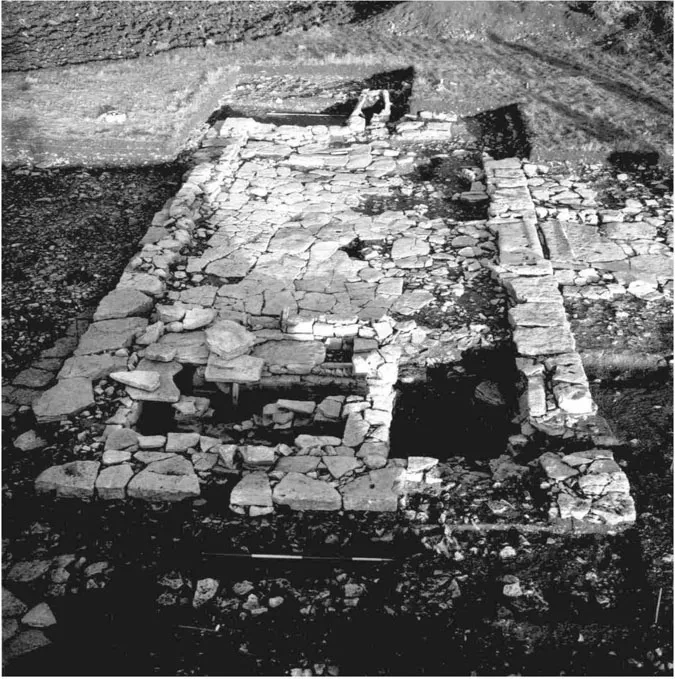
Without the demand for grain to be supplied to towns and to the garrisons on the Rhine, much less arable land would have been needed and, therefore, fewer people for the labour-intensive work of ploughing, sowing, harvesting, and processing (Illus. 1.1). Pollen sequences show increases in grasses, but few fields were abandoned altogether; trees and woodland did not grow over them, so they were used for raising animals. Unfortunately, cereals are harvested for their grains before they can pollenate, so intermittent ploughing of fields predominantly used for grazing may be disguised. The different types of cereal grown depended both upon soil and climatic suitability and upon personal preference; a trend towards growing bread-wheats may be because their taste was preferred, not because they required less threshing and were therefore labour-saving. Medieval field boundaries more often than not overlie Roman ones, though some of those may reflect the lie of the land rather than continued maintenance.8
Illustration1.1 An excavated Romano-British barn at Worth Matravers, Dorset. In the foreground is a grain-dryer; hot air from the stoke-pit on the right was drawn under the partly surviving stone-flagged floor, on to which grain would have been piled to ‘parch’ it for easier milling or to stop it from germinating if it was wanted for ale. Production of cereals in an area of thin soils, so close to the sea that salt-laden winds would have affected their growth, reflects imperial demand for British grain. The dryer was filled in and floored over; either the barn was still roofed, or it was a hard-standing for animals. After its demolition, a grave was cut through the wall at the top right, undated but probably of the same sixth- to seventh-century date as a small cemetery excavated nearby; the stone slab structure annexed to the middle of the barn’s wall may have been a cist grave from which all trace of a skeleton had gone. The photograph therefore demonstrates the pressures placed on farmers by Rome, reduction in demand at the end of the Roman period, and new early medieval uses: the Decline and Fall of the Roman Empire in a Dorset field (Graham et al. 2002, 19–25; Ladle 2018, 78–93).
The bones of the animals reared, mainly sheep and cattle, may show slight changes in size from the Roman period, but they were certainly not seriously mal-nourished and left to fend for themselves; many lived for several years to provide wool, milk, and traction before being slaughtered for meat, hides, and bones for tools. Pigs were mostly killed in their second year, when at their most productive for meat, as they have no use but as pork; they were therefore being closely controlled, even when feeding in woodland in the autumn. Chickens, ducks, and geese were kept. Wild boar, deer, and wild birds figured little in people’s diet; horses may sometimes have been eaten, but most died when too old to be much use for meat. Agriculture was not practised for basic subsistence alone, as some things like iron had to be acquired, and rents in kind, termed renders, almost certainly had to be given to chiefs and overlords, but farmers were able to practise ‘risk-aversion’ strategies, avoiding over-reliance on any one product.9
Without the imperial troops to maintain order for the civilian magistrates, ‘post-colonial’ conditions came into play. In some areas, opulent Roman villas seem to have been the country retreats of people who made large profits from supplying goods and services to the Empire and receiving bribes for helping to administer it, but were also in use as estate centres. The suspicion that too many excavations of Roman villas used to be focused on walls and mosaic floors, shovelling off the overlying layers in order to reach them and dismissing evidence of craft and agricultural processing activity as squatter occupation, has been justified by some recent work. Perhaps the most surprising, albeit preliminary, results have been reported from Chedworth, Gloucestershire, where a very large villa has producedfifth- and sixth-century radiocarbon dates, including one for a wall which bounded a mosaic, so that the mosaic itself must have been laid no earlier than the year 424. It was not of top quality, but even for a second-rate work to have been possible well in the fifth century would suggest more survival of skills and patronage than previously realized. Late Roman shelly pottery was found as were imported fifth- and sixth-century wares from the Mediterranean. At least part of the villa remained as a high-status place, therefore, but other parts were, more typically, downgraded, with a grain-dryer inserted where wealthy occupants used to stroll. Also in the Cotswolds, a villa at Frocester, Gloucestershire, remained in use, with relatively large amounts of pottery, albeit not of high quality, and some other items that are likely to run on well into the fifth century.10
Wealth, or at least serious attempts to signal it, has also been found in the west of Londinium in the modern Trafalgar Square area. A large kiln was still producing bricks and tiles in the first half of the fifth century; no demand was coming from within the city as it was being abandoned, so the supplies must have been for a villa or a shrine. Nearby, burials included one in a reused stone sarcophagus. Other cemeteries were in use around London; one to the east contained a grave of someone buried with a belt-buckle of a type usually associated with military costume. It raises the possibility that a soldier had been hired to defend the city in the early fifth century, but he also had a ‘cross-bow’ brooch, an imperial symbol of authority. Despite being unoccupied, London could have been seen as still usable in an emergency, as might Silchester, Hampshire, where the very recent discovery of a buckle of late fourth-/early fifth-century type joins a scatter of post-
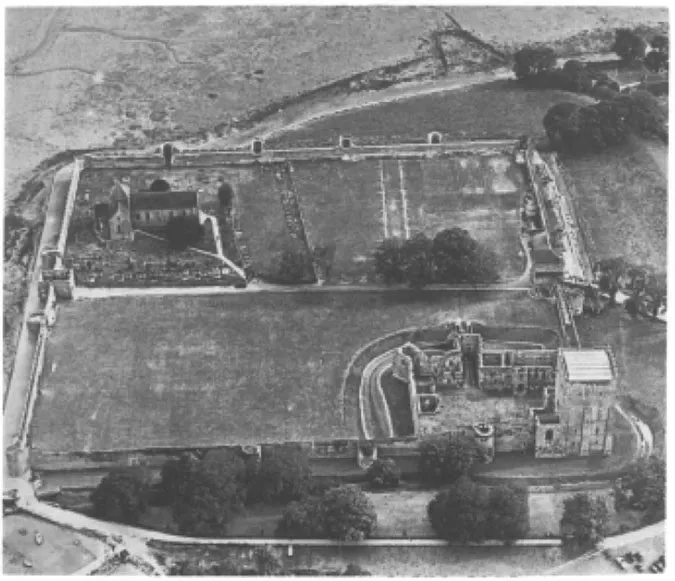
Roman objects from inside and outside its walls. Shore forts like Portchester (Illus. 1.2) and Pevensey also have fifth-century objects and could have been retained in use, as might have been the signal station or small fort at Filey, Yorkshire. Some of the forts along Hadrian’s Wall were also still used, like Birdoswald and Vindolanda; those might have become power bases for former garrison leaders, who had to live by extortion because they were no longer receiving wages. At the west end of the Wall, Carlisle remained in some sort of use, with a timber building and a belt fitting found in one excavated site. Belt fittings with military connotations are widespread, usually as stray finds, and may show that people were claiming that they would fight for their position in life; some have christian imagery.11
Illustration1.2 Portchester Castle, Hampshire, was a Roman shore-fort where the stone walls required little subsequent maintenance to remain usable, like the circuit defences of many towns. Excavation has shown that the interior was used from the third century onwards, but whether it had a defensive role in the fifth century is not known; the only objects excavated are not ‘military’. Occupation of the sixth to eighth centuries was not substantially different from that of other sites, but it was a burh and probably a thegn’s residence in the ninth to eleventh centuries, becoming the site of a castle. The lower part of the Water Gate, on the left, is early Norman; the keep was built in three stages (the buttress ...
Table of contents
Cover
Half Title
Title
Copyright
Contents
List of Illustrations
Acknowledgements for Illustrations
Introduction
1 The Fifth Century: Living Without the Legions
2 The Sixth Century: Adjusting to Change
3 The Seventh Century: Kings, Christianity, and Commerce
4 The Eighth Century: Surpluses and Subjections
5 The Ninth Century: Kings and Vikings
6 The Tenth Century: Towns and Trade in Troubled Times
7 The Eleventh Century: Conquests and their Consequences
8 The Twelfth Century: Community and Constraint
9 The Thirteenth Century: Magnates, Money, and Obligations
10 The Fourteenth Century: Dearth and Death
11 The Fifteenth Century: Living in Reduced Circumstances
References
Index
Trusted by 375,005 students
Access to over 1.5 million titles for a fair monthly price.
Study more efficiently using our study tools.
Frequently asked questions
Yes, you can cancel anytime from the Subscription tab in your account settings on the Perlego website. Your subscription will stay active until the end of your current billing period. Learn how to cancel your subscription
No, books cannot be downloaded as external files, such as PDFs, for use outside of Perlego. However, you can download books within the Perlego app for offline reading on mobile or tablet. Learn how to download books offline
Perlego offers two plans: Essential and Complete
Essential is ideal for learners and professionals who enjoy exploring a wide range of subjects. Access the Essential Library with 800,000+ trusted titles and best-sellers across business, personal growth, and the humanities. Includes unlimited reading time and Standard Read Aloud voice.
Complete: Perfect for advanced learners and researchers needing full, unrestricted access. Unlock 1.5M+ books across hundreds of subjects, including academic and specialized titles. The Complete Plan also includes advanced features like Premium Read Aloud and Research Assistant.
Both plans are available with monthly, semester, or annual billing cycles.
We are an online textbook subscription service, where you can get access to an entire online library for less than the price of a single book per month. With over 1.5 million books across 990+ topics, we’ve got you covered! Learn about our mission
Look out for the read-aloud symbol on your next book to see if you can listen to it. The read-aloud tool reads text aloud for you, highlighting the text as it is being read. You can pause it, speed it up and slow it down. Learn more about Read Aloud
Yes! You can use the Perlego app on both iOS and Android devices to read anytime, anywhere — even offline. Perfect for commutes or when you’re on the go. Please note we cannot support devices running on iOS 13 and Android 7 or earlier. Learn more about using the app
Yes, you can access Archaeology, Economy, and Society by David A. Hinton in PDF and/or ePUB format, as well as other popular books in Social Sciences & European Medieval History. We have over 1.5 million books available in our catalogue for you to explore.