eBook - ePub
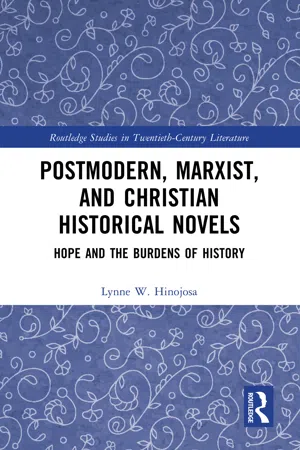
Postmodern, Marxist, and Christian Historical Novels
Hope and the Burdens of History
- 248 pages
- English
- ePUB (mobile friendly)
- Available on iOS & Android
eBook - ePub
Postmodern, Marxist, and Christian Historical Novels
Hope and the Burdens of History
About this book
Postmodern, Marxist, and Christian Historical Novels: Hope and the Burdens of History argues historical novels can help readers receive the burdens of history—meaning both the burdens of the past, present, and future and the burden of living in time—and develop a more robust conception of and concrete practice of hope. Since the 1960s, historical novels have been a dominant literary genre, but they have been influenced primarily not by Christian but by postmodern and marxist thinkers and writers. This book provides a theological and literary analysis of all three types of historical novels—postmodern, marxist, and Christian—and outlines what each school of thought can learn from each other regarding historical understanding and hope. Using Jürgen Moltmann's theology of hope and Frank Kermode's literary criticism as a theoretical basis, the book offers readings of novels by Julian Barnes, A.S. Byatt, Kazuo Ishiguro, Margaret Atwood, Michael Ondaatje, Ian McEwan, and Ursula LeGuin, among others, and ends with an extended analysis of Marilynne Robinson's Gilead series.
Information
1 History, Hope, and Historical Novels: Postmodern, Marxist, and Christian
DOI 10.4324/9781003244578-1
Marilynne Robinson's four Gilead novels raise profound epistemological and ethical questions about how we gather information about other people and make judgments of them. Telling the stories of the same characters but from different points of view or narrative consciousnesses, the novels reveal the complexity of human perception and understanding. Gilead takes the form of a letter written by the elderly Congregationalist preacher, John Ames, to his seven-year-old son. Home spans the same time and events as Gilead but concentrates its perspective mostly in the consciousness of Glory Boughton, the daughter of John Ames's neighbor and lifelong best friend, Robert Boughton, also a lifelong minister. Lila tells the backstory of John Ames's second wife, Lila, who is 30 years his junior, the mother of his son, and about whom readers do not learn much in the first two novels. Jack tells some of the prehistory of Jack Boughton, the wayward, prodigal son of Robert Boughton just returned to his hometown in Gilead and Home. As the reader learns information obscured in one narrative but revealed in another, she realizes how her capacity—as well as the capacity of the characters—to make adequate judgments of other people is always limited and that her perspective of reality can always be widened.
Yet the novels highlight the consequences of our epistemological limits not just for interpersonal relationships but also for larger social ones. Robinson carefully sets her characters within the context of the pre-civil rights era in the United States and thereby makes race relations and their history crucial elements of the plots. Any insight the attentive reader might gain about human perception by reflecting on the stories of the individual characters has to be applied also within the context of the larger structures of society and history. The reader should reflect not only on her ability to judge others but also on her understanding and judgment of race relations in the United States and on her own position within the larger social structures that shape those relations.
One scene, treated in both Gilead and Home, brings these inseparable elements of the interpersonal and the structural to the forefront. It takes place on the front porch of Robert Boughton's home, where the main characters have gathered.1 In Ames's recounting in Gilead, Jack Boughton turns the conversation to the theological question of predestination, asking whether people's characters might be pre-established and unchangeable. Here, the reader believes Jack is wondering about himself and whether he can escape or move on from his own past with its burdens of sin and scandal. Jack's past troubles seem especially present to him now that he is back in Gilead, the small Iowa town in which he grew up but then left for 20 years without coming back, abandoning in his youth a girl pregnant with his child. As the other characters do, readers struggle to believe change is possible for Jack because they cannot ignore what they know about who he has been and what he has done. For example, they know Jack's abandoned child died tragically as a toddler of an infection that could easily have been avoided. They know he did not return to Gilead for his mother's funeral. After a dissatisfactory answer from Ames about predestination and perdition, Lila speaks up: “What about being saved? If you can’t change, there don’t seem much purpose in it” (Gilead 152). The conversation goes on for a while with Jack and Lila genuinely interested in questions of predestination and salvation, but as the two elderly preachers weary of the topic, Lila steps in again:
“A person can change. Everything can change.”“Thanks,” says Jack. “That's all I needed to know.”(Gilead 153)
In her simple response, Lila expresses the essence of Christian hope to Jack: hope that time and character can be made new. Only at the end of Gilead does the reader become open to the same hope. There, the reader is given new information about Jack and learns he is now married to a black woman and has a child with her. Given that the novel is set in the 1950s, the reader at this late hour now begins to understand more of Jack's character, the difficulties he faces, and the changes he has perhaps already undergone. Like John Ames, in whom Jack confides this information, the reader begins to gain sympathy and garner hope for him. Now, after all, readers are open to believing Jack may already be different than who they thought he was, but they also see how history and society have set impossible limits on his ability to live a new life.
Through the reader's and Ames's struggle to understand Jack, Robinson shows how hope is, at least in part, about believing things can change and increasing one's understanding of the past and the present such that one becomes open to new and widened perspectives. Revised historical understanding allows others to appear in a new light and makes possible new forms of relationship. Attending to the historical past and understanding how it shapes the present is part of the practice of hope.
As beautiful as the opening to hope is in Gilead, however, readers should not miss the fact that in this same porch conversation in Home, Robinson places the question of Jack's character alongside the question of the church's complacency on issues of race in the United States. Readers should not rest easy in the personal hope they mustered while reading Gilead, for Jack's inability legally to marry a black woman is determined by larger structural injustices in society. In this second novel, before he raises the topic of predestination, Jack raises the question of the American church's failed response to problems of race. Tentatively, Jack brings up a magazine article he had given Ames to read, saying: the author “said the seriousness of American Christianity was called into question by our treatment of the Negro. It seems to me there is something to be said for that idea” (Home 217). The conversation, which will be discussed more in Chapter Six, continues for a bit, but in the end, Jack receives unsatisfactory and ignorant responses on race from both his father and Ames, who agrees with Jack but says, “I’m not really familiar with the issue” (Home 217). Only at this point does Jack turn to the theological question of predestination, the discussion of which is much more extended in this second novel than it was in Gilead.
In Home's version of the porch scene, readers may sense more explicitly than in Gilead how the seeming impossibility of Jack's personal change is bound to the historical stagnancy of the church when it comes to changing racial attitudes in society. Again, important epistemological and ethical questions are implied, and now both novels must be put in dialogue with each other. For example, when she eventually garners hope for Jack at the end of Gilead, does the reader also begin to hope that racial reconciliation, racial justice, and the reforming of racial attitudes might be possible in the United States? Or does this connection of the personal and the structural elude her? Does the reader even know of her own ignorance regarding this history? Does she have the motivation to learn the history of the systemic problems, to reflect on her own connectedness to these problems, to work towards resolving them?
All too painfully for Jack, Old Boughton and John Ames have not had such energy. Their worlds have been too small; their interests too narrow. In fact, in his letter in Gilead Ames barely mentions the race portion of the conversation and never offers a sustained reflection on race, although he touches on the history of black people in Gilead occasionally. Ames did not see Jack's question about the church and race to be as important as the taunting, personal challenge he took the question of predestination to be. Only Glory in Home becomes more attuned to Jack's concerns.
Perhaps the inertia and ignorance of Ames and old Boughton seem understandable. America's social problems of race are vast and complex and have seemed far away from the small town of Gilead, Iowa.2 Yet by connecting the two issues, the idea of personal change and the idea of structural change (which for Jack are inseparable), Robinson's novels show how hope for both levels may depend on similar things: coming to understand the past, how people and institutions are historically formed, and to see the connections one did not see before, opening oneself humbly to new perspectives and being willing to admit when one's vision has been too narrow. These novels show how if one does not work to understand the past and see one's own situatedness and connectedness within larger social and historical structures, one has a very limited, private conception of hope. In turn, if one disavows the possibility of change, whether because of one's active skepticism or passive complacency or inertia, or even one's theological stance regarding history and society, perhaps one is not gaining self-knowledge, loving one's neighbors, or practicing Christian hope.
Jack Boughton believes the white church in the United States has for the most part abandoned its responsibility to work for racial justice. On a broader scale, the reader is opened to contemplating why the white church has failed to understand and teach others about the past, to know its own history on these matters, to work hopefully towards overcoming the burdens of racial injustice, to recognize its own complicity and complacency. Painfully, the extended lack of attention paid to issues of race in Gilead has dire consequences for Jack and his mixed-race family. Complacency about structural racism blinds Ames and old Boughton from interpreting adequately who Jack is and how they might help him and love him better. They do not have “eyes to see.” Even more, despite Iowa never having anti-miscegenation laws, these two lifelong ministers have failed in their leadership roles to prepare the town of Gilead to be a place where people like Jack and his family might be welcomed. As Robinson said in a recent interview, “Jack on the one hand would have the legal right to live unmenaced with his family in his home land, and on the other hand, the cultural evolution of the place counteracted the enlightened history of it, so there was no way that he could be assured that he actually could live with his family there.”3 In the wake of this, Jack (as well as his family) is forced into being a wayfarer, lost in an unjust society and with longstanding personal relationships which offer no assistance as they unwittingly perpetuate and solidify the structural injustices he longs to overcome.
Chapter Six returns to and offers more thorough readings of Robinson's novels and her emphasis on historical understanding. For now, they have raised several questions. What is the fundamental nature of Christian hope, and how is it related to one's conception of history? Do Christians really believe things can change, that time and people can be made new, just as Christ entered the world and changed history forever? If so, then to what extent is change possible? Is it possible but only for individual people, or can whole societies and structures also change and be made new? What role do Christians play within such social change, and what role should they play? If a Christian concept of hope is not linked to the idea of change and newness within history and society, why not? What should Christians believe about the course of human history and their own roles within it? Is Christian hope only about the afterlife?
Christian Hope and Historical Novels: Current and Critical Contexts
This book is about the nature of Christian hope and the power of historical novels to inspire and inform it. Using Jürgen Moltmann's theology of hope, it argues Christian hope is a practice inextricable from having a theory and knowledge of history, which must address the past, the present, and the future, and account for living in time. It argues that knowing history is deeply connected to understanding the structural level of society and to seeing the embeddedness of the self, one's neighbors, and the church within those structures. In turn, this book argues historical novels like Robinson's can play a significant role in helping readers both understand history and the church's role within it more fully and be instilled with a more robust conception and active practice of hope.
But what would a Christian approach to understanding the past and writing historical novels involve? Is it even possible for a novel to inspire and inform a Christian sense of hope or any form of hope? Unfortunately, there are not many recent examples of literary historical novels written by authors who confess Christian belief.4 Even further, according to Sarah Arthur, a judge of literary fiction for the magazine Christianity Today, it seems to be a downright rarity to see any Christian novel, historical or not, exhibiting both theological depth and literary skill.5 One could try to explain this in a number of ways, but the fact is that since the 1960s, the historical novel and literary studies, in general, have been influenced most strongly not by Christian thought but by two other strands of thought which typically oppose both Christianity and each other: marxism and postmodernism. It would be remiss to ignore these other traditions, for they continue to be the strongest influences today on theories of history, hope, and fiction and offer ideas and techniques worth considering when thinking about the possibility of a Christian historical novel and what it means to practice hope.
This book focuses especially on the decades since the 1960s, when through the influence of postmodern thought the historical novel became a dominant and popular novel subgenre, which it has remained to the present day. The literary critic Perry Anderson argues “the most striking single change [postmodernism] wrought in fiction is the pervasive recasting of it around the past” (Progress). Most major literary writers since the 1960s have written at least one historical novel if not more, and as Anderson says, the conventions of postmodern historical novels have become “as global as the postmodern itself” (Progress). While postmodernism recasts the novel toward the past, marxist writers, who have also taken great interest in the historical novel, have often aimed to recast it, perhaps paradoxically, toward the future.
Debates amongst postmodern and marxist-inspired writers and critics over the nature of history and fiction have greatly influenced the genre in new ways and expanded the range of novels categorized as historical fiction. It would be a misconception to think that a historical novel is one that merely creates a historical context to be the background to a plot. While this is certainly an element of such novels, both postmodern and marxist historical novelists since the 1960s have used that context to address explicitly the nature of history itself and how past, present, and future relate to and influence each other. They are also deeply interested in the philosophy of time and human responses to living in it. Whether looking to the past or to the future, in these new historical novels time, history, and narrative themselves become predominant themes and self...
Table of contents
- Cover
- Half Title
- Series Page
- Title Page
- Copyright Page
- Dedication
- Contents
- Acknowledgments
- 1 History, Hope, and Historical Novels: Postmodern, Marxist, and Christian
- 2 Frank Kermode, Jürgen Moltmann, and Three Modern Derivatives of Christian Hope
- 3 Postmodern Historical Novels: Idealistic Hope and Ironic Hope
- 4 Marxist Historical Novels: Utopic Hope
- 5 Moltmann on Eschatological Historiography and the Modern Church
- 6 Marilynne Robinson’s Gilead Series: Historical Novels for a Disburdened Church
- Index
Trusted by 375,005 students
Access to over 1.5 million titles for a fair monthly price.
Study more efficiently using our study tools.
Frequently asked questions
Yes, you can cancel anytime from the Subscription tab in your account settings on the Perlego website. Your subscription will stay active until the end of your current billing period. Learn how to cancel your subscription
No, books cannot be downloaded as external files, such as PDFs, for use outside of Perlego. However, you can download books within the Perlego app for offline reading on mobile or tablet. Learn how to download books offline
Perlego offers two plans: Essential and Complete
- Essential is ideal for learners and professionals who enjoy exploring a wide range of subjects. Access the Essential Library with 800,000+ trusted titles and best-sellers across business, personal growth, and the humanities. Includes unlimited reading time and Standard Read Aloud voice.
- Complete: Perfect for advanced learners and researchers needing full, unrestricted access. Unlock 1.5M+ books across hundreds of subjects, including academic and specialized titles. The Complete Plan also includes advanced features like Premium Read Aloud and Research Assistant.
We are an online textbook subscription service, where you can get access to an entire online library for less than the price of a single book per month. With over 1.5 million books across 990+ topics, we’ve got you covered! Learn about our mission
Look out for the read-aloud symbol on your next book to see if you can listen to it. The read-aloud tool reads text aloud for you, highlighting the text as it is being read. You can pause it, speed it up and slow it down. Learn more about Read Aloud
Yes! You can use the Perlego app on both iOS and Android devices to read anytime, anywhere — even offline. Perfect for commutes or when you’re on the go.
Please note we cannot support devices running on iOS 13 and Android 7 or earlier. Learn more about using the app
Please note we cannot support devices running on iOS 13 and Android 7 or earlier. Learn more about using the app
Yes, you can access Postmodern, Marxist, and Christian Historical Novels by Lynne W. Hinojosa in PDF and/or ePUB format, as well as other popular books in Literatura & Crítica literaria. We have over 1.5 million books available in our catalogue for you to explore.