This volume includes the proceedings from Proceedings of the Ninth International Conference Fukuoka, Japan, June 4-7, 1996. This work represents a broad spectrum of new ideas in the field of applied artificial intelligence and expert systems, and serves to disseminate information regarding intelligent methodologies and their implementation in solving various problems in industry and engineering.
eBook - ePub
Industrial and Engineering Applications or Artificial Intelligence and Expert Systems
- 808 pages
- English
- ePUB (mobile friendly)
- Available on iOS & Android
eBook - ePub
Industrial and Engineering Applications or Artificial Intelligence and Expert Systems
About this book
Information
Machine Learning
COIN CLASSIFICATION USING A NOVEL TECHNIQUE FOR LEARNINGCHARACTERISTIC DECISION TREES BY CONTROLLING THE DEGREE OF GENERALIZATION
Department of Computer Science, Lund University
Lund, Sweden, S-221 00
Email: [email protected]
ABSTRACT
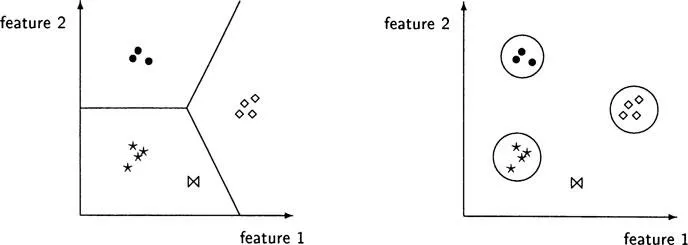
A novel method for learning characteristic decision trees is applied to the problem of learning the decision mechanism of coin-sorting machines. Decision trees constructed by ID3-like algorithms are unable to detect instances of categories not present in the set of training examples. instead of being rejected, such instances are assigned to one of the classes actually present in the training set. To solve this problem the algorithm must learn characteristic, rather than discriminative, category descriptions. In addition, the ability to control the degree of generalization is identified as an essential property of such algorithms. A novel method using the information about the statistical distribution of the feature values that can be extracted from the training examples is developed to meet these requirements. The central idea is to augment each leaf of the decision tree with a subtree that imposes further restrictions on the values of each feature in that leaf.
1. INTRODUCTION
One often ignored problem for a learning system is how to know when it encounters an instance of an unknown category. In many practical applications it cannot be assumed that every category is represented in the set of training examples (i.e., they are open domains [Hut94]) and sometimes the cost of a misclassification is too high. What is needed in such situations is the ability to reject instances of categories that the system has not been trained on.
In this article we will concentrate on an application concerning a coin-sorting machine of the kind often used in bank offices.1 Its task is to accept and sort (and count)a limited number of different types of coins (for instance, a particular country’s), and to reject all other coins. The vital part of the machine is a sophisticated sensor that the coins pass one by one. The sensor measures electronically five properties (diameter, thickness, permeability, and two kinds of conductivity)of each coin, which all are given a numerical value. Based on these measurements the machine decides of which type the current coin is: if it is of a known type of coin, it is sorted, otherwise it is regarded as an unknown type and is rejected.
The present procedure for constructing the decision mechanism is carried out mostly by hand. A number of coins of each type are passed through a sensor and the measurements are recorded. The measurements are then analyzed manually by an engineer, who chose a minimum and a maximum limit for each property of each type of coin. Finally, these limits are loaded into the memory of the machine. When the machine is about to sort a new coin, it uses the limits in the following way: if the measurement is higher than the minimum limit and lower than the maximum limit for all properties of some type of coin, the coin is classified as a coin of this type. If this is not true for any known type of coin, the coin is rejected.
Thus, in the present method, which is both complicated and time consuming, it is the skill of the engineer that decides the classification performance of the coin-sorting machine. Moreover, this procedure must be carried out for every new set of machines (e.g., for each country’s). In addition, there are updating problems when a new kind of coin is introduced. This is not only applicable when a new denomination is introduced, or when the appearance of an old denomination is changed. It is, for instance, not unusual that the composition of the alloy is changed. In fact, this happens often undeliberately as it is difficult to get exactly the same composition every time and, moreover, there are sometimes trace elements of other metals in the cauldron. Another kind of problems comes from the fact that it is difficult to make all the sensors exactly alike. As a consequence of this and the fact that all machines used for the same set of coins use the same limits, each sensor must be calibrated. Moreover, this calibration is not always sufficient and service agents must sometimes be sent out to adjust the limits on particular machines.
However, if we construct a method which automatically learns the decision mechanism, it would be possible to bring down the effects of these problems. In short, the task to be so...
Table of contents
- Cover
- Half Title
- Title Page
- Copyright Page
- Table of Contents
- Preface
- Conference Organization
- List of Sponsors
- Invited Papers
- Automated Reasoning
- CAD/CAM
- Case-Based Reasoning
- Database
- Decision Support
- Diagnosis
- Distributed Ai
- Fuzzy Logic And Control
- Genetic Algorithm
- Intelligent Tutoring
- Knowledge Acquisition
- Knowledge-Based Systems
- Knowledge Representation
- Logic Programming
- Machine Learning
- Manufacturing
- Monitoring
- Neural Network
- Neural Network Applications
- Natural Language
- Planning and Scheduling
- Practical Applications
- Robotics
- Vision
- Abstracts for Poster Session
- Index of Authors
Trusted by 375,005 students
Access to over 1.5 million titles for a fair monthly price.
Study more efficiently using our study tools.
Frequently asked questions
Yes, you can cancel anytime from the Subscription tab in your account settings on the Perlego website. Your subscription will stay active until the end of your current billing period. Learn how to cancel your subscription
No, books cannot be downloaded as external files, such as PDFs, for use outside of Perlego. However, you can download books within the Perlego app for offline reading on mobile or tablet. Learn how to download books offline
Perlego offers two plans: Essential and Complete
- Essential is ideal for learners and professionals who enjoy exploring a wide range of subjects. Access the Essential Library with 800,000+ trusted titles and best-sellers across business, personal growth, and the humanities. Includes unlimited reading time and Standard Read Aloud voice.
- Complete: Perfect for advanced learners and researchers needing full, unrestricted access. Unlock 1.5M+ books across hundreds of subjects, including academic and specialized titles. The Complete Plan also includes advanced features like Premium Read Aloud and Research Assistant.
We are an online textbook subscription service, where you can get access to an entire online library for less than the price of a single book per month. With over 1.5 million books across 990+ topics, we’ve got you covered! Learn about our mission
Look out for the read-aloud symbol on your next book to see if you can listen to it. The read-aloud tool reads text aloud for you, highlighting the text as it is being read. You can pause it, speed it up and slow it down. Learn more about Read Aloud
Yes! You can use the Perlego app on both iOS and Android devices to read anytime, anywhere — even offline. Perfect for commutes or when you’re on the go.
Please note we cannot support devices running on iOS 13 and Android 7 or earlier. Learn more about using the app
Please note we cannot support devices running on iOS 13 and Android 7 or earlier. Learn more about using the app
Yes, you can access Industrial and Engineering Applications or Artificial Intelligence and Expert Systems by Takushi Tanaka, Setsuo Ohsuga, Ali Moonis, Takushi Tanaka,Setsuo Ohsuga,Ali Moonis in PDF and/or ePUB format, as well as other popular books in Computer Science & Computer Science General. We have over 1.5 million books available in our catalogue for you to explore.