eBook - ePub
Transport of Suspended Solids in Open Channels
Proceedings of Euromech 192, Munich/Neubiberg, 11-15 June 1985
- 278 pages
- English
- ePUB (mobile friendly)
- Available on iOS & Android
eBook - ePub
Transport of Suspended Solids in Open Channels
Proceedings of Euromech 192, Munich/Neubiberg, 11-15 June 1985
About this book
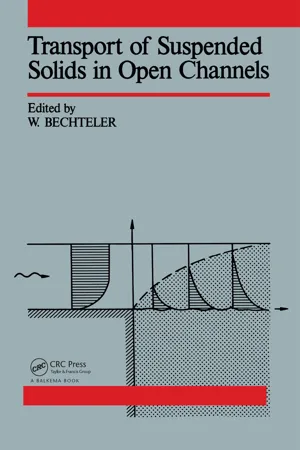
Conference Proceedings of Euromech 192: Transport of suspended solids in open channels, Munich, Neubiberg, 11-15 June 1985. Rapid growth in water requirements makes it necessary to increase the amount of water drawn from rivers. The dams necessary for capturing river water have to be built to resist damage when large floods occur, and an idea of the possible destructive power of floods is given by the front cover photograph.
Information
1 Flow structures as related to suspended sediment transport, particle-fluid dynamics
Recent developments on the mechanics of sediment suspension
B. Mutlu Sumer
Technical University of Denmark, Institute of Hydrodynamics & Hydraulic Engineering, Lyngby
ABSTRACT: Some developments in our knowledge of the properties of the sediment suspension in turbulent boundary-layer flow are reviewed, the emphasis being placed on the processes close to the bed of a turbulent open channel. The suspension process considered in this paper is the one which is due only to the action of turbulence. This is normally what occurs in water flows with silt and sand size sediment particles. The processes which involve gravel size sediment suspension in water flow and also sand suspension in air flow are excluded in the present review. The work which relates the sediment suspension to the near-bed turbulence structures (namely the bursting process) is reviewed with special reference to the author’s own work. Lift forces on a moving particle near the bed are discussed. Available information is given, covering both the smooth and rough bed cases. Finally, the paper addresses to one other important aspect of the suspension process: the limiting stages of suspension. Information on our knowledge of 1) the termination of suspension (of the particles which are put into the flow above the constant-stress layer) and 2) the initiation of suspension (of bed-material particles) is reviewed. In this context the paper discusses some new data obtained using 1) a conventional flume facility with a loose particle which is a member of a bed of like particles and 2) a turbulent-spot facility with a sediment bed (of size small compared with spot dimensions) placed on an otherwise rigid wall.
1. INTRODUCTION
Entrainment and suspension of sediment particles from a loose boundary is one of the most important aspects of sediment transport, since it is this aspect which, along with the deposition process, determines the complex boundary condition at the bed. In practice, the sediment entrainment and suspension can be encountered in various contexts such as in plane bed erosion, in the erosion which takes place at the re-attachment point behind bed forms, in bridge-pier erosion, etc. This paper concerns the entrainment and suspension process over a plane bed. It is assumed that the size of sediment particles is sufficiently small with respect to the length scale of typical turbulence structures near the bed and also that the sediment particles are sufficiently light, yet heavier than the fluid, but satisfying the condition ρp >/> ρ where ρp and ρ are the particle density and the fluid density respectively. Normally, the silt and the sediment particles the size of even coarse sand in water flow satisfy these conditions. Thus, in this paper, suspension of the gravel-size sediment particles in water flow and that of the sand in air flow are excluded, where mechanisms other than or in addition to turbulence (such as collision of sediment particles with the bed, lift forces due to close proximity of the large-size particles to the bed, etc.) are involved. It is also assumed that the sediment concentration is sufficiently low so that we can neglect effects such as the influence of sediment in suspension on the turbulence structure and also the interaction between the particles which possibly takes place when the concentration is high. Furthermore, it should be noted that, although this paper concerns the entrainment and suspension process over a plane bed, the information which will be given in the paper can be applicable locally to any bed form where a turbulent boundary layer is present.
After the discovery of the so-called bursting process in the mid-sixties (see Grass, 1983, for an up-to-date review), attempts have been made to relate the suspension process to this newly discovered sequence of turbulent-flow events (Sutherland, 1967, Engelund & Gravesen, 1972, Grass, 1974, Jackson, 1976, Sumer & Oguz, 1978, and Sumer & Deigaard, 1979 and 1981). Two approaches have been adopted in these studies. One is to experiment with a bed of erodible material (usually sand) and the other with a moveable single particle over a smooth bed or a bed of like particles. There are several difficulties with the former, as many entrainment events occ...
Table of contents
- Cover
- Half Title
- Title Page
- Copyright Page
- Table of Contents
- Preface
- 1 Flow structures as related to suspended sediment transport, particle-fluid dynamics
- 2 Concentration distribution and transport of suspended load under steady flow conditions
- 3 Reservoir sedimentation, settling basins
- 4 Resuspension, suspended and bed-load interaction
- 5 Suspended sediment transport under nonsteady flow conditions
- 6 Special topics
Trusted by 375,005 students
Access to over 1.5 million titles for a fair monthly price.
Study more efficiently using our study tools.
Frequently asked questions
Yes, you can cancel anytime from the Subscription tab in your account settings on the Perlego website. Your subscription will stay active until the end of your current billing period. Learn how to cancel your subscription
No, books cannot be downloaded as external files, such as PDFs, for use outside of Perlego. However, you can download books within the Perlego app for offline reading on mobile or tablet. Learn how to download books offline
Perlego offers two plans: Essential and Complete
- Essential is ideal for learners and professionals who enjoy exploring a wide range of subjects. Access the Essential Library with 800,000+ trusted titles and best-sellers across business, personal growth, and the humanities. Includes unlimited reading time and Standard Read Aloud voice.
- Complete: Perfect for advanced learners and researchers needing full, unrestricted access. Unlock 1.5M+ books across hundreds of subjects, including academic and specialized titles. The Complete Plan also includes advanced features like Premium Read Aloud and Research Assistant.
We are an online textbook subscription service, where you can get access to an entire online library for less than the price of a single book per month. With over 1.5 million books across 990+ topics, we’ve got you covered! Learn about our mission
Look out for the read-aloud symbol on your next book to see if you can listen to it. The read-aloud tool reads text aloud for you, highlighting the text as it is being read. You can pause it, speed it up and slow it down. Learn more about Read Aloud
Yes! You can use the Perlego app on both iOS and Android devices to read anytime, anywhere — even offline. Perfect for commutes or when you’re on the go.
Please note we cannot support devices running on iOS 13 and Android 7 or earlier. Learn more about using the app
Please note we cannot support devices running on iOS 13 and Android 7 or earlier. Learn more about using the app
Yes, you can access Transport of Suspended Solids in Open Channels by W. Bechteler in PDF and/or ePUB format, as well as other popular books in Physical Sciences & Mechanics. We have over 1.5 million books available in our catalogue for you to explore.