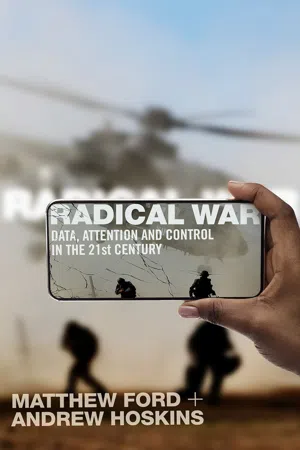
This book examines the digital explosion that has ripped across the battlefield, weaponising our attention and making everyone a participant in wars without end.
'Smart' devices, apps, archives and algorithms remove the bystander from war, collapsing the distinctions between audience and actor, soldier and civilian, media and weapon. This has ruptured our capacity to make sense of war. Now we are all either victims or perpetrators.
In Radical War, Ford and Hoskins reveal how contemporary war is legitimised, planned, fought, experienced, remembered and forgotten in a continuous and connected way, through digitally saturated fields of perception.
Plotting the emerging relationship between data, attention and the power to control war, the authors chart the complex digital and human interdependencies that sustain political violence today. Through a unique, interdisciplinary lens, they map our disjointed experiences of conflict and illuminate this dystopian new ecology of war.
eBook - ePub
Radical War
Data, Attention, Control
- English
- ePUB (mobile friendly)
- Available on iOS & Android
eBook - ePub
About this book
Information
1
WAR AND THE DEMOCRATISATION OF PERCEPTION
Gamers were all fingers and thumbs on their gamepads. They were watching livestreamed games on Twitch, a video-sharing site owned by Amazon and designed for e-gamers. Social media was buzzing. Facebook had the scoop. What was Twitch livestreaming? A Neo-Nazi terrorist attack against two New Zealand mosques. The gunman self-streamed the deed. They hoped to kill as many as they could.1 In seventeen minutes, there were fifty-one dead and fifty injured. This was Christchurch, New Zealand, on 15 March 2019, and the world saw everything. The New York Times tried to scoop the headline – ‘A Mass Murder of, and for, the Internet’ – but the gunman had out-scooped a global news brand.2 The incident was posted, reposted and posted again in successive waves of sharing across YouTube, Twitter and Reddit. Then a sense of morality kicked in, with platform moderators struggling to remove horrific clips as a race ensued against those masses posting and reposting. Details emerged from the attack: the killer shouted a meme, ‘subscribe to PewDiePie’ – a reference to Felix Kjellberg, a Swedish digital games player. Kjellberg owned one of the most subscribed YouTube channels and had been accused of having links to anti-Semitism and alt-right neo-Nazi movements.3 The social media multiplier was spinning beyond control. Facebook’s Newsroom tweeted: ‘In the first 24 hours we removed 1.5 million videos of the attack globally, of which over 1.2 million were blocked at upload.’4 Reddit acted to ban any forums named ‘gore’ and ‘watchpeopledie’, forums that had acquired 300,000 subscribers within hours.5 Forum moderators argued the video should be kept open as it offered ‘unfiltered reality’, but Reddit’s content controllers faced a tidal wave of information to try and manage, and in the end the pages came down.6 By that point, it was impossible to gauge the scale or intensity of shared viewing on WhatsApp, Telegram and other encrypted messaging services.
Livestreaming and reproduction of violent political imagery is an everyday event. This radicalising content is the real-time battlefield, reshaping discussion irrespective of whether someone owns a smartphone or not. It is also a global game between those who post violent images and the guardians who try to take them down – it is live, it is online, and it is a race. The complexity of digital infrastructures that underpin this arena remove any certainty that all the images of the Christchurch attack were removed. The scale of uncertainty is amplified by the opacity of the information infrastructures themselves. Consequently, we cannot know how many copies of the video there were or how many viewed the attack live. The number of links sharing the content and the quantity of narrated commentary remain unknown.
In response, Facebook and other social media platforms established the Global Internet Forum to Counter Terrorism (GIFCT) to try to help prevent this sort of livestreaming in the future. As the copycat attack by Stephen Balliet against the Jewish community in Halle, Germany, in October 2019 demonstrated, GIFCT proved inadequate to the task almost from the get-go.7 Balliet, as the actor-killer, issued an online manifesto for distribution via an alt-right extremist message board 8chan before livestreaming the attack on Facebook and Twitch. Real life now mirrored a first-person shooter game. Around 2,200 people viewed Twitch before the stream was pulled down. The normal content would otherwise be friends participating in video games. This new dystopian show was all about two people killed and one injured.8
* * *
Violence is ubiquitous, some might even say mundane. People are subject to it in all sorts of contexts, and across all parts of society. This complicates understanding and underlines how violence is both contentious and subject to multiple interpretations (Miller 2020, pp. 5–8). Violence is represented in all sorts of media. The actuality of it even gets streamed live over gamer channels like Twitch. It can be domestic, hidden, religious, criminal or political. Violence orders social groups in different ways. In the military, it is about the controlled application of violence. In gangs, it might be designed to conjure fear to shape relations within and between rival groups. At a football match, violence might frame how fans identify themselves or provide opportunities to let off steam. For the media, violence creates clicks and drives attention. Within the state, the government claims a monopoly on the legitimate use of violence. Between states, political violence is war.
Today, our understanding of war and violence is mediated by connected technologies like the smartphone. These devices now saturate our experience of the world. Violence as it appears in these contexts produces intense spectacle in which local, national and transnational narratives and identities are brought into new conflict. Thus, the attacks in Christchurch inspired copycat attacks in Halle. The attackers targeted different communities, but their anti-Semitic and racist intent and their livestreaming through Twitch had both national and transnational political intent. How local and global audiences made sense of the violence and how the attacks produced political effects is nevertheless always contextual. However, if we accept that there is no going back to a pre-digital age, that no-one is going to turn off the internet, then there can be no political violence without its digital representation. In these circumstances, connected technologies like the smartphone help to create asynchronous experiences of war and violence. This produces a collapse of context and leaves audiences stuck in the moment, free to define the meaning of these experiences in whatever way they choose (Brandtzaeg and Lüders 2018).
In the twentieth century, states prosecuted wars and the media reported on them. However, in this century information infrastructures have created the conditions in which media is now made for the prosecution of war. This is a direct consequence of a convergence between the weapons of war and the media of war, between the means through which wars are fought and the means through which war is experienced. People participate in their own surveillance – using smartphone apps, uploading geolocated video – and in the process, we contend, they have become part of the machinery of war, enabling the delivery of ordnance to targets. This, above all else, demands a re-examination of how war in a deeply mediated world now works. For the explosion of data and smart devices has weaponised attention, de-territorialised war and made the seizure of minds both easier and cheap.
For example, WhatsApp is an end-to-end encrypted messenger service owned by Facebook. Free to download to your smartphone, WhatsApp can be used to prosecute war overseas and organise political violence at home. Overseas, WhatsApp was in use among armed forces coordinating Reaper drone attacks in Mosul.9 American forces have been advised to download the app for operational use on their phones,10 and it has been hacked by Israeli ‘cyber-arms dealer’, NSO Group. While the 2019 vulnerability was patched by WhatsApp, NSO Group has gone on to extend its Pegasus software to collect data from phones without even having to work through an app.11 The result of all this is that the smartphone becomes a sensor. It can ‘collect intimate data from a target device, including capturing data through the microphone and camera, and gathering location data’.12 This is not just about the United States or the NSO Group either. In Ukraine, the Russian government uses Telegram, the cross-platform, instant messaging system, to keep track of people and promote division.13
Compare this with the way that WhatsApp, Instagram and social media sites like Parler and Gab were used by supporters of President Trump to organise an insurrection and storm the Capitol Building on 6 January 2021. Including veterans from the wars in Iraq and Afghanistan – one of whom, Ashli Babbitt, was shot dead by Capitol Police14 – the insurrection’s goal was to stop Congress from certifying President Biden’s election victory. Recording and broadcasting events from their smartphones, the protagonists produced data that made it easy for the FBI to identify and then subsequently arrest them. At the same time, the events on the Capitol have created a digital archive for Trump supporters to look back on and invoke in their ongoing efforts to re-elect the forty-fifth president. The smartphone and the digital ecosystem it fostered have created all number of entirely new media for war and violence to occupy. In the process, we now experience a constantly churning spectacle of opinions and perceptions that spill out and feed back into each other, irrespective of whether they are expressed overseas or at home.
For the evangelists of the information age, the internet would lead to the spread of democracy and the onward march of progress. In 2011, for example, networked technologies made it possible to amass large numbers of protestors in Tahir Square in Cairo; those protestors then called for the downfall of the Egyptian President Hosni Mubarak (Tufecki 2017). But for authoritarians, insurgents and terrorists, the twenty-first-century information ecology also lends itself to fostering division, fear and uncertainty. For instance, Afghans learnt to post whatever they wanted to Facebook, to store whatever information they liked on their personal devices and to leave images or data in the cloud without having to fear for the consequences. Since the Taliban retook Kabul in August 2021, however, Afghans have had to weigh up what parts of their digital selves they must delete for fear of retribution. In this case, ‘[t]he challenge is how do you balance getting information – like what’s going on at the airport, and people trying to reach you – with eliminating evidence that a group would use to implicate you in something and take you round back to make an example of you’.15 Put this way, the digital environment is not just another channel for distributing distrust among adversaries and cementing support among the converted but is the warzone itself. Now, online and offline experiences integrate, shape perception and drive people to action.
Information infrastructures exacerbate the distribution of distrust in ways that are uneven and with second- and third-order effects that are difficult to control. Regional wars have always offered an opportunity for larger powers to test new equipment and the associated concept of military operations. The Armenia–Azerbaijan war in September 2020, for example, made it possible for Israel to establish the effectiveness of their Harpy and Harop loitering munitions.16 Employed by Azerbaijan’s armed forces, the drones provoked much discussion on social media as to whether they had effectively brought the era of the tank to an end.17 Much of this debate was nonetheless shaped by the availability of online media about these wars. Before the outbreak of hostilities, the Azerbaijani Army released a rock track called ‘Fire’ by Narmin Kerimbeyova, Ceyhun Zeynalov and the Nur group that heavily featured the Harpy drone in the music video.18 As the war unfolded, this video went viral, shaping perception and framing the propaganda and social media commentary that followed.
The effectiveness of the drone aside, this conflict also offered an opportunity to test how state-directed information operations might be used on the battlefield. In particular, how might the different information infrastructures in Armenia and Azerbaijan shape the way that the conflict was portrayed? According to the non-governmental organisation Freedom House, Armenia has a more open approach to accessing the internet when compared to Azerbaijan.19 This openness, however, could be used against Armenia. Indeed, Azerbaijan’s capacity to dominate social media almost certainly had more to do with Baku’s decision to employ cyber-attacks on Armenia while cracking down on its critics at home and directly taking control of its online propaganda efforts.20 This swamped Armenia’s more open approach to net freedom, leaving the country vulnerable to Distributed Denial of Service attacks that left many Turkish and Azerbaijani websites inaccessible and creating problems accessing TikTok.21
Considering the chaos these sorts of attacks might create, intelligence agencies have inevitably spent considerable time trying to understand how to adjust to the way civilian information infrastructures have radically refashioned social engagement.22 The fear is that these new technologies will foster ‘an embedded fifth column, where everyone, unbeknownst to him or her, is behaving according to the plans of one of our competitors’.23 This has a military dimension, one in which confusion at home can be used to gain strategic or tactical advantage in war (Chotikul 1986; Thomas 2004).24 One way that the armed forces have sought to get inside the challenges posed by subversion has been to try to accelerate the speed at which they make decisions. This would allow them to operate more quickly than those trying to undermine cohesion at home. For Western armed forces, this has meant integrating existing government structures, doctrines and digital platforms with those units responsible for carrying out air, land, sea, cyber and information operations.25 In the UK, the hope is that these discrete spheres of military and government activity can then be fused to deliver coherent political effects at speed to gain ‘information advantage’.26 Nevertheless, it is not clear how we might realistically imagine ‘information advantage’ when hyperconnectivity, information overload, ubiquitous surveillance and rolling social media are contributing to a post-trust environment.
Seen through the prism of these bureaucratic structures, the experience of war remains framed by how the armed forces organise themselves. Looked at from outside the prism of the military, however, a useful way to think about experience under digital conditions is to talk about a ‘dimension’. For example, Laurence Scott argues that digital technologies are reshaping what it is to be human to the extent that we are now ‘four dimensional’. He argues that
the fourth dimension doesn’t sit neatly above or on the other side of things. It isn’t an attic extension. Rather, it contorts the old dimensions. And so it is with digitization, which is no longer a space in and out of which we clamber, via the phone lines. The old world itself has taken on, in its essence, a four-dimensionality. (Scott 2015, p. xv)
Even if you don’t have a Facebook account, the company boasts 2.91 billion active users who do.27 In these circumstances, and given the levels of global connectivity, our subliminal day-to-day engagement with the world is entirely mediated by digital experiences. This is true whether users are recording a moment and uploading it to Facebook or organising a social gathering – even with people who do not use social media – via their smartphone. In our terms, this is a new and fertile space in which war is flourishing. And yet the military continue to try to make sense of these experiences through bureaucratic prisms as expressed in their organisation structures and doctrines. While this makes it possible to sustain a way of seeing that privileges the military’s version of reality, sustains outmoded martial cultures and maintains doctrinal purity, it does not help to make sense of war as it might be understood by society more broadly.
Thus, in an effort to escape these military constructs, we explicitly reject Clausewitzian definitions of war. The use of violence is not exclusively under the control of the state or the military. Strategists and the military may prefer to define war as a continuation of politics by other means. By contrast, in Radical War, we seek to understand how political violence gains meaning in a 24/7 always online environment. By taking this broader approach, we can investigate the way knowledge about war has become a battle for control over the relationship between data and attention. Our analysis consequently decentres the battlefield, directs our principal concerns away from military strategy, and instead moves us towards a theory of knowledge about how we can know war in a networked, highly mediated world.
To replace the rigidity of the Clausewitzian model of war, we propose to map political violence across three dimensions that we label, data, attention and control:
1.Data: involves the intense connectivity and the datafication (see Appendix) of battle. This produces immense data volumes that enable multiple, simultaneous, messy and weaponised data trajectories, creating accidental archives and new human–machine configurations of perception. In these contexts, data can be any kind of information, so long as it’s expressed in digital form. These shape how wars are used as ‘lessons’ and go on to (de)legitimise current/future strategy. This creates an:
2.Attention disorder that clutters and confuses what Paul Virilio (2009) describes as the grey ecology as it reshapes the relationship between knowledge, understanding and the battlefield. This creates a crisis of representation that fragments interpreta...
Table of contents
- Cover
- Half Title
- Title
- Copyright
- Contents
- List of Diagrams
- Acknowledgements
- Prologue: War Since 9/11
- Introduction: War in the Age of the Smartphone
- Radical War: A Definition
- 1. War and the Democratisation of Perception
- 2. Understanding the New War Ecology
- Part 1 Data
- Part 2 Attention
- Part 3 Control
- Epilogue
- Appendix 1: Glossary of Terms
- Appendix 2: Key ICT Indicators
- Notes
- Bibliography
- Index
- Back Cover
Trusted by 375,005 students
Access to over 1.5 million titles for a fair monthly price.
Study more efficiently using our study tools.
Frequently asked questions
Yes, you can cancel anytime from the Subscription tab in your account settings on the Perlego website. Your subscription will stay active until the end of your current billing period. Learn how to cancel your subscription
No, books cannot be downloaded as external files, such as PDFs, for use outside of Perlego. However, you can download books within the Perlego app for offline reading on mobile or tablet. Learn how to download books offline
Perlego offers two plans: Essential and Complete
- Essential is ideal for learners and professionals who enjoy exploring a wide range of subjects. Access the Essential Library with 800,000+ trusted titles and best-sellers across business, personal growth, and the humanities. Includes unlimited reading time and Standard Read Aloud voice.
- Complete: Perfect for advanced learners and researchers needing full, unrestricted access. Unlock 1.5M+ books across hundreds of subjects, including academic and specialized titles. The Complete Plan also includes advanced features like Premium Read Aloud and Research Assistant.
We are an online textbook subscription service, where you can get access to an entire online library for less than the price of a single book per month. With over 1.5 million books across 990+ topics, we’ve got you covered! Learn about our mission
Look out for the read-aloud symbol on your next book to see if you can listen to it. The read-aloud tool reads text aloud for you, highlighting the text as it is being read. You can pause it, speed it up and slow it down. Learn more about Read Aloud
Yes! You can use the Perlego app on both iOS and Android devices to read anytime, anywhere — even offline. Perfect for commutes or when you’re on the go.
Please note we cannot support devices running on iOS 13 and Android 7 or earlier. Learn more about using the app
Please note we cannot support devices running on iOS 13 and Android 7 or earlier. Learn more about using the app
Yes, you can access Radical War by Matthew Ford ,Andrew Hoskins ,Matthew Ford,Andrew Hoskins in PDF and/or ePUB format, as well as other popular books in History & Military & Maritime History. We have over 1.5 million books available in our catalogue for you to explore.