Hydrometeorological Extreme Events and Public Health
eBook - ePub

Hydrometeorological Extreme Events and Public Health

  1. English
  2. ePUB (mobile friendly)
  3. Available on iOS & Android
eBook - ePub

About this book

CONTINGENCY PLANNING FOR INCREASED FLOODS AND DROUGHTS RESULTING FROM CLIMATE CHANGE TO PROTECT HUMAN HEALTH

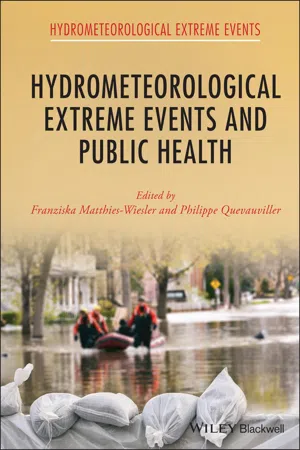
Hydrometeorological Extreme Events and Public Health outlines the links between climate change, trends in hydrometeorological extreme events, and the effects on human health, and describes new developments in health adaptation and disaster risk management. The work provides technical facts, examples of international and national approaches and scientific projects, and covers key issues such as multi-sectoral collaboration, disaster preparedness, response and recovery, as well as stakeholder involvement, and costs.

Readers will find:

  • Specific observed and projected health effects of heavy precipitation events, floods, and droughts
  • A comprehensive analysis of recent studies on the health costs of extreme weather events
  • A discussion of the impact and interdependency of international health and climate agreements

For professionals working in the areas of hydrology, disaster management and prevention, and in the public health sector, Hydrometeorological Extreme Events and Public Health serves as a comprehensive resource on new challenges resulting from climate change and on how we can plan for and adapt to this uncharted territory to protect human lives and human health. The book is the fifth volume of the Hydrometeorological Extreme Events Series.

Trusted by 375,005 students

Access to over 1.5 million titles for a fair monthly price.

Study more efficiently using our study tools.

Information

Year
2022
Print ISBN
9781119259305
eBook ISBN
9781119259251

1
Introduction

Ian Clark
Former Head of unit of the European Commission
Since early 2020, due to COVID-19, the world has faced its most serious health crisis for a century with an enormous toll on human life together with severe effects on the health of the population and strains on health systems as well as on socio-economic well-being. More than 2 years since the first cases, the risks of the pandemic are still high. This health crisis has been a stark reminder of the dangers of insufficient preparation as most countries throughout the world were clearly not ready to face such a crisis and much of the response, certainly at the early stage, was ad hoc. At the same time, COVID-19 is a ‘simple’ crisis compared to the climate crisis, which is the most complex and intractable problem facing humankind. While recovery from Covid is a major challenge for the whole world and will take years, there are clear solutions, in particular through vaccination of a very large share of the population. These solutions are backed by a strong consensus at both policy and scientific levels which, however, is not the case for climate change. Meanwhile, the health threats due to climate change are increasing. The last decade was the hottest on record, with eight of the hottest years ever recorded. The health consequences of these increased temperatures include death and injury from extreme precipitation, tropical cyclones, heatwaves, floods, forest fires, as well as storm surges. The world can also expect the emergence and spread of infectious diseases and allergens linked to geographical shifts in vectors and pathogens. There will be additional challenges for the capacities of health systems due, for example, to the spread of previously unknown diseases from the Southern Hemisphere to the Northern Hemisphere.
This book is a timely publication to contribute to science and policy debates as we emerge from the Covid crisis and also as scientific input to underpin the upcoming COP26 deliberations and decisions.
2021 saw a new worldwide political impetus to reinforce climate action in support of health post-Covid building on the strong health provisions of the 2015 Paris agreement on climate change, as well as the 2015 Sendai Framework for Disaster Risk Reduction. The COP26 in Glasgow November 2021 was a major milestone for agreement on increased action. Already in April 2021 at the high-level summit to prepare COP26, a number of countries made renewed and updated pledges. Health and security also featured at the summit – countries aim to scale up locally led solutions to climate vulnerability. Furthermore, in Europe, new policy developments in the EU aim to reinforce action to address the health challenge brought by climate change: a new Climate Adaptation Strategy launched in February 2021 proposes reinforced action to better understand climate-related risks to health and to increase capacity to reduce these risks. In addition, the revised Union Civil Protection Mechanism of May 2021 reinforces civil protection actions to help address climate change as well as health emergencies.
Over the past decade, a considerable body of scientific and policy literature has been developed analysing the impact of weather events on health but much less on long-term weather–climatic impacts. This publication aims to also contribute to the latter growing debate.
The book analyses and summarises the state of knowledge of climate change and certain specific extreme weather events for health, including the question of the health costs of extreme events and secondly addresses the international efforts since the early years of the century and particularly the agreements of 2015 to integrate health and climate action together.
Most of the extreme events mentioned above that cause health impacts are linked to precipitation and temperature, which are the subjects of Chapter 2. Based on assessments prepared using General Circulation Models, their performance in assessing potential health impact results for three periods is analysed: 1996–2014, 1996–2005 and forecasts for 2061–2100. It discusses the advances in modelling as well as the inaccuracies.
Chapter 3 focuses on the state of scientific knowledge about climate change and health, starting with the most recent IPCC assessment report from 2014 completed by summaries of more recent studies.
Flooding is the most frequent disaster worldwide and the health consequences are the subject of Chapter 4, looking at both the short- and long-term impact both on population well-being as well as the potential impact on health systems.
Chapter 5 includes a comparative analysis of the three 2015 international agreements – the Paris climate agreement, the Agenda 2030 agreement on Sustainable Development and the Sendai Framework for Disaster Risk Reduction – both their new and reinforced actions to address human health and well-being and the links between the three agreements. According to the World Health Organization (WHO), the Paris climate agreement is potentially the strongest international health agreement of this century. Building on this comparison, Chapter 6 analyses the international health agreements developed by WHO and how these have evolved in recent times to address more specifically climate and extreme weather impacts. The second part of Chapter 6 outlines specific diseases associated with the impacts of extreme hydrometeorological events. Finally, Chapter 7 presents the results of a wide body of academic work estimating health costs of extreme weather events, a subject neglected in most economic impact assessments of such events. Finally, the book identifies gaps and areas for additional study and calls for more attention in decision-making to account for the significant health costs.
2
Precipitation and Temperature Extremes in a Changing Climate

Enrico Scoccimarro1 and Antonio Navarra2
1 Fondazione Centro Euro-Mediterraneo sui Cambiamento Climatici, Bologna, Italy
2 Universita’ di Bologna, Bologna, Italy

2.1 Introduction

Episodes of large societal and economic relevance are caused by extreme weather events (Parry et al. 2007; Peterson et al. 2008). When estimating the impacts of climate change, the potential changes in climate variability and hence extreme events present a prime concern.
The distinction between extreme weather events and extreme climate events is not clear, but mainly relates to the timescale they refer to. An extreme weather event is associated with changes in weather conditions for a short period, from less than a day to a few weeks. An extreme climate event occurs over a longer period. It can be the accumulation of several weather events (not only extreme ones), such as a long period of days associated with low precipitation leading to a drought period (Seneviratne et al. 2012).
Different extreme events affect our society over different regions of the planet and people are subject to different kinds of weather extremes, with some places also subject to more than one kind of event. Since 1980 in the United States, there have been more than 10,000 deaths and in excess of 1.5 trillion USD in damage due to extreme weather events (NCEI, 2019; Smith and Matthews, 2015). The total reported economic losses caused by weather extremes for the same period over Europe amounted to approximately 453 billions of euros (EEA 2019). Many climate extremes are the result of natural climate variability (including phenomena such as El Niño), and natural decadal or multi-decadal variations in the climate provide the backdrop for anthropogenic climate changes (Seneviratne et al. 2012). Even if there were no anthropogenic changes in climate, a wide variety of natural weather and climate extremes would still occur. Heatwaves, extreme precipitation, droughts, floods, storm surges and tropical cyclones are the most common extreme events providing risks and causing damage to our society (Bell et al. 2018). The evaluation of their impact is region dependent and many research gaps must still be addressed to improve the resilience of public health to such events. Most of these events are linked to two parameters – temperature and precipitation – that are considered reasonably well represented by state-of-the-art general circulation models (GCMs). A good characterisation of the precipitation event probability distribution helps not only to identify extreme precipitation conditions but also to assess drought and floods, together with precipitation patterns associated with tropical cyclones (Scoccimarro et al. 2014). On the other hand, a good representation of the temperature events distribution gives support not only to the identification of extreme daily temperature events but also tropical nights and heatwaves (Russo et al. 2014; Silliman et al. 2008; Zampieri et al. 2016).
Because of the temperature and precipitation roles in affecting human health and natural systems, it is important to assess potential changes in the tails of their distribution of events (the rarest conditions and/or events) under different climatic conditions. Changes in extremes can be linked to changes in the mean, variance or shape of probability distributions. However, all of these changes in extremes can also be directly related to changes in the mean climate, because mean future conditions in some variables are projected to lie within the tails of the distributions of present-day conditions. It is well known that in several cases the changes in extremes scale closely with changes in ...

Table of contents

  1. Cover
  2. Serious page
  3. Title page
  4. Copyright
  5. Table of Contents
  6. List of Contributors
  7. Editors
  8. Series Preface
  9. Foreword
  10. 1 Introduction
  11. 2 Precipitation and Temperature Extremes in a Changing Climate
  12. 3 Climate Change and Health
  13. 4 Flooding and Public Health in a Changing Climate
  14. 5 The Climate Change, Disaster Risk Reduction and Health Nexus
  15. 6 Preparedness and Response in View of Climate Change Impacting on Health Challenges
  16. 7 The Health Costs of Hydrometeorological Extreme Events
  17. 8 Conclusions and Perspectives
  18. Index
  19. End User License Agreement

Frequently asked questions

Yes, you can cancel anytime from the Subscription tab in your account settings on the Perlego website. Your subscription will stay active until the end of your current billing period. Learn how to cancel your subscription
No, books cannot be downloaded as external files, such as PDFs, for use outside of Perlego. However, you can download books within the Perlego app for offline reading on mobile or tablet. Learn how to download books offline
We are an online textbook subscription service, where you can get access to an entire online library for less than the price of a single book per month. With over 1.5 million books across 990+ topics, we’ve got you covered! Learn about our mission
Look out for the read-aloud symbol on your next book to see if you can listen to it. The read-aloud tool reads text aloud for you, highlighting the text as it is being read. You can pause it, speed it up and slow it down. Learn more about Read Aloud
Yes! You can use the Perlego app on both iOS and Android devices to read anytime, anywhere — even offline. Perfect for commutes or when you’re on the go.
Please note we cannot support devices running on iOS 13 and Android 7 or earlier. Learn more about using the app
Yes, you can access Hydrometeorological Extreme Events and Public Health by Franziska Matthies-Wiesler, Philippe Quevauviller, Franziska Matthies-Wiesler,Philippe Quevauviller in PDF and/or ePUB format, as well as other popular books in Physical Sciences & Meteorology & Climatology. We have over 1.5 million books available in our catalogue for you to explore.