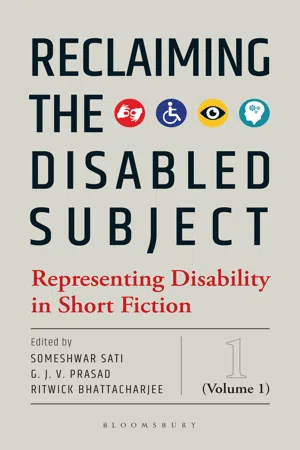
Mired inside its rather archaic comprehension as a medical phenomenon, disability, for a long time now, has been ignored as a marker of identity. The world has only been busy in rectifying the absences that have, ostensibly "dis-abled", rather than accepting such impaired existences as human beings themselves. The volume intends to reclaim the representations of disability and present narratives that do not just use the figure of the disabled as a means to an end. It includes translation of 17 disability centric short stories from multiple Indian languages into English. Further it uses these stories as illustration to test and develop new theoretical formulations concerning disability and the disabled. What grants the proposed work its uniqueness is, in other words, not only the translations of the erstwhile lost stories of disability but also the use of these stories towards the formation of theoretical paradigms to move forward the project of Disability Studies.
The volume shows, interrogates and problematizes the affect that impairment and disability has on those who are "abled". It presents how the "normal" human being approaches the disabled and interacts with them.
All in all, owing to its academic engagement with disability as a phenomenon and within a narrative, this work intends to take the role of a resource book that will find ready use in the newly emergent multidisciplinary field of Disability Studies and will be of great significance to India and the world at large especially since Literature has a major role to play in this field. Not only, then, does it present different disability narratives to the world but, through their academic interrogation, also allows researchers and academics, especially in India, to form the theoretical enhancements in Disability Studies that both our country and the world desperately require.
- 300 pages
- English
- ePUB (mobile friendly)
- Available on iOS & Android
eBook - ePub
About this book
Trusted by 375,005 students
Access to over 1.5 million titles for a fair monthly price.
Study more efficiently using our study tools.
Information
Table of contents
- Cover
- Half Title
- Title Page
- Copyright
- Contents
- Acknowledgements
- Introduction by G.J.V. Prasad, Someshwar Sati and Ritwick Bhattacharjee
- Chapter 1. Vishakha by Medha Trivedi (trans. Nilufer E. Bharucha): Introduction
- Chapter 2. Lohini Sagai by Ishwar Petlikar (trans. Shilpa Das as ‘Ties of Blood’): Introduction
- Chapter 3. Pangu by Kalindi Charan Panigrahi (trans. Subhendu Mund as ‘Handicapped’): Introduction
- Chapter 4. Subha by Rabindranath Tagore (trans. Banibrata Mahanta): Introduction
- Chapter 5. Gungiya by Mahadevi Varma (trans. Shubhra Dubey): Introduction
- Chapter 6. Kurai Piravi by T. Jayakanthan (trans. Hemchandran Karah as ‘Incomplete Being’): Introduction
- Chapter 7. Koobad by Khalid Jawed (trans. Sania Hashmi as ‘The Hunchback’): Introduction
- Chapter 8. Woh by Rashid Jahan (trans. Shilpaa Anand and Aneesa Mushtaq as ‘That Woman’): Introduction
- Chapter 9. Kushtorogir Bou by Manik Bandyopadhyay (trans. Brati Biswas as ‘The Leprosy Patient’s Wife’): Introduction
- Chapter 10. Thakara by P. Padmarajan (trans. Sanju Thomas): Introduction
- Chapter 11. Beethoven by Saurabh Kumar Chaliha (trans. Rajashree Bargohain): Introduction
- Chapter 12. Khitin Babu by Sachidanand Hiranandan Vatsyayan ‘Ajnyeya’ (trans. Ritwick Bhattacharjee): Introduction
- Chapter 13. Seh Da Takkla by Gurdial Singh (trans. Jasdeep Singh as ‘The Mute Fury’): Introduction
- Chapter 14. Shwaas by Madhavi Gharpure (trans. Rohini Mokashi Punekar as ‘Breath’): Introduction
- Chapter 15. Cikitsa by Raamaa Chandramouli (trans. Indira Babbellapati as ‘Cikitsa: The Treatment’) : Introduction
- Chapter 16. Moonnu Andhanmar Anaye Vivarikkunnu by E. Santosh Kumar (trans. Shalini Rachel Varghese as ‘Three Blind Men Describe an Elephant’) : Introduction
- Chapter 17. Drushti by Bolwar Mahamad Kunhi (trans. Keerti Ramachandra) : Introduction
- Glossary
- Index
- About the Editors
- About the Authors
- About the Translators
Frequently asked questions
Yes, you can cancel anytime from the Subscription tab in your account settings on the Perlego website. Your subscription will stay active until the end of your current billing period. Learn how to cancel your subscription
No, books cannot be downloaded as external files, such as PDFs, for use outside of Perlego. However, you can download books within the Perlego app for offline reading on mobile or tablet. Learn how to download books offline
Perlego offers two plans: Essential and Complete
- Essential is ideal for learners and professionals who enjoy exploring a wide range of subjects. Access the Essential Library with 800,000+ trusted titles and best-sellers across business, personal growth, and the humanities. Includes unlimited reading time and Standard Read Aloud voice.
- Complete: Perfect for advanced learners and researchers needing full, unrestricted access. Unlock 1.5M+ books across hundreds of subjects, including academic and specialized titles. The Complete Plan also includes advanced features like Premium Read Aloud and Research Assistant.
We are an online textbook subscription service, where you can get access to an entire online library for less than the price of a single book per month. With over 1.5 million books across 990+ topics, we’ve got you covered! Learn about our mission
Look out for the read-aloud symbol on your next book to see if you can listen to it. The read-aloud tool reads text aloud for you, highlighting the text as it is being read. You can pause it, speed it up and slow it down. Learn more about Read Aloud
Yes! You can use the Perlego app on both iOS and Android devices to read anytime, anywhere — even offline. Perfect for commutes or when you’re on the go.
Please note we cannot support devices running on iOS 13 and Android 7 or earlier. Learn more about using the app
Please note we cannot support devices running on iOS 13 and Android 7 or earlier. Learn more about using the app
Yes, you can access Reclaiming the Disabled Subject by in PDF and/or ePUB format, as well as other popular books in Literature & Asian Literary Criticism. We have over 1.5 million books available in our catalogue for you to explore.