High School and Undergraduate Physics Practicals
eBook - ePub

High School and Undergraduate Physics Practicals

With 3D Simulations

  1. 228 pages
  2. English
  3. ePUB (mobile friendly)
  4. Available on iOS & Android
eBook - ePub

High School and Undergraduate Physics Practicals

With 3D Simulations

About this book

This book describes more than thirty physics practicals at high school and undergraduate levels with background information on each one, a description of the equipment needed, and instructions on how the experiment is performed. Uniquely, for those without access to a real laboratory, the book provides access to highly detailed 3D simulations of all the experiments.

The simulations are a superset of the Virtual Physics Laboratory as reviewed and given the Green Tick of Approval by the Association for Science Education. They run in any browser that supports WebGL, such as Microsoft Edge or Firefox on Windows and Safari on Mac. For the school or university student who wants to practice and widen their knowledge of physics, or for those who are learning on their own, this is an ideal book for honing and broadening experimental skills.

The simulations are the result of many years researching the teaching of online science, a field in which the author has published many papers.

The companion website for the book can be found here: https://www.virtual-science.co.uk/
Frequently asked questions

Yes, you can cancel anytime from the Subscription tab in your account settings on the Perlego website. Your subscription will stay active until the end of your current billing period. Learn how to cancel your subscription.
No, books cannot be downloaded as external files, such as PDFs, for use outside of Perlego. However, you can download books within the Perlego app for offline reading on mobile or tablet. Learn more here.
Perlego offers two plans: Essential and Complete
  • Essential is ideal for learners and professionals who enjoy exploring a wide range of subjects. Access the Essential Library with 800,000+ trusted titles and best-sellers across business, personal growth, and the humanities. Includes unlimited reading time and Standard Read Aloud voice.
  • Complete: Perfect for advanced learners and researchers needing full, unrestricted access. Unlock 1.4M+ books across hundreds of subjects, including academic and specialized titles. The Complete Plan also includes advanced features like Premium Read Aloud and Research Assistant.
Both plans are available with monthly, semester, or annual billing cycles.
We are an online textbook subscription service, where you can get access to an entire online library for less than the price of a single book per month. With over 1 million books across 1000+ topics, we’ve got you covered! Learn more here.
Look out for the read-aloud symbol on your next book to see if you can listen to it. The read-aloud tool reads text aloud for you, highlighting the text as it is being read. You can pause it, speed it up and slow it down. Learn more here.
Yes! You can use the Perlego app on both iOS or Android devices to read anytime, anywhere — even offline. Perfect for commutes or when you’re on the go.
Please note we cannot support devices running on iOS 13 and Android 7 or earlier. Learn more about using the app.
Yes, you can access High School and Undergraduate Physics Practicals by Robert Lucas in PDF and/or ePUB format, as well as other popular books in Physical Sciences & Physics. We have over one million books available in our catalogue for you to explore.

Information

Publisher
CRC Press
Year
2022
Print ISBN
9781032197395
eBook ISBN
9781000572490
Edition
1
Subtopic
Physics
Index
Physics

1 Millikan’s Oil Drop Experiment

DOI: 10.1201/9781003262350-2

Introduction

This experiment is one of the most important ever performed. Joseph John ‘J. J.’ Thomson had identified the electron as a charged particle in 1897 and had measured its charge-to-mass ratio. The next step was to obtain a value for either the mass or the charge.
Robert Millikan was born in Illinois in 1868 and obtained his Physics doctorate in 1895, just two years before Thomson’s experiment. He received the Nobel Prize in 1923 ‘for his work on the elementary charge of electricity and on the photoelectric effect’.
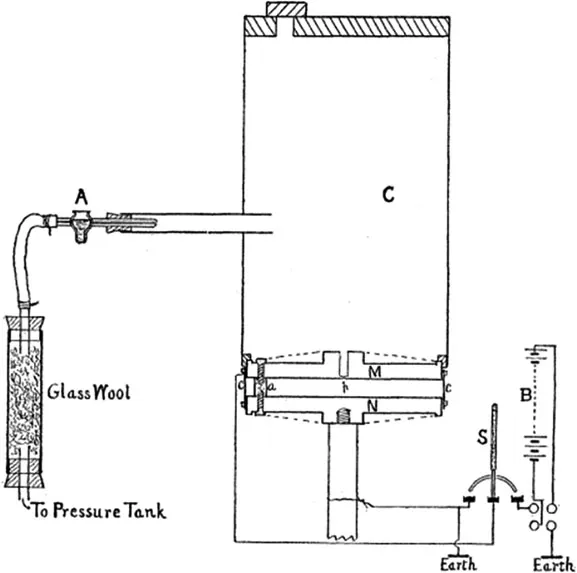
In Millikan’s experiment, he sprayed oil drops into a chamber (C). These drops obtain a charge from the friction of going through the atomizer at (A). These drops fall under gravity through a hole in the plate (M). There is another plate (N) below the first plate, and these are separated by a ring with several windows. One of these windows is used to illuminate the chamber between the two plates, and another window is used to observe the motion of the oil drops.
An electrostatic charge can be applied to the plates. This charge can be varied, and it allowed Millikan to balance the force due to gravity against the electrostatic force and bring the particles to a standstill. It is this balancing of forces that allowed Millikan to determine the charge on an electron. One small detail remains, and that is that the oil drops had a number of charges on them that only sometimes would be due to a single electron. So Millikan observed the motion of particles with multiples of the electron charge. This meant that he had to do many observations and look for the ones that had the least charge on to find the single charge amount.
In our version of the experiment, tiny (1.02 microns across) polymer balls are used instead of oil. We use an equation of motion that balances the forces due to gravity, drag, and the electrostatic. As with Millikan’s version, we get a distribution of the number of charged electrons on our polystyrene balls.
  • Question: What is the volume of a single polymer ball?
  • Question: What is the mass of a single polymer ball given that the density is 1.05 g/ml?
This hand drawing shows the oil atomiser on the left which feeds into the main tank. In this are the two plates to which a potential difference will be applied. There is a hole in the top plate which allows the droplets of oil to pass through. At the right of the drawing is a schematic of the battery which is connected to the plates.
FIGURE 1.1 Millikan’s drawing of his apparatus.

The Objective

To find the charge on a single electron.

The Apparatus

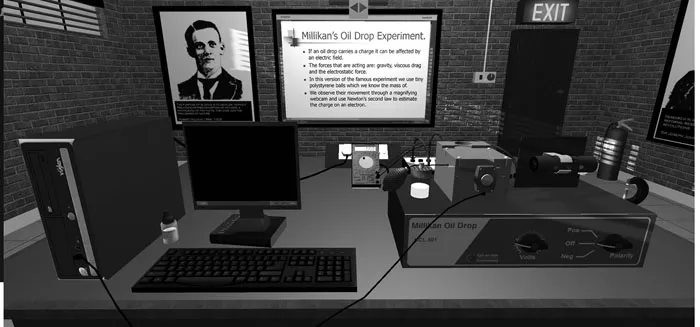
The apparatus is shown in Figure 1.2.
This is a screenshot of the simulation. It shows the main part of the apparatus which includes the chamber on the right. This has voltage and polarity controls. A webcam views the internal part of the chamber between the plates. The webcam is connected to a PC on the left, this displays the view of the camera. The power supply is behind the main part of the apparatus and to the left of this is a meter that records the voltage across the plates.
FIGURE 1.2 View of the experiment’s simulation.
You will need:
  • A high-voltage power supply for the plates with polarity and voltage control
  • A low-voltage power supply for the light bulb
  • An electrostatic chamber
  • A multimeter
  • A bottle of polymer balls
  • A squeeze atomizer
  • A light source
  • A telescope or webcam with reticle
  • A micrometer
The kit can either be sourced in the form shown in Figure 1.2 or assembled from the components listed. The electrostatic chamber is the small box behind the webcam and to the left of the light. In this case, it was supplied as part of the main unit, but it can be sourced as a separate item. It consists of two metal plates held apart by a transparent separation ring. The metal plates are fitted with connectors so that they can be connected to a high-voltage electrical supply. There are three other holes into the internal chamber: one for introducing the particles, one for letting light in so that the particles are illuminated, and one for observing the interior of the chamber.
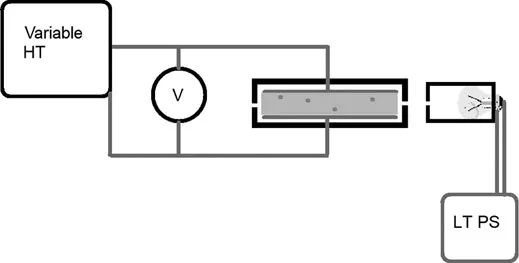
This shows the wiring of the high-tension circuit connected to the plates with a voltmeter connected across the plates, and the low-tension supply connected to the lamp used to illuminate the chamber.
FIGURE 1.3 Schematic of the electrical circuits.
The space between the plates is viewed using a webcam, although it can also be viewed directly by eye through a telescope. This is considerably less convenient due to how easy it is to disturb the equipment. The image is displayed on the screen when the chamber is illuminated, and the webcam is activated. The high- and low-voltage supply is the box behind the chamber. To the right of the chamber, you can see the light source. The low-voltage output is connected to the light. The high-voltage output goes to the box that controls the polarity and voltage. A meter to the left of the power supply indicates the voltage difference between the plates. There are controls on the unit below the chamber for varying the voltage and reversing its polarity.
The atomizer is to the left of the electrostatic chamber and is filled with a solution containing the polymer balls. Squeezing the bulb of the atomizer sends a puff of balls into the chamber.

The Variables

The independent variable is the voltage, and we are going to measure the speed of the polymer particles, which is the dependent variable.

The Physics

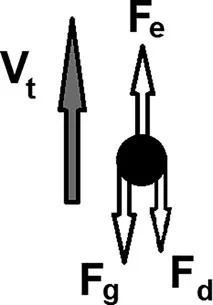
When the polymer particles are moving inside the chamber, they can be considered to be at their terminal velocity. Although for some of the time they are accelerating because they are so light, they reach their terminal velocity almost immediately. Therefore, in all cases we can consider that the forces acting on the particles cancel out; that is, upward forces equal downward forces. We are going to observe the velocities of the polymer balls as they move upwards. In this case:
This shows a schematic of a polymer sphere with the electrical force pulling the sphere upwards and gravity and drag pulling the sphere downwards. An arrow indicates that the velocity of the sphere is upwards.
FIGURE 1.4 The forces acting on a polymer sphere.
Vt is the terminal velocity, which in this case (and the cases we are going to observe) is an upward drift. The upward force on the particle is Fe, the electrostatic force. The downward forces are Fg, the force due to gravity, and Fd, the force due to viscous drag. The forces balance, so we can write:
Fe = Fg + Fd
The electrostatic force is given by:
Fe = qE
Where E is the field, which in this case is simply described as the voltage divided by the distance between th...

Table of contents

  1. Cover
  2. Half Title
  3. Title
  4. Copyright
  5. Dedication
  6. Contents
  7. About the Author
  8. Introduction
  9. 1 Millikan’s Oil Drop Experiment
  10. 2 Planck’s Constant
  11. 3 Rutherford’s Gold Foil Experiment
  12. 4 Measuring the Acceleration Due to Gravity
  13. 5 Average Velocity Using an AirTrack
  14. 6 Determining Acceleration Using an AirTrack
  15. 7 Confirmation of Newton’s Second Law
  16. 8 Showing Conservation of Energy Using an AirTrack
  17. 9 Conservation of Momentum in an Inelastic Collision Using an AirTrack
  18. 10 Hooke’s Law
  19. 11 Young’s Modulus
  20. 12 Velocity of Rifle Shell Using a Ballistic Balance
  21. 13 Simple Pendulum
  22. 14 Simple Harmonic Motion Using a Mass-Spring System
  23. 15 Capacitor Charge and Discharge
  24. 16 The Internal Resistance of a Dry Cell
  25. 17 The IV Characteristics of a Diode
  26. 18 The IV Characteristics of a Filament Lightbulb
  27. 19 The Resistivity of Constantan
  28. 20 Resistors in Series and Parallel
  29. 21 Heat Transfer
  30. 22 Boyle’s Law
  31. 23 Charles’s Law
  32. 24 Mechanical Equivalent of Heat
  33. 25 Specific Heat Capacity of Brass
  34. 26 Investigation of Mechanical Waves
  35. 27 Measuring the Speed of Water Ripples
  36. 28 Infrared Radiation
  37. 29 Diffraction Using a Monochromatic Laser
  38. 30 Inverse Square Law for Gamma Radiation
  39. 31 Refraction of Light
  40. 32 Magnetic Field Due to a Coil of Wire
  41. 33 Investigation of Magnetic Flux of a Current-Carrying Wire
  42. 34 Magnetic Flux Linkage
  43. Appendix 1 Uncertainties
  44. Appendix 2 Using Excel for the Results
  45. Appendix 3 Controlling the Simulations
  46. Index