I, for one, am convinced that the essential role of all the educational actors, through a genuine presence to each other, is to enable the emergence of personal inquiry which contributes to the opening up of our learning space. It also sets in motion the co-actors, the learner and those who accompany that learner toward a place where it is possible to actualize their own potential.... If inquiry is the true sap of the tree of knowledge and learning, the different actors in the educational setting can no longer do without it on their own journey.
eBook - ePub
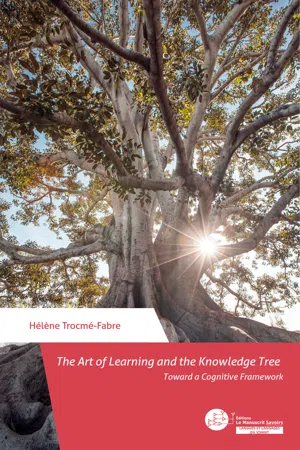
The Art of Learning and the Knowledge Tree. Toward a Cognitive Framework
- English
- ePUB (mobile friendly)
- Available on iOS & Android
eBook - ePub
The Art of Learning and the Knowledge Tree. Toward a Cognitive Framework
About this book
Information
Topic
EducationSubtopic
Classroom ManagementLifelong Learning
The key words of our cognitive life
The major lessons from the evolution of life, from the natural sciences and from systemic thinking enable us to identify ten key words that represent the basic functioning of our brain as a learning structure.
These key words mark the ten stages we pass through when we learn. They are the stages of life that our organism completes in its interaction with the environment, while obeying the three laws of living functioning systems: regulation, adaptation and evolution17. We must not forget that the learners should only be accompanied on their journey toward, and up to the threshold of, a time and space in which they can act autonomously. Our errors as educators, no doubt, stem from our desire to be present for every moment and throughout the journey.
The ten fundamental stages of our cognitive life can be summarized by the following acts: contextualizing, respecting life laws, organizing, creating meaning, choosing, innovating, exchanging, understanding, integrating, and communicating.
These ten stages correspond to basic aptitudes, biographical savoir-faire, or ways of “being” and “doing”, which make up our personal histories, according to the logical order of our “livingness.” Each of them could be developed with numerous practical examples, such as assessments and extensions. Here we only outline them briefly.
Stages of the Journey
The first stage in knowing-how-to-learn is the ability to use our senses, our eyes, our ears, our whole body (our “mind-body”), connecting with the world around us, being able to contextualize: identifying the context in which we find ourselves. The corresponding ability is to “know-how-to-discover.”18 The learning landscape is immense and covers everything that enables us to connect with the physical world: shapes (and their history), colors (and their cultural perception), dimensions, textures, distances, sounds, smells/odors, tastes…, and our ways of associating, relating, nuancing, and combining according to the personal histories and cultures that forge our world views.
At this level, two pitfalls should be avoided: closing oneself off within a restricted, uniform, and therefore reductive field of vision that is symptomatic of poor contextualization or, on the opposite end of the spectrum, being excessively open to a context and therefore incapable of stepping back and distancing oneself from the immediate context.
The second stage, just as important as the first, forms the initial groundwork of knowing-how-to-learn.
This is the ability to recognize the laws of nature, that is to say, to recognize the norms and regularities of the world in which we live19. In other words, it means:
- Knowing how to decipher complexity, our complexity, and that of others and matter.
- Knowing how to recognize the different levels of reality (microscopic, macroscopic, infinite…), thereby knowing how to avoid applying the same code, the same norm, the same tool to different situations or contexts.
- Knowing how to recognize biodiversity in space and over time.
Mistakes often made at this level involve refusing to accept heterogeneity, complexity, the constant quest for balance, and ignoring of the perpetual interplay between “potentialization” (making things possible) and “actualization” (making things actually happen in the here and now).
The third stage is organizational: knowing how to organize, which includes knowing how to compare, classify, select, generalize, code and analyze.
The human brain is an anatomically and biologically selective structure, built to choose, to “stabilize the world”20. It is madness to deprive it of this fundamental aptitude by failing to welcome or develop it through education.
Dysfunction at this level is often related to inadequate organization of complexity. The consequence is a linear, causalist, purely symmetrical conception of reality, a framing of an argument in “either-or” terms whereby we trap ourselves into a perpetual tension between opposites, rather than seeing them as complementary, or better yet, as reciprocal. On the other hand, an excess of organizational know-how may result in extreme organizational patterns, a generalization that is equally as reductive since it negates the diversity of life and its characteristic process of becoming. This is what Flaubert denounced when he criticized the French for their “rage de conclure” (“raging desire to conclude”).
At this point, the learners need to ground themselves in their own personal experience and the knowledge they have gathered. No one can learn for us, understand for us, nor make the connection with what we already know for us. It is up to the learners to generate meaning, a meaning that will allow them to “self-structure” in neurobiological terms.
The Fourth Stage
This new stage is that of knowing how to make meaning, a meaning rooted ...
Table of contents
- Foreword
- Preface to the first edition
- Preface to the second edition
- Preface to the third edition(bilingual edition)
- Introduction
- How the model came to be
- Learning, an interaction
- Lifelong Learning
- Emergence of the act of learning
- Structuring and organizing learning
- Organizing pedagogical guidance and support
- Allowing a space for questions to emerge
- Les ouvrages d’Hélène Trocmé-Fabre
Trusted by 375,005 students
Access to over 1.5 million titles for a fair monthly price.
Study more efficiently using our study tools.
Frequently asked questions
Yes, you can cancel anytime from the Subscription tab in your account settings on the Perlego website. Your subscription will stay active until the end of your current billing period. Learn how to cancel your subscription
No, books cannot be downloaded as external files, such as PDFs, for use outside of Perlego. However, you can download books within the Perlego app for offline reading on mobile or tablet. Learn how to download books offline
Perlego offers two plans: Essential and Complete
- Essential is ideal for learners and professionals who enjoy exploring a wide range of subjects. Access the Essential Library with 800,000+ trusted titles and best-sellers across business, personal growth, and the humanities. Includes unlimited reading time and Standard Read Aloud voice.
- Complete: Perfect for advanced learners and researchers needing full, unrestricted access. Unlock 1.5M+ books across hundreds of subjects, including academic and specialized titles. The Complete Plan also includes advanced features like Premium Read Aloud and Research Assistant.
We are an online textbook subscription service, where you can get access to an entire online library for less than the price of a single book per month. With over 1.5 million books across 990+ topics, we’ve got you covered! Learn about our mission
Look out for the read-aloud symbol on your next book to see if you can listen to it. The read-aloud tool reads text aloud for you, highlighting the text as it is being read. You can pause it, speed it up and slow it down. Learn more about Read Aloud
Yes! You can use the Perlego app on both iOS and Android devices to read anytime, anywhere — even offline. Perfect for commutes or when you’re on the go.
Please note we cannot support devices running on iOS 13 and Android 7 or earlier. Learn more about using the app
Please note we cannot support devices running on iOS 13 and Android 7 or earlier. Learn more about using the app
Yes, you can access The Art of Learning and the Knowledge Tree. Toward a Cognitive Framework by Hélène Trocmé-Fabre in PDF and/or ePUB format, as well as other popular books in Education & Classroom Management. We have over 1.5 million books available in our catalogue for you to explore.