eBook - ePub
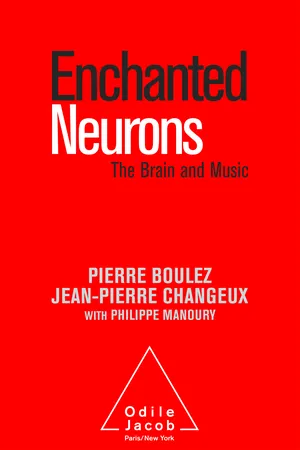
Enchanted Neurons
The Brain and Music
- 256 pages
- English
- ePUB (mobile friendly)
- Available on iOS & Android
eBook - ePub
About this book
What happens in the mind of the creator, the composer, when he creates, is still unknown. It is this "mystery" that this book aims to shed light on. Does artistic creation involve specific intellectual and biological processes? Can we get as close as possible to its mechanism to understand how a composer, a musician, a conductor, chooses to put together this and that note, to make this and that rhythm succeed one another, to bring out something new, to produce beauty, to arouse emotion? Is it possible to understand what happens in the composer's brain when he writes Le Sacre du printemps or Le Marteau sans maître ? Trying to build a neuroscience of art is the challenge of this book, which is the result of a debate between Jean-Pierre Changeux, the neurobiologist, who made the brain the main focus of his research, and Pierre Boulez, the composer, for whom the theoretical questions related to his art, music, have always been essential. A deeply new book. An intellectual event. Conductor, composer, founder of Ircam, Pierre Boulez is one of the greatest creators of the 20th century. Also a music theorist, he held the "Invention, Technique and Language" chair at the Collège de France for nearly twenty years. Honorary professor at the Collège de France, member of the Academy of Sciences, Jean-Pierre Changeux is one of the greatest contemporary neurobiologists. Philippe Manoury is a composer and professor emeritus at the University of California, San Diego.
Information
CHAPTER 1
What is music?
Music and pleasure
Jean-Pierre Changeux: I’ll start with a classic definition of music from the Encyclopedia of Diderot & d’Alembert: “Music is the science of sounds, as they are capable of pleasantly affecting the ear, or the art of arranging and managing sounds in such a way that from their consonance, from their order, and from their relative durations, pleasant sensations are produced.”1 How does that definition strike you? The author, by the way, is Jean-Jacques Rousseau.
Pierre Boulez: It’s the standard eighteenth-century French definition, and I don’t like it at all. It reeks of sentimental hedonism. If you put it to Jean-Sebastian Bach, he’d probably have a good laugh despite the overlap in time. You could say more simply that music is the art of selecting sounds and relating them to each other. Except that by saying that, you haven’t defined music; you’ve described a particular type of artisanal activity. Still, it does allow you to create contrasting points of view: “this sound is musical,” “that sound is noise,” “this combination of sounds is chaotic,” “that combination of sounds is melodic.” The culture in which we are immersed plays a key role in our aesthetic judgments and our artistic sensibilities. Moreover, the same question pops up in other artistic endeavors. Is an installation art, or is it just a more or less sophisticated decoration of a space, like a department store window?
J.-P.C.: I think I see what you’re getting at, but could you elaborate?
P.B.: Think a bit about Rousseau’s definition of music. In Bach’s writing, there really is something other than the pleasure of the sonorities. Of course, this pleasure is certainly sometimes present in diatonic chorales, without tension or distortion, and where the continuous flow dominates. But Bach composed much more dramatic chorales where you find distortions due to chromatisms. And what was it he wanted to do in the Art of Fugue? Hard to say. No doubt he wanted to prove his virtuosity before he died. But here I mean rather virtuosic writing or thinking as opposed to merely virtuosic description or characterization. It’s still hard to say, “Yes, the Art of Fugue pleasantly affects the ear.” If it didn’t pleasantly affect the ear, it wouldn’t be considered a masterpiece among masterpieces!
Philippe Manoury: It’s not even certain that the Art of Fugue does affect the ear pleasantly. At the end of the day, the succession of canons and fugues isn’t all that pleasant. Moreover, perhaps the work wasn’t even composed to be heard uninterrupted, in its entirety.
P.B.: The work was created to be “read” chapter by chapter, but separately (that’s an assumption on my part, as Bach himself wrote nothing about it). Those who have tried to finish his last great fugue have piled up subjects and counter-subjects without managing to add any real value to it. That increases the virtuosity, but not the meaning. The question is just as complex with the Musical Offering, although there we are closer to reality since Bach wrote this set of pieces for three instruments. They are real pieces, so to speak, whereas the Art of Fugue is…unreal! It’s a work written not to be played but to be read. Is the pleasure in the listening, or is it purely intellectual? I’m not so sure. What drove Bach to conceive it? Certainly not Frederick II. Incidentally, Frederick never even reacted to Bach’s Musical Offering, which suggests that he didn’t find it very interesting.
As you see, the Art of Fugue is a work I find problematic, even more so than Beethoven’s late quartets, where you sense that he’s fighting with the material, with the theme, with the instruments. Indeed, there Beethoven is fighting with everything. But it’s a real fight. Whereas the Art of Fugue is perfectly controlled. But to what end?
J.-P.C.: Does any other work in the history of music pose issues similar to ones you mention with respect to the Art of Fugue?
P.B.: No. I cannot think of anything that is even remotely similar.
P.M.: Not even in the twentieth century? I’m thinking about works that are comparably abstract.
P.B.: Webern’s Variations for Piano seems to me to come closest, in the way that Mondrian approaches pure geometry. But even with Webern there are twists and turns. And of course the form, despite everything, remains classical.
P.M.: The border is often blurred between what is judged to be music and what is considered not to be music. Berlioz’s comments on what he had heard of Chinese music at the London World’s Fair in 1851, for example, leave one wondering. He found their songs atrocious, compared them to the yawning of dogs and the screeching of skinned cats, while describing their musical instruments as veritable instruments of torture. Debussy, on the other hand, was quick to note – quite provocatively – that “Javanese music obeys laws of counterpoint which make Palestrina seem like child’s play. And if one listens to it without being prejudiced by one’s European ears, one will find a percussive charm that forces one to admit that our own music is not much more than a barbarous noise more fit for a traveling circus.”2 On that point at least he was absolutely right. Pierre Boulez, surely you remember that the vocalization of Japanese Nō was perceived by Europeans as a series of ugly, disagreeable, and above all nonmusical screeching.
P.B.: I heard French actors in Jean-Louis Barrault’s theater company make these kinds of remarks. When they imitated Japanese actors, it was only to caricature them. They did not understand the dramatic meaning of Nō for the simple reason that they did not know the codes. In the same vein, it is conceivable that Arabic singers might find the vocal virtuosity of Nō actors totally inept.
J.-P.C.: So you’re saying that the Encyclopedia’s definition of music refers more to musical entertainment.
P.B.: Not quite. Even in Rameau there is a lot of light music that isn’t all that pleasant. That’s what is not so good about him. His recitatives are much more dramatic and far more interesting, as are his pieces for harpsichord. I once spent a little time going through the music of the era because I was interested in knowing how it worked. But I must say that I got bored very quickly. There’s a whole side of seventeenth-century French instrumental music that is exasperating. You find exceptions, of course, but in general they are small descriptive pieces – nice, sweet, forgettable.
P.M.: I think that trying to formulate a definition of music, or any art for that matter, is a perilous exercise. Whether we like it or not, we are in thrall to the values and aesthetic norms “in effect” in our times. In 1917, when Duchamp wanted to exhibit a urinal in New York as a work of art, independent of his desire to provoke, he asserted that ideas and concepts prevail over creation; the art object exists from the moment it is dated, signed, and exhibited wherever works of art are exhibited.
P.B.: We made Duchamp a hero for glorifying the urinal. I have to say it leaves me cold. I think we’ve overestimated found objects. Sometimes they are in fact interesting as natural sculptures, but that’s just accidental. Generally, the art is trivial – and the trivial has never shaken many people up.
J.-P.C.: The Encyclopedia’s definition of music hasn’t impressed either of you. Perhaps Diderot’s entry titled “Beautiful” might prove more fruitful for us. He begins, “How is it that almost all men agree that there is a beautiful; that some of them can experience it strongly where it lies, yet so few know what it actually is?” This elusive aspect is still relevant today. Following a lengthy analysis of the past use of the word, Diderot finally introduces his own definition: “I then call beautiful outside of myself, that which contains in itself what can awaken in my understanding the idea of rapports… The perception of rapports is thus the basis of the beautiful.”3 Distinguishing beauty from the pleasant, and without alluding to pleasure, Diderot emphasizes that it is the composition of the work that creates these rapports, pointing out the rule of “consensus partium,” the relationship of the parts to the whole. This is a far cry from the idea that the work of art must simply be pleasing to the eye or to the ear.
P.M.: The idea of art as pleasurable is very problematic, especially today. Would we ask that a play by Shakespeare or Ibsen, a poem by Goethe or Mallarmé, a painting by El Greco or Cézanne be simply pleasing? No, of course not. Isn’t the idea of pleasure associated with that of reward, which you neurobiologists know something about?
J.-P.C.: Reward and pleasure are not synonymous. Rewards may be positive and pleasant, but also negative and unpleasant, entailing pain or suffering. Moreover, both involve different transmitters: dopamine, for example, in the first case and serotonin in the second. Generally speaking, laboratory animals routinely avoid negative rewards. But humans are not laboratory rats; they have a unique repertoire of emotions and feelings that shade and reframe positive and negative rewards. A “negative reward” can be motivating.
Humans possess a great capacity for sympathy and empathy that is part of social life. Francisco de Goya’s Disasters of War and Third of May 1808 affect us profoundly, ev...
Table of contents
- Cover Page
- Title Page
- By The Author
- Copyright Page
- INTRODUCTION
- CHAPTER 1 - What is music?
- CHAPTER 2 - Beauty and the rules of the art: A paradox
- CHAPTER 3 - From the ear to the brain: The physiology of music
- CHAPTER 4 - Darwin on the mind of the composer
- CHAPTER 5 - Conscious and non-conscious musical invention
- CHAPTER 6 - Musical creation and scientific creation
- CHAPTER 7 - Learning music
- Acknowledgments
- Notes
- Contents
Trusted by 375,005 students
Access to over 1.5 million titles for a fair monthly price.
Study more efficiently using our study tools.
Frequently asked questions
Yes, you can cancel anytime from the Subscription tab in your account settings on the Perlego website. Your subscription will stay active until the end of your current billing period. Learn how to cancel your subscription
No, books cannot be downloaded as external files, such as PDFs, for use outside of Perlego. However, you can download books within the Perlego app for offline reading on mobile or tablet. Learn how to download books offline
Perlego offers two plans: Essential and Complete
- Essential is ideal for learners and professionals who enjoy exploring a wide range of subjects. Access the Essential Library with 800,000+ trusted titles and best-sellers across business, personal growth, and the humanities. Includes unlimited reading time and Standard Read Aloud voice.
- Complete: Perfect for advanced learners and researchers needing full, unrestricted access. Unlock 1.5M+ books across hundreds of subjects, including academic and specialized titles. The Complete Plan also includes advanced features like Premium Read Aloud and Research Assistant.
We are an online textbook subscription service, where you can get access to an entire online library for less than the price of a single book per month. With over 1.5 million books across 990+ topics, we’ve got you covered! Learn about our mission
Look out for the read-aloud symbol on your next book to see if you can listen to it. The read-aloud tool reads text aloud for you, highlighting the text as it is being read. You can pause it, speed it up and slow it down. Learn more about Read Aloud
Yes! You can use the Perlego app on both iOS and Android devices to read anytime, anywhere — even offline. Perfect for commutes or when you’re on the go.
Please note we cannot support devices running on iOS 13 and Android 7 or earlier. Learn more about using the app
Please note we cannot support devices running on iOS 13 and Android 7 or earlier. Learn more about using the app
Yes, you can access Enchanted Neurons by Pierre Boulez,Jean-Pierre Changeux,Philippe Manoury in PDF and/or ePUB format, as well as other popular books in Biological Sciences & Neuroscience. We have over 1.5 million books available in our catalogue for you to explore.