- 288 pages
- English
- ePUB (mobile friendly)
- Available on iOS & Android
eBook - ePub
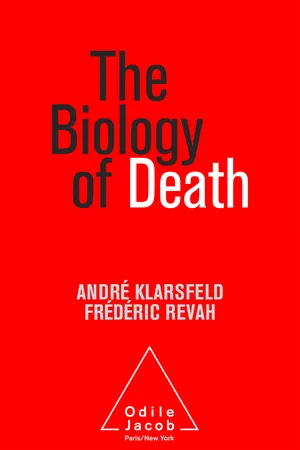
The Biology of Death
About this book
Why are most living creatures condemned to die "naturally" even when they have a favourable and protected environment? Is death a "useful" biological process or does it not correspond to any natural necessity? Biology has only recently begun to address these issues. However, today it provides a coherent and rigorous framework for interpreting death, its existence as mechanisms at the very heart of life. André Klarsfeld and Frédéric Revah take stock of all this research, which overturns many preconceived ideas on a subject that has haunted humanity since the beginning. André Klarsfeld is a neurobiologist and researcher at the Alfred-Fessard Institute of the CNRS in Gif-sur-Yvette. Frédéric Revah is a neurobiologist by training. He was a member of the Institut Pasteur and held positions of responsibility in the pharmaceutical industry. He is now a scientific director in a biotechnology company.
Information
CHAPTER ONE
The biology of death: A Brief History
The fact that death is often feared, like a monster we dare not look at square on, is undoubtedly one of the reasons for the ignorance of science in this area.
Elie METCHNIKOFF
There is a “radical difference between physics and biology,” according to the philosopher Georges Canguilhem: “Illness and death in the living who have created physics, sometimes risking their lives, are not problems of physics. Illness and death of living physicists and biologists are problems of biology.”1 What subject could be more emotionally loaded than death?
Long considered a divine malediction or punishment, death seemed alien to living things. It was imposed on life, which was originally capable of eternity. Authors of classical antiquity, such as Aristotle, said it clearly: Lacking immortality, a privilege the gods have reserved for themselves, humans can perpetuate through their descendents. Reproduction is a means of escaping death to a certain extent, of communing with the gods.
Of the two boundary experiences of human life—namely reproduction and death—it is on the latter that the founding myths are based. Death, then, is excluded from a naturalist approach. This result is not surprising. Death, especially violent death, is observed almost immediately. The sudden disappearance of a loved one induces people to reflect on the meaning of life, much more than on the immediate or distant causes of death. In antiquity, there was little interest in studying the longevity of living species, although that period produced very detailed, and sometimes fanciful, descriptions of methods of reproduction.2 Nothing was too astonishing, nothing too marvelous, when it came to the engendering of the living, which indeed assumes extraordinarily diverse forms. After all, the relationship between the sexual act and the birth of a child is not obvious, and raises many questions. The mystery of death, on the other hand, is not so much death itself, which is inevitably commonplace, but its effect on the individual, for no one can report on the full experience.
The development of naturalism, in the eighteenth century, moved away from the view of ancient times by searching for a more rational justification for this imposed death which, of course, like all of creation, was still considered the fruit of divine will. Carl Linnaeus, the founder of biological classification systems, and his students provided the first and most complete attempt at rationalizing death. The son of a Swedish pastor, Linnaeus showed an early taste for botany, which led him to spend time studying plants at the expense of his schooling. Deemed unfit for serious studies, he became a cobbler’s apprentice. Fortunately, he was later led into science by a local doctor who recognized his talent. According to Linnaeus, divine wisdom imposed a natural order, which was based on four related phenomena: propagation, geographic distribution, destruction, and preservation. Simple calculations showed that “even one plant, if left unchecked by animals, could cover and envelop our entire globe”3 in a short time. This possibility, he reasoned, is why the “Sovereign Moderator” created predators, which “help… preserve a just proportion among all the species, thus preventing them from multiplying excessively to the detriment of man and animals.”4 Although “at first glance, we do not really admire the butchery and the horrible War of All against All,”5 Linnaeus posited that all scourges—including contagious diseases, aging, even war itself—were created by God for the greater good of all living things, since there must be a balance between births and deaths. Prey was not created for the predator; on the contrary, the predator works in the service of the prey by preserving a just proportion in the balance of nature. Without this, prey would be doomed to suffer famine—or even worse, it would eliminate other species by invading the planet.
According to the Linnaean school of thought, nothing was left to chance in the economy of nature, not even aesthetics: “So that fallen and dead trees do not remain useless to the Universe and no longer present such a sad sight, nature accelerates their destruction in a singular fashion…. How industriously nature works to destroy a single trunk!” Is it not admirable, for example, that: “the woodpecker, by pecking at rotten trees in search of insect larva, hastens their destruction so that they do not spoil the view for too long.” The agents of destruction also had their role for the common good of all creation. If we were unable to fathom the utility of divine works, Linnaeus reasoned, it was only through ignorance of the designs that inspired them. God did not create anything in vain, even death.
The French naturalist Georges Louis Leclerc, Count of Buffon, contested the classification system proposed by Linnaeus, his exact contemporary. (They were both born in 1707.) Nor did he share Linnaeus’s intransigent finalism. Buffon’s ideas had a much more modern-day resonance when he admitted that nature is not exempt from mistakes—that it “tinkers,” to use the term of François Jacob. But he proposed roughly the same ideas as Linnaeus on the fundamental balance of nature. Through the endless game of reproduction and death, Buffon reasoned, “the total quantity of life is always the same, and death, though it seems to destroy everything… does no harm to nature, which only shines the brighter. Nature does not allow death to annihilate species, but instead shows itself to be independent of death and of time by allowing individuals to be cut down and destroyed.”
In any case, death did not occupy a preeminent position with respect to reproduction, as it did in ancient times. The two were considered equal—essential features of the living, and in permanent opposition and balance. Thus, death was no longer deemed an original, immutable center around which life organized itself as best it could. The “Copernicization” of death was underway.
Opposition and complicated balance were also present in the vitalistic conceptions that were in vogue at the beginning of the Age of Enlightenment. According to the vitalists, living beings owed their existence, and especially their survival, to the action of a “vital principle” that constantly struggled against physical properties. Physical properties were equated to forces of death. In living bodies, vital laws had to be present in order to oppose physical laws. Life was defined as a negation, a force that defied physical laws. No one expressed this principle better than the great anatomist Xavier Bichat, who founded the study of living tissues, or histology. At the very beginning of his Physiological Research on Life and Death, published in 1800,6 Bichat coined the inescapable phrase that is still included in the definition of “Life” in most French dictionaries: “Life is the ensemble of functions that resist death.”7 The final outcome of the combat is played out in advance, because “it is the nature of vital properties to wear out.”
It was the very year of Bichat’s death, in 1802 (he was only thirty years old), that the word biology made its first appearance, penned by Jean-Baptiste de Monet, chevalier de Lamarck. He made a distinction between organic, “necessarily doomed to death,” and inorganic, which was immortal since it was not alive. The temporal finiteness of organisms was even considered a primordial characteristic: “A living body is a natural body limited in its duration, organized in its parts… possessing what we call life, and necessarily doomed to lose it, that is, to suffer death, which is the end of its existence.”8
We shouldn’t think, however, that Lamarck and Bichat agreed about the status of death, though both considered it a programmed part of life. Lamarck rejected vitalism: “Nothing is more unlikely, and in fact, is less proven, than this supposed ability that one attributes to living bodies to resist the forces to which all other bodies are subjected.”9 He believed that living matter and raw matter were governed by the same physical laws. If these laws produced extremely particular results when applied to living matter, it was because of the extremely parti...
Table of contents
- Cover Page
- Title Page
- Copyright Page
- Dedication Page
- Acknowledgments
- Prologue
- Chapter one - The biology of death: A Brief History
- Chapter two - The difficult measure of biological time
- Chapter three - Aging and longevity across the species
- Chapter four - What's the point of dying?
- Chapter five - In search of the fundamental mechanisms
- Chapter six - Programmed death that benefits life
- Chapter seven - The dangers of programmed cell death gone awry
- Chapter eight - Delaying death
- Conclusion
- Glossary
- Bibliography
- Index
- Contents
Trusted by 375,005 students
Access to over 1.5 million titles for a fair monthly price.
Study more efficiently using our study tools.
Frequently asked questions
Yes, you can cancel anytime from the Subscription tab in your account settings on the Perlego website. Your subscription will stay active until the end of your current billing period. Learn how to cancel your subscription
No, books cannot be downloaded as external files, such as PDFs, for use outside of Perlego. However, you can download books within the Perlego app for offline reading on mobile or tablet. Learn how to download books offline
Perlego offers two plans: Essential and Complete
- Essential is ideal for learners and professionals who enjoy exploring a wide range of subjects. Access the Essential Library with 800,000+ trusted titles and best-sellers across business, personal growth, and the humanities. Includes unlimited reading time and Standard Read Aloud voice.
- Complete: Perfect for advanced learners and researchers needing full, unrestricted access. Unlock 1.5M+ books across hundreds of subjects, including academic and specialized titles. The Complete Plan also includes advanced features like Premium Read Aloud and Research Assistant.
We are an online textbook subscription service, where you can get access to an entire online library for less than the price of a single book per month. With over 1.5 million books across 990+ topics, we’ve got you covered! Learn about our mission
Look out for the read-aloud symbol on your next book to see if you can listen to it. The read-aloud tool reads text aloud for you, highlighting the text as it is being read. You can pause it, speed it up and slow it down. Learn more about Read Aloud
Yes! You can use the Perlego app on both iOS and Android devices to read anytime, anywhere — even offline. Perfect for commutes or when you’re on the go.
Please note we cannot support devices running on iOS 13 and Android 7 or earlier. Learn more about using the app
Please note we cannot support devices running on iOS 13 and Android 7 or earlier. Learn more about using the app
Yes, you can access The Biology of Death by André Klarsfeld,Frédéric Revah in PDF and/or ePUB format, as well as other popular books in Biological Sciences & Biology. We have over 1.5 million books available in our catalogue for you to explore.