- English
- ePUB (mobile friendly)
- Available on iOS & Android
eBook - ePub
About this book
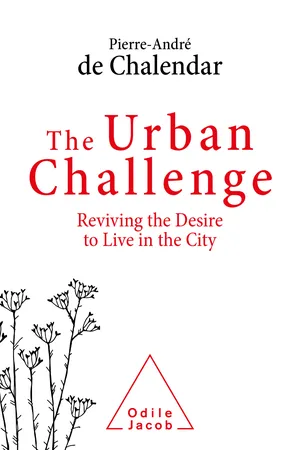
Once the seductive symbol of sophistication and unlimited possibility, the city has become synonymous in our imagination with sprawl, stress, pollution—even the propagation of disease. How do we reawaken the attraction humanity has so long felt toward these centers of trade, knowledge, and cultural exchange? And what must we do to make the city hospitable to both its inhabitants and the natural environment? The work of a business leader and world traveler rather than an urbanist, The Urban Challenge is a passionate argument for a redefined city model that favors sustainability and inclusion: a place where man and nature are no longer in conflict, and where the hallmarks of urban life, from mobility to housing, provide us with comfort, well-being, and innovative ways of living better together. Pierre-André de Chalendar is chairman and CEO of the Saint-Gobain Group, which he has transformed into a leader in urban housing renovation and sustainable construction. He is also the author of a previous book on climate and decarbonization, Our Fight for the Climate: A Carbon-Free and Growing World Is Possible (Le Passeur, 2015). "Cities are our most vibrant cultural and economic centers, but today they face an array of complex issues. The Urban Challenge helps us imagine how they can change and grow—and become greener, healthier, and more prosperous places for all." Michael Bloomberg, founder of Bloomberg LP and Bloomberg Philanthropies, and former Mayor of New York City.
Information
CHAPTER 1
All the lights in the world
Cities with deserted streets, emptied of all human presence. A view of the end of the world, evoking science fiction films in which human beings are brutally erased from the surface of the Earth by some mysterious catastrophe. Between March and May 2020, and with a mixture of amazement and disbelief, we all watched these live images, filmed in Paris, London, Rome, Barcelona, Munich, Berlin, Jerusalem, New York, Calcutta, La Paz, San Francisco, and Wuhan, to name but a few. No matter how hard we search, we can find no precedent for this singular situation—except perhaps in Paris on June 14, 1940, when Nazi troops entered a city empty of its two million inhabitants (though on that day the bookstalls on the banks of the Seine remained open). Even if they revealed their beauty and the richness of their historical and monumental heritage, these ghost towns, surrounded by highways and empty airports, expressed their fragility in the face of an invisible enemy. Colossi with feet of clay against the pandemic. They also revealed the extent to which their role in the economic, social, and cultural life of our societies was predominant. Certainly, as we will see later, COVID-19 is not the only disease to have confronted great cities. But, even more than in the past, the dominance of the urban model in today’s world exposes it to the risk of paralyzing the entire economy when a great city is unable to function normally. Hence the current debates questioning the future of the city, because the epidemic revealed not only a health issue but also all the fractures that can weaken urban societies.
Uruk, the legendary city of Mesopotamia
When I began writing this book, I had not planned to delve into the history of cities; this subject has been explored many times by professional historians. My subject is the city of today and tomorrow—but a city is not an industrial product, one that begins on a drawing board and comes out of the factory looking handsome and new. Indeed, I couldn’t imagine the city of tomorrow without taking a closer look at the city of yesterday—and even the day before yesterday, especially since I’ve always loved history. So I asked myself a very simple question: when and why did humans feel the need to gather in large numbers and build cities? Remembering my history and geography classes, I realized that almost everything in them centered around cities. Some notable cities have ruled empires, like Rome, Lisbon, Madrid, and Vienna. Others have ruled world trade, like Venice, Amsterdam, and Hamburg. Still others were the result of the political will of a sovereign, a desire to leave in history the indelible trace of his reign, like St. Petersburg. Finally, other cities, such as Florence or Paris, have been symbols of artistic creation and intelligence. But which city appeared first—and why at that particular time and place?
In a fascinating book, Metropolis,1 the British essayist Ben Wilson answers these questions by evoking the legendary city of Uruk, formed in 5000 BC, which was, before even the biblical sites, the first real city in the world and which remained the most populated for at least a millennium. Situated in ancient Mesopotamia, between the Tigris and Euphrates rivers, it consecrated the golden age of Mesopotamian civilization. Historians have long wondered why the inhabitants of this region gathered in this location. The climatic conditions were not very favorable; the rains were rare, and the land was dry. But it was precisely these difficulties that pushed human beings to collaborate in digging canals, irrigating the arid land, and, triumphing over adversity in an effort to gain the protection of their deities. Agriculture, the breeding of cattle, the building of temples, and the pooling of labor were the key elements that contributed to the founding of Uruk, which in its splendor was surrounded by a high wall and moats fed from the waters of the Euphrates. The town was made up of a network of narrow, interconnecting streets lined with houses opening onto interior gardens, populated by several tens of thousands of inhabitants as well as free-roaming elephants, buffaloes, donkeys, goats, dogs, and ibexes.
The site was rediscovered in the middle of the nineteenth century by an English geologist. Archaeologists subsequently discovered that around 3000 BC Uruk extended over 230 hectares, that the arts flourished there, and that the city was dominated by a group of monumental temples. Wilson also explains that it is in Uruk that the oldest written tablets from Mesopotamia were discovered, accrediting both the legend that writing was invented there and the thesis that invention can be born only of a gathering of humans, eager to communicate and exchange ideas with each other. In one of the oldest texts of ancient literature, The Epic of Gilgamesh (probably written circa 2100 BC), there is reference to a legendary hero of the Sumerian period, Enkidu, a wild man who lives in harmony with nature, in the company of wild animals—until he meets a young woman, Shamat, who is bathing in a pond. She attracts him to Uruk after describing the thousand and one wonders of the city, where the inhabitants are richly dressed, dance, share sumptuous meals, drink beer; where one can meet the most beautiful women and see the finest works of art. I was surprised that already, in this early period of human history, the opposition between nature and the city was clear. Enkidu symbolizes the primitive state of mankind in all its harshness, but also the freedom of natural life. Shamat embodies the sophistication and seduction of urban culture, which alone allows humans to surpass themselves, to express their talents and powers. The wild man is thus civilized by contact with the city, though he remains in danger of being corrupted and seduced—the corrupting city is thus an idea as old as the world, or almost. This story, which mixes and opposes nature and city, foretells those of the Bible, written somewhat later. Indeed, the Bible begins with a description of the Garden of Eden, and the cities of the book of Genesis, whether Babel or Sodom, evoke the dark sides of urbanization and human settlements. By contrast, the New Testament finishes at the end of the Book of Revelation with the description of Jerusalem on High, the heavenly city, the ultimate human destiny under the figure of a city where the whole of humanity is assembled in love and participates in fullness in the life of God.
From Byblos to Carthage, the empire of the Phoenicians and then the Romans
In the meantime, while taking a broad look at the evolution of urban civilization, I was struck by the importance of the economy and commercial exchanges in the formation and development of cities, an idea that interests me greatly as a business leader. This explains the emergence of the great stock of seafarers and entrepreneurs that the Phoenicians produced during the first millennium BC. From their homeland (present-day Lebanon), they established a series of maritime cities all around the Mediterranean, from Byblos to Carthage, from the west coast of Morocco to Cadiz and Lisbon, exchanging olive oil, perfumes, fabrics, silver, gold, copper, and ivory—even as far as Babylon and Nineveh. Phoenician sailors ventured far out into the Atlantic Ocean to capture cargoes of murex, the carnivorous marine gastropods from which they extracted a dye—“Tyre purple,” the color of royalty—for the high priests of Babylon and the other great cities of the region. In their pursuit of this sea animal, which had to be caught in large quantities, the Phoenicians created designs for cities along the Atlantic coast.
Following this, in the wake of the Phoenicians, large ports were developed around the Mediterranean: Athens, Alexandria, and Byblos. The city then became an economic center, a hub of the most diverse transactions; it learned cosmopolitanism, and writing became a tool for exchange. Several centuries before our era, the Greeks laid the foundations for a network of cities in the Aegean Sea, Asia Minor, and as far as the French coast, where they settled with a Ligurian tribe to found what is today the city of Marseille. Etruscan merchants then began to build their own cities in the Po Valley and Tuscany. A little further south, on the banks of the Tiber, a Latin-speaking group, living in huts on Mount Palatine, drained the marshes and began to build a city they called Rome. This city, writes Wilson, “was the result of ideas that arrived by ship from across the Mediterranean.” I remember from my high school days that Greek civilization spread throughout southern Europe thanks to a vast constellation of nearly a thousand cities perched on the coasts and islands of the Mediterranean—“like frogs around a pond,” as Plato put it. These cities were open to foreign influences from Asia, Egypt, Mesopotamia, Persia, favoring the spread of new theories in navigation, astronomy, medicine, and philosophy. The administration of these cities gave rise to the formulation of a true political philosophy, which the Greeks called polis—a concept proposing the bases for the political, religious, military, and economic organization of the free citizens forming these new urban communities.
This philosophy deeply marked Western thought for centuries. I know the city of Washington, D.C. quite well and learned there that many of its buildings resemble Greek or Roman temples because James Madison, fourth president of the United States (1809–1817), wanted the architecture of the capital to recall the force and influence of the ancient cities. Madison elaborated the main principles of the American Constitution (through the Federalist Papers, published between 1787 and 1788), influenced by his studies of the ancient republics and confederations of Rome (of course), but also the Amphictyonic League of Delphi (in the sixth century BC) and the Lycian Confederation in Asia Minor, which had developed the proportional voting system.
With a few exceptions, I have noticed that the genealogy of cities, especially in Europe, is very old. They were almost all born under the Roman Empire—obviously not just by chance. In Gaul, in Germania, and in England, it was the desire of the elite among the conquered peoples to adopt a more sophisticated way of life, to access the Latin concept of cultus (synonymous with refinement and sophistication) and break with the vulgarity of the rusticitas—leading to the creation of cities. The Roman Empire was also made up of a network of cities, military and administrative centers built on the Mediterranean model and linked together by roads and bridges. In Gaul, the Via Agrippa linked Arles to Boulogne-Sur-Mer via Lyon and Amiens; the Via Domitia linked Spain and Narbonne to Briançon. In England, Germania, Spain, and the Balkans, proper road networks connected the main urban centers of the Empire. The Gallo-Roman Lutetia (now Paris) had nearly ten thousand inhabitants, concentrated on the Île de la Cité and the left bank of the Seine. Wealthy families lived in villas built on the Roman model, the city boasted an amphitheater, thermal baths, and a forum (on the present-day Montagne Sainte-Geneviève); it owes its economic expansion to the corporation of the Nautes, who ruled over river traffic (as represented on the capital’s coat of arms). Londinium, founded in 43 AD after the invasion of England by Emperor Claudius, quickly became an important center of trade with the Roman provinces of the continent—“enormously frequented by merchants and merchant ships,” as Tacitus writes in his Annals.
The golden age of the Hanseatic League
It was largely on this network of road infrastructures and merchant cities that the great cities of the Middle Ages were developed and where a first wave of urbanization took place. In the thirteenth century, Paris was the largest city in the Christian West, with more than two hundred thousand inhabitants. A new urban population grew up around the cathedrals and castles, whose construction brought thousands of workers into the city alongside the emergence of a new class of bourgeois encouraged by the economic boom and the development of trade guilds. Such expansion of population pushed back the old city limits and thus, between the eleventh and twelfth centuries, Paris was equipped with three walled enclosures before Louis XIII built a fourth during the Thirty Years War (1618–1648).
The city and its economy, the urban center and its productive activities, are deeply intertwined. If cities develop, it is because they become true economic and commercial centers, serving religious and political needs as well. If we look briefly at the economic history of cities, we discover that this relationship was consolidated beginning with the formation of trade guilds in the twelfth and thirteenth centuries, probably distant heirs of Gallo-Roman professional organizations. The Parisian guilds for water merchants in 1121 and for butchers in 1162, and the drapers’ guild in Valenciennes in 1167, were among the first to appear. And from the twelfth century onward, the authority and activities of these guilds were codified to form a set of regulations whose essential provisions prevailed until 1791. This period was marked by a strong growth in activity, and thus by the development of cities; the agricultural age was gradually replaced by the age of urban civilization and industry, in which town halls and market halls were built. This was also the time when the Hanseatic League was founded and trade between Germany and northern Italy intensified. Craftsmen grouped together, often in the same district as parishioners of the same church. The erection of great architectural works, such as cathedrals, favored the development and organization of trades. In Strasbourg, the masons who built the cathedral founded confraternities that were both spiritual and professional. The cathedrals of Noyon, Laon, Senlis, Saint-Gervais de Soissons, and Notre-Dame de Chartres were all part of the same movement. It was this entrepreneurial freedom that developed in the cities, as much as the creative spirit of the craftsmen that nourished the guilds. From the twelfth century onward in the industrial and commercial towns of Northern France, such as Cambrai, Noyon, Laon, and Saint-Quentin, corporations (guilds, town councils, and other institutions) became the basis of municipal life, in which members were bound by a series of principles, customs, and obligations.
This phenomenon could be observed everywhere in Europe. During the twelfth century, under the Teutonic Knights fueled by a fever for conquest of new territories, the northern city of Lübeck (founded at the end of the 1150s) gave birth to a vast urban expansion toward the Slavic lands of Eastern Europe, resulting in the creation of several hundred cities over barely two centuries. But Lübeck and other cities in this region, such as Hamburg, were not only trading centers but also defenders of a new “free” urban class that chose to govern itself away from the grip of princes and the church. In 1226, Lübeck became a free imperial city, governed by a council of twenty members appointed by the merchant guilds and nominating four mayors who for centuries were considered leading political figures in Europe. Together with Hamburg (also a free city) and Bremen, Lübeck formed the Hanseatic League, an association of merchant cities that ruled over territories that today form the Baltic States, Scandinavia, Germany, and Poland. Their influence extended over the whole of political and economic Europe until the eighteenth century, and they still play an essential role in the European economies today.
I am not forgetting Venice—a city dear to the hearts of the French—which is a perfect illustration of this city-state concept. In the twelfth century, with more than a hundred thousand inhabitants, it was one of the largest cities in the West, with a unique political organization in the “Republic of Venice,” named in keeping with Plato’s ideal of the Republic. As early as 1310, the city was governed by a “Council of Ten” representing the city’s oligarchy, which elected a doge for life. Less “democratic” than that of the Hanseatic cities, Venice’s system of government allowed it to extend its economic influence over a large part of Europe, and also to the Byzantine Empire, the Black Sea, Central Asia—and even China. This republican independence did not end until 1796 with the invasion of the city by Bonaparte’s troops. More than any other European city, Venice was the symbol, for several centuries, of a triple influence: commercial, political, and cultural.
As times progressed, great discoveries further accelerated the enrichment of European cities. At the end of the fifteenth century, the eyes of the whole of Europe were turned toward Lisbon, a cosmopolitan city upon which merchants converged from all over the continent, especially the Germans and the Dutch. It was the most exotic city in Europe at the time, open to the great merchant cities of Asia (in 1500, seven of the largest cities in the world were located on the Asian continent), but also to Africa—and soon to America. The cartographers of the time held “the upper hand,” as Erik Orsenna recounts so well,2 and their maps of the new world were sold at a high price when they were not jealously guarded by the sovereign.
What does this first phase of the urbanization of Europe tell us? Above all, I draw this lesson: the urban phenomenon responds to a deep desire for humanity. It was this desire that pushed the young Enkidu into the arms of Uruk, the legendary city of Mesopotamia. It was this same desire that presided over the foundation of the ancient cities, the merchant cities of the Middle Ages, and the royal cities of the following centuries. This desire is of several orders. First of all, it is linked to the appetite for enrichment, for it is in cities that economic wealth is created. But it is also a desire for encounters, knowledge, acquisition of skills, exchange of ideas. It is also a desire for freedom, because being in the city is an escape from serfdom that allows a certain liberty of thought and opinion. The history of Paris is quite singula...
Table of contents
- Cover Page
- Title Page
- Copyright Page
- Dedication Page
- Introduction
- CHAPTER 1 - All the lights in the world
- CHAPTER 2 - At the heart of the world's contradictions
- CHAPTER 3 - Leaving the city?
- CHAPTER 4 - Making the desirable city
- CHAPTER 5 - How smart can the city be?
- CHAPTER 6 - Rebuilding the city on the city - The burning obligation to renovate
- CHAPTER 7 - Mobilizing all technologies to rebuild a sustainable city
- CONCLUSION - Dreaming tomorrow's city and bringing it to life
- Acknowledgments
- Contents
Trusted by 375,005 students
Access to over 1.5 million titles for a fair monthly price.
Study more efficiently using our study tools.
Frequently asked questions
Yes, you can cancel anytime from the Subscription tab in your account settings on the Perlego website. Your subscription will stay active until the end of your current billing period. Learn how to cancel your subscription
No, books cannot be downloaded as external files, such as PDFs, for use outside of Perlego. However, you can download books within the Perlego app for offline reading on mobile or tablet. Learn how to download books offline
Perlego offers two plans: Essential and Complete
- Essential is ideal for learners and professionals who enjoy exploring a wide range of subjects. Access the Essential Library with 800,000+ trusted titles and best-sellers across business, personal growth, and the humanities. Includes unlimited reading time and Standard Read Aloud voice.
- Complete: Perfect for advanced learners and researchers needing full, unrestricted access. Unlock 1.5M+ books across hundreds of subjects, including academic and specialized titles. The Complete Plan also includes advanced features like Premium Read Aloud and Research Assistant.
We are an online textbook subscription service, where you can get access to an entire online library for less than the price of a single book per month. With over 1.5 million books across 990+ topics, we’ve got you covered! Learn about our mission
Look out for the read-aloud symbol on your next book to see if you can listen to it. The read-aloud tool reads text aloud for you, highlighting the text as it is being read. You can pause it, speed it up and slow it down. Learn more about Read Aloud
Yes! You can use the Perlego app on both iOS and Android devices to read anytime, anywhere — even offline. Perfect for commutes or when you’re on the go.
Please note we cannot support devices running on iOS 13 and Android 7 or earlier. Learn more about using the app
Please note we cannot support devices running on iOS 13 and Android 7 or earlier. Learn more about using the app
Yes, you can access The Urban Challenge by Pierre-André de Chalendar in PDF and/or ePUB format, as well as other popular books in Social Sciences & Human Geography. We have over 1.5 million books available in our catalogue for you to explore.