eBook - ePub
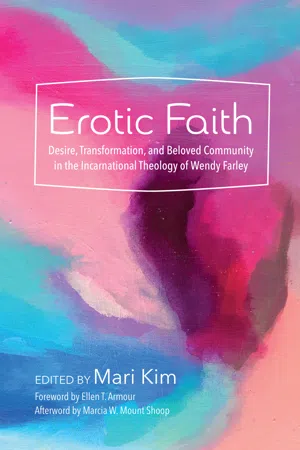
Erotic Faith
Desire, Transformation, and Beloved Community In the Incarnational Theology of Wendy Farley
- 258 pages
- English
- ePUB (mobile friendly)
- Available on iOS & Android
eBook - ePub
Erotic Faith
Desire, Transformation, and Beloved Community In the Incarnational Theology of Wendy Farley
About this book
The thought of contemporary North American theologian and ethicist Wendy Farley is an unflinching clarion call to justice and compassion. Farley invites us to discover ways of embodying the deep compassion capable of resisting pernicious distortions and traumatizing injustices that harm and dehumanize us all. This volume of essays embodies her invitation to awaken as beloved community. And when we are overwhelmed by the magnitude of struggle and despair, Farley reminds us that the powerful longing of hope, at times against all evidence, refuses to give up on seeking justice and wholeness. Compassionate justice, radical hospitality, creative liberation, and deep listening emerge as more than ethical values for Farley; they are expressions of erotic faith, a praxis of faithfulness born of divine desire.
These writings explore transformative perspectives and practices that have the capacity to help us recover and author our identity as the "god-bearers" we are. Erotic faith embodies the love-seeking persistence of divine faithfulness necessary to transform us from within; it meets the truth of human harm, vulnerability, and suffering by offering a complex, struggling, unscripted creativity capable of remaking us, and our world, until the beloved community is whole.
Information
Topic
Theology & ReligionSubtopic
Christian Theologyone
Gathering Victims, Allowing No Villains: The Challenge of Wendy Farley’s Theology
Wendy Farley’s works always make me cry. I read Tragic Vision and Divine Compassion in the year after I was raped.26 The urge to take seriously the compassionate presence of God was illumined for me then and became entrenched in my core understanding of the gospel. Even if my theology changes with the encounter of new experiences, deeper spirituality, and greater conflict, I remain convinced that I will center myself on the kind of present God that expresses itself as Emmanuel: God with us.
I needed go no further than the preface of The Wounding and Healing of Desire to admire the depths from which Farley writes, the challenges she mitigates, and the courage of her confessional witness.27 In the days when parts of my life align with the experiences she recounts, I am not only assured that desire itself is meaningful, but that there may be theological value in the depths of paralysis. I cannot name where my tears began in Gathering Those Driven Away.28 I suspect it is in the sheer beauty of how Farley constructs theology. Here is one example. Nearly a decade ago, Karen Torjesen and I were talking about Origen and Augustine when she made what might have seemed like a throwaway comment: “Heresy is the shadow-side of orthodoxy.”29
That orthodoxy is constructed from a negation of the other seems clear. That heresy is dragged alongside it was revelatory to me. I embrace the proposition that heretics are as Christian as the rest, losing less because of theological inadequacies and more by the political power struggles of their day. I love that heresy is not hard to find; that it hides around the corner, in hushed arbors, and in house churches and theology pubs; that it asserts itself in the daily lives of individuals and communities. In Gathering, Farley not only considers so-called heretics—the losers and victims of Christendom’s past—alongside thinkers accepted in the Western Christian scholarly tradition, she also reveals the sinister acts by which they were deemed heretics in the first place. In so doing, she gathers in those who were driven away, modeling her thesis with her method.
Farley also exhibits a radical engagement for the Western Christian tradition, despite its exclusionary traits. As she moves in and through various thinkers, calling forth the teachings that gather people in, she does so with a compassionate heart for all. For instance, the average feminist religious scholar would see it as shameful to affirm an atonement theory of salvation. With the multitude of convincing work on their deficits, atonement theories have become the persona non grata in feminist theological spheres. Yet Farley is able to see the divine even there: “Perhaps the idea of atonement, as well as serving to justify suffering and uphold patriarchal structures, also speaks to the delusions of guilt and punishment in ways that bring news of a gracious love. We might cling to this imaginary love until we are strong enough to accept the reality of an infinite tenderness that had never let us go.”30 How easy it is for us theologians and people of faith to become so emboldened by our convictions that we are unable, unwilling, or blinded to the value of what grasps others in theories we may personally eschew. Here, Farley’s own scholarly compassion mirrors the divine compassion she purports and also serves as a characteristic of good constructive theology. As one weaves together a courageous and emboldened view of our most liberative, inclusive life with the divine, it is easy to highlight the shortcomings of others without compassionately recognizing the deep motivations of perspectives we might never embrace.
In a marketplace where ideas are readily commodified and codified, Gathering Those Driven Away defies easy classification. While this may be a result of negotiating savvy and embodiment, I believe that it is the result of an amazing range of conversation partners. While the theology in Gathering gains its fortitude from Irenaeus, Marguerite Porete, Pelagius, the mindfulness of Buddhism, the practice of mothering, liberationists, postcolonialists, and faithful engagement with the Bible (to name just a few), the work manages to exhibit the characteristics of them all. It is feminist, liberation, classical, heretical, comparative, queer, poetic, embodied, concerned, joyful, and mysterious. By conversing in print with those who have been driven away and those who are concerned with those who are driven away, Gathering brings forth the multiplicity of the voices that sing the same song of joyful concern (or, more aptly, “concerned joy”) in our world. Taking them into her own theology, incorporating rather than transcending, Farley calls us towards a theological position that fits poorly in the names wherein many of us find our homes.
But I still suspect that it is not this beauty that evokes my tears. Over 25 years ago, I began speaking out against sexual violence. My activism was rooted in well-meaning, yet often destructive churches that unintentionally drive away those who deeply need to be embraced by a communal embodiment of God’s grace and presence. Through education, structures, programs, and a book, I wanted to show churches how to stop evicting their own.31 This work was and continues to be motivated by my own experience as a survivor of sexual violence. It was and is rooted in compassionate solidarity with those who loved me, who also underwent a psychological and theological crisis in the face of intimate violence and intense suffering. I have insisted on the terminology “those who have experienced sexual violence” to try to highlight the fact that sexual violence affects communities. The obvious victims are those who are violated, but so are the people who love them, as well as the violators and the people who love them—and, given the patterns of abuse, it is not always easy to distinguish victim and violator. I have eschewed language of “the rapist” to remind myself that an individual is more than a single act. That is where I have been able to locate forgiveness.
As the years have progressed, I find myself speaking more often to groups of male clergy who ask about my ideas and programs for violators. I have none. My ministry around churches and sexual violence does not include a ministry to and for those who violate. I admit that my heart is not that large. My forgiveness is not that deep. Farley lays my entire faith on the threshold. Will I open the door? she asks. How wide? Like Farley, I believe that sexuality and pleasure and embodiment unnerve Christian theologies. And yet I am unable or unwilling to minister to those I see as villains. Gathering ch...
Table of contents
- Title Page
- Foreword: Theology as Intimate Address:Wendy Farley’s Gathering Those Driven Away
- Preface
- Contributors
- Introduction: Thinking the Unthinkable:Theology as Pain, Joy, Anger, Compassion, Justice, Tradition, and Many Other Things
- Chapter 1: Gathering Victims, Allowing No Villains: The Challenge of Wendy Farley’s Theology
- Chapter 2: Mindful Desire: Contemplation and the Practice of Theology in Wendy Farley
- Chapter 3: Theology That Breaks Your Heart
- Chapter 4: Unauthorized Writing:Feminist Theology as Apophasis
- Chapter 5: Attentive to the Ordinary:Eros and Apophasis in Practical Theology
- Chapter 6: On Erotic Faithfulness: Or How Eve Earned Her Name
- Chapter 7: Farley’s Gathering: A Jewish View
- Chapter 8: Suffering the Good: Constructing Solidarity in the Theodicies of Scripture and Thérèse of Lisieux
- Chapter 9: Eros for the Natural World:Reading Wendy Farley’s Eros for the Other as a Resource for Environmental Theology
- Chapter 10: Lived Faith Seeking Understanding:Learning from Wendy Farley
- Chapter 11: Recovering Care: A Conversation with Wendy Farley’s Incarnational Approach to Being Together in Community
- Chapter 12: Virtually Baroque:A Postcolonial Interlude on the Salvific Opacity of the Divine Eros
- Chapter 13: To Be and to Become Divine:Nondualism in the Theology of Wendy Farley
- Chapter 14: Canon, Comparison, and Other Lovers
- Afterword: Consider Silence
Trusted by 375,005 students
Access to over 1.5 million titles for a fair monthly price.
Study more efficiently using our study tools.
Frequently asked questions
Yes, you can cancel anytime from the Subscription tab in your account settings on the Perlego website. Your subscription will stay active until the end of your current billing period. Learn how to cancel your subscription
No, books cannot be downloaded as external files, such as PDFs, for use outside of Perlego. However, you can download books within the Perlego app for offline reading on mobile or tablet. Learn how to download books offline
Perlego offers two plans: Essential and Complete
- Essential is ideal for learners and professionals who enjoy exploring a wide range of subjects. Access the Essential Library with 800,000+ trusted titles and best-sellers across business, personal growth, and the humanities. Includes unlimited reading time and Standard Read Aloud voice.
- Complete: Perfect for advanced learners and researchers needing full, unrestricted access. Unlock 1.5M+ books across hundreds of subjects, including academic and specialized titles. The Complete Plan also includes advanced features like Premium Read Aloud and Research Assistant.
We are an online textbook subscription service, where you can get access to an entire online library for less than the price of a single book per month. With over 1.5 million books across 990+ topics, we’ve got you covered! Learn about our mission
Look out for the read-aloud symbol on your next book to see if you can listen to it. The read-aloud tool reads text aloud for you, highlighting the text as it is being read. You can pause it, speed it up and slow it down. Learn more about Read Aloud
Yes! You can use the Perlego app on both iOS and Android devices to read anytime, anywhere — even offline. Perfect for commutes or when you’re on the go.
Please note we cannot support devices running on iOS 13 and Android 7 or earlier. Learn more about using the app
Please note we cannot support devices running on iOS 13 and Android 7 or earlier. Learn more about using the app
Yes, you can access Erotic Faith by Mari Kim in PDF and/or ePUB format, as well as other popular books in Theology & Religion & Christian Theology. We have over 1.5 million books available in our catalogue for you to explore.