eBook - ePub
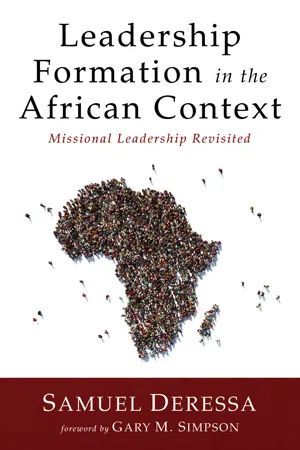
Leadership Formation in the African Context
Missional Leadership Revisited
- 210 pages
- English
- ePUB (mobile friendly)
- Available on iOS & Android
eBook - ePub
About this book
The teachings of Christian leadership have been dominated by a focus on the influence of a leader on its followers. Samuel Deressa's new book, Leadership Formation in the African Context, highlights how an African concept of community and holistic approach to ministry provides a biblically sound approach to understanding leadership formation and practice in this new age. This book links the issue of missional leadership with the life of the congregation. It provides theological and practical insights into how we can understand leadership formation in contexts where churches are engaged in the Missio Dei as a community of believers.
Information
Topic
Theology & ReligionSubtopic
African HistoryChapter 1
Introduction
As an African, I see myself as a product of a community where religion played a vital role in shaping the society. As a child, I was taught how to behave, worship, and relate to others in my community. Growing up, I observed how every member of the community was curiously watching over my shoulder, trying to shape my future to help me be someone who would meet their expectations. Through the years, I have come to understand that “belonging is the key to existence” in the African contexts: “since I belong, therefore, I am, the sine qua non of existence.”1 This is different from western contexts, where individualism has often taken the place of community.
As John Mbiti rightly articulates, the communities in Africa
Make, create or produce the individual; for the individual depends on the corporate group. [According to African cultural world view], physical birth is not enough: the child must go through rites of incorporation so that it becomes fully integrated into the entire society. These rites continue throughout the physical life of the person, during which the individual passes from one stage of corporate existence to another.2
I have been through this cultural process to be who I am today. There is no doubt that there exists an intersection between the culture that nurtured my ethos and my faith. I have become aware that it was the culture that dictated my faith, and vice versa. The aim of this book is to explore such experiences by focusing on the study of congregational culture within which emerging leaders (like myself) are being formed and empowered in the African context. It explores the connection between two important concepts: spiritual formation and leadership formation.
Leadership formation continues to emerge today as one of the main topics discussed among scholars and church leaders. As the church faces massive shifts throughout the world, these scholars and leaders ask what it means to be a church and how to raise effective leaders in this new age. For churches in the Global North (the western world), the decline in membership of historical denominations, the growing number of migrates with diverse religious background, the rapid expansion of mega churches, and many other changes that are happening have resulted in the disruption of long-standing practices. Because of these shifts, there is a growing recognition among church leaders that business as usual is no longer possible, and that there needs to emerge a new or different alternative to what has been traditional leadership formation and practices.
In addition, global Christianity has experienced a major demographic shift in the past few decades. With the decline of Christianity in the North, and accelerated growth of Christianity in the South, the South has now become the heartlands of global Christianity. With this demographic shift, the Southern Christians have been aware of the need for missional leaders who can play a role in creating, shaping, and leading missional churches in global mission. This is mainly because, as Alan Roxburgh and Fred Romanuk have rightly stated, it is impossible to have a missional church or effectively engage in God’s mission without missional leadership (and vice versa).3 What does it mean to raise leaders in this new global age? How are disciples being formed in light of God’s mission in the world? This book will address these questions by drawing mainly from the insights shared in the missional church literature to date, and attempts to contribute some new insights in to thinking further about leadership formation from African perspective.
Missional Church Conversation
The missional church conversation started in North America as a response to Leslie Newbigin’s critical analysis of the missionary encounter in the 20th century. It was Newbigin’s impression that the church in England had lost its connection with its cultural context that became the reason for the start of this conversation about mission. Newbigin, after working as a missionary in South India for a decade, came up with the following question: What is a missionary engagement with western culture in our time? Newbigin reflected much on Barth’s idea of the Trinity and mission and its implications for the western context.
Challenged by Newbigin’s writings, the missional church conversation was started in North America in the late 1980s. It was his identification and framing of crises and challenges in the way mission was understood and carried out in the western world that attracted American missiologists to engage in this conversation—which then resulted in the creation of the Gospel and Our Culture Network (GOCN). GOCN played a significant role in initiating and leading the conversation. This conversation mainly addressed ecclesiology and mission, with a focus on the dynamic interrelations between gospel, church, and culture. As Guder and Barrett emphasized, this conversation was need to create a missional reor...
Table of contents
- Title Page
- Foreword
- Acknowledgments
- List of Abbreviations
- Chapter 1: Introduction
- Chapter 2: Litrature Review
- Chapter 3: Theological and Biblical Perspectives
- Chapter 4: Theoretical Perspectives
- Chapter 5: Research Methodology and Design
- Chapter 6: Results of the Study and Interpretation
- Chapter 7: Theological and Biblical Reflection on the Research Findings
- Chapter 8: Theoretical Reflections on the Research Findings
- Appendix A
- Appendix B
- Appendix C
- Appendix D
- Appendix E
- Appendix F
- Appendix G
- Appendix H
- Bibliography
Trusted by 375,005 students
Access to over 1.5 million titles for a fair monthly price.
Study more efficiently using our study tools.
Frequently asked questions
Yes, you can cancel anytime from the Subscription tab in your account settings on the Perlego website. Your subscription will stay active until the end of your current billing period. Learn how to cancel your subscription
No, books cannot be downloaded as external files, such as PDFs, for use outside of Perlego. However, you can download books within the Perlego app for offline reading on mobile or tablet. Learn how to download books offline
Perlego offers two plans: Essential and Complete
- Essential is ideal for learners and professionals who enjoy exploring a wide range of subjects. Access the Essential Library with 800,000+ trusted titles and best-sellers across business, personal growth, and the humanities. Includes unlimited reading time and Standard Read Aloud voice.
- Complete: Perfect for advanced learners and researchers needing full, unrestricted access. Unlock 1.5M+ books across hundreds of subjects, including academic and specialized titles. The Complete Plan also includes advanced features like Premium Read Aloud and Research Assistant.
We are an online textbook subscription service, where you can get access to an entire online library for less than the price of a single book per month. With over 1.5 million books across 990+ topics, we’ve got you covered! Learn about our mission
Look out for the read-aloud symbol on your next book to see if you can listen to it. The read-aloud tool reads text aloud for you, highlighting the text as it is being read. You can pause it, speed it up and slow it down. Learn more about Read Aloud
Yes! You can use the Perlego app on both iOS and Android devices to read anytime, anywhere — even offline. Perfect for commutes or when you’re on the go.
Please note we cannot support devices running on iOS 13 and Android 7 or earlier. Learn more about using the app
Please note we cannot support devices running on iOS 13 and Android 7 or earlier. Learn more about using the app
Yes, you can access Leadership Formation in the African Context by Samuel Deressa in PDF and/or ePUB format, as well as other popular books in Theology & Religion & African History. We have over 1.5 million books available in our catalogue for you to explore.