eBook - ePub
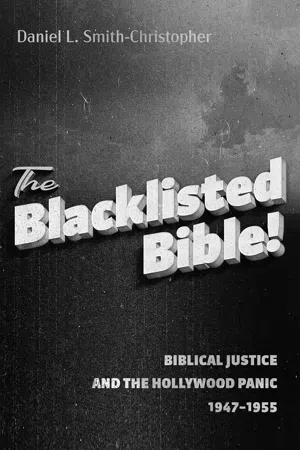
The Blacklisted Bible
Biblical Justice and the Hollywood Panic 1947–1955
- 180 pages
- English
- ePUB (mobile friendly)
- Available on iOS & Android
eBook - ePub
About this book
Choosing ten films that were considered "suspicious," "un-American," or even "dangerous" by the conservative media, and especially the infamous "House Un-American Affairs Committee" (HUAC) between 1947-1953, each chapter briefly outlines how progressive Christians should have supported the message of the film rather than condemned it. Each chapter explains why the film was considered controversial, and then proposes a number of arguments drawing heavily on Scripture, arguing that Christians should have, and still should, consider these films about social justice issues to be deeply biblical, and not "un-American." Intended for an adult education series, this book can serve as a kind of "handbook" for a church or parish "Film Series" that raises serious questions of social justice and Christian response.
Information
Chapter One
The Big Clock
(1948)
Director: John Farrow
Writer: Jonathan Latimer, based on the novel by Kenneth Fearing
Producer: John Farrow
Production Company: Paramount
Notable Actors: Ray Milland, Charles Laughton, and Maureen O’Sullivan
Summary
An editorial executive (Milland) working for a large media empire becomes caught up in a murder he did not commit. Although married, he foolishly spends an evening flirting with another woman—a woman who later ends up murdered after he left her quite alive. He begins to realize that the murder was committed by the owner of the company himself (Laughton), but knows that he himself looks suspiciously guilty. He must race against time and escape discovery within the very building of the media empire itself, until the mystery is solved.
I. Before You Watch the Film
Arguably the least controversial of our ten controversial films, this first gem goes straight to the classic film shelf labeled film noir. Film noir (French for “dark film”) was a term first used by a French film reviewer in 1946, and it refers to a specific style of films made in the late 1940s and 1950s, mostly (but not exclusively) American and usually black and white. Film noir normally features a hard, edgy, and cynical attitude about life, and often involves crime. It is particularly well adapted to black and white, with its exaggerations of night and dark settings suggesting rougher aspects of life. If it is a crime story, the classic film noir detective often had a cynical attitude to life. The famous mystery writer Dashiel Hammett invented his classic detective, Sam Spade, played on the screen most famously by Humphrey Bogart in the 1941 film The Maltese Falcon. This film is often cited as one of the classic examples of film noir—and the classic film noir hard-boiled (typically hard-drinking) and cynical private eye usually has a difficult relationship with the local police who, nevertheless, know him well! The hard-boiled detective is a stereotype that continues right up to the present in film and television (and is the cinematic background to fully appreciating Harrison Ford’s character in my own personal favorite film of all time, Ridley Scott’s 1982 sci-fi noir classic, Blade Runner). Furthermore, however, some believe that film noir was a reaction against rosy middle-class (and largely white) attitudes of American nationalist optimism and even puritanism,1 which would thus clearly draw fire from conservative Christian audiences deeply invested in that same rosy, white image of America as somehow a Christian ideal. Once again, American Christians can too often be justifiably faulted for blindness when it comes to the suffering of fellow Americans, much less those beyond our borders, by insisting that everything is “just fine” and anyone who suggests otherwise is “un-American.” It is a nostalgia for these attitudes that often fire political campaigns to “make America great again,” or “go back”, which would hardly endear itself to those who suffered in “those good old times.”
The director was Australian John Farrow (the father of Mia Farrow). He converted to Catholicism to marry his second wife, Maureen O’Sullivan, who plays the loyal wife of Ray Milland’s character, George Stroud, in our film. John Farrow died in Los Angeles, aged fifty-eight, in 1963, not long after working for a while on one of the more famous life of Jesus movies, King of Kings, which was released in 1961.
Though clearly a noir film, The Big Clock is not a detective story in the normal sense, but certainly deals with cynical views of corporate life, and definitely deals with crime. The film was based on the novel written by the left-wing writer Kenneth Fearing. Fearing was born in 1902, raised in Chicago, and was mainly known as a poet, moving to New York in 1924 to launch a literary career. When he wrote The Big Clock, Fearing himself considered this work to be a criticism of corporate power and especially corporate media. Writing about Kenneth Fearing’s work, recent film scholars have pointed out that his criticism of the media mogul in the film (Earl Janoth, played with magnificent malevolence by Charles Laughton) was almost certainly based on media tycoon Henry Luce, since Fearing worked for Luce’s Time magazine dynasty in the thirties as a book reviewer, and composed his novel in the 1940s when the Luce empire was at its height. Time (and Life magazine) was everywhere: the company had international editions, classroom editions, and Luce eventually purchased interests in NBC TV and in radio, and became deeply involved in political lobbying later in his life. But there was an even darker side to Luce’s economic control and political interests. Merrill Schleier writes, “Luce held an abiding belief that American capitalism and religious values should serve as the blueprint for the entire globe. The function of his vast media empire was to disseminate these ideals both nationally and internationally . . .”2 Even more ominously, however, Ben Terrall points out that Luce himself once flirted with fascist ideas: “in the 30s Luce wrote of his admiration for Mussolini and downplayed the threat posed by Hitler. In a 1934 speech, Luce said, ‘The moral force of Fascism, appearing in totally different forms in different nations, may be the inspiration for the next general march of mankind.’”3
The film writer, Jonathan Latimer, prepared his script for the 1948 film only two years after the 1946 release of Fearing’s novel. Latimer, however, introduced significant changes—in the novel the “clock” was only a metaphor, but Latimer’s script called for the literal clock that is quite important as an image in the film version. One could say that the clock serves as the beating heart of the building, and it is representative of the corporate control even of time itself. However, there is also an emphasis in the film on the destructive impact of financial pressures on artistic development. Film critics have often observed that both the novel and the film present the dilemma faced by a modern writer trying to maintain some kind of integrity in the face of corporate pressures of a job with a major media empire.
Therefore, financial control of all aspects of our lives appears to be another central element of the film. The media dictator Janoth even disregards the family life of his employees, expecting total and complete submission to his will. Notice the pressure that George Stroud faces when he must disappoint his wife yet again—and Janoth’s lack of any concern for the life of his employee. Along these lines, watch for the placement in the story line of a painting entitled The Temptation of Judas as a strong hint toward Fearing’s suspicion of the compromising and corrupting influence of financial interests on anything resembling morality and truth. It is interesting to note that The Temptation of Judas was apparently going to be the original title of Fearing’s novel.
There is an important addendum to the role of this painting in the story. An interesting subplot that was introduced already in the novel was the story of the bohemian artist played gleefully by Elsa Lanchester (later married to Charles Laughton). One of Roosevelt’s New Deal policies was to provide employment for artists, and the government therefore had a large collection of paintings that were neglected and eventually sold off in the mid-1940s. Luce and Hearst both delighted in running stories about these 1930s paintings gathering dust and being sold off at bargain basement prices, thus attempting to humiliate both the artists and the programs that helped them. Of course, the point was helping the artists survive, not necessarily for the US Government to gather masterpieces—although these WPA works today command serious and critical interest! Kenneth Fearing alludes to these events in the purchase of the painting in The Big Clock. Furthermore, the artist was named Louise Patterson, which Fearing borrowed from the name of a famous Black activist of the 1930s. Note how Louise “gets her own back” in the film, and now we know what was going on behind the scenes with this story line.
Despite all this, as we noted, there is little evidence that the film itself stirred major or significant political controversy at the time compared to our other films, although it is interesting that the influential Los Angeles Times gossip columnist, Hedda Hopper, who was often at...
Table of contents
- Title Page
- Acknowledgments
- Introduction
- Chapter 1: The Big Clock
- Chapter 2: No Way Out
- Chapter 3: Broken Arrow
- Chapter 4: Crossfire
- Chapter 5: Salt of the Earth
- Chapter 6: The Grapes of Wrath
- Chapter 7: The Lawless
- Chapter 8: Mr. Deeds Goes to Town
- Chapter 9: Keeper of the Flame
- Chapter 10: The Boy with Green Hair
- Concluding Thoughts on Bible and Cinema
- Bibliography
Trusted by 375,005 students
Access to over 1.5 million titles for a fair monthly price.
Study more efficiently using our study tools.
Frequently asked questions
Yes, you can cancel anytime from the Subscription tab in your account settings on the Perlego website. Your subscription will stay active until the end of your current billing period. Learn how to cancel your subscription
No, books cannot be downloaded as external files, such as PDFs, for use outside of Perlego. However, you can download books within the Perlego app for offline reading on mobile or tablet. Learn how to download books offline
Perlego offers two plans: Essential and Complete
- Essential is ideal for learners and professionals who enjoy exploring a wide range of subjects. Access the Essential Library with 800,000+ trusted titles and best-sellers across business, personal growth, and the humanities. Includes unlimited reading time and Standard Read Aloud voice.
- Complete: Perfect for advanced learners and researchers needing full, unrestricted access. Unlock 1.5M+ books across hundreds of subjects, including academic and specialized titles. The Complete Plan also includes advanced features like Premium Read Aloud and Research Assistant.
We are an online textbook subscription service, where you can get access to an entire online library for less than the price of a single book per month. With over 1.5 million books across 990+ topics, we’ve got you covered! Learn about our mission
Look out for the read-aloud symbol on your next book to see if you can listen to it. The read-aloud tool reads text aloud for you, highlighting the text as it is being read. You can pause it, speed it up and slow it down. Learn more about Read Aloud
Yes! You can use the Perlego app on both iOS and Android devices to read anytime, anywhere — even offline. Perfect for commutes or when you’re on the go.
Please note we cannot support devices running on iOS 13 and Android 7 or earlier. Learn more about using the app
Please note we cannot support devices running on iOS 13 and Android 7 or earlier. Learn more about using the app
Yes, you can access The Blacklisted Bible by Daniel L. Smith-Christopher in PDF and/or ePUB format, as well as other popular books in History & Art Theory & Criticism. We have over 1.5 million books available in our catalogue for you to explore.