- 536 pages
- English
- ePUB (mobile friendly)
- Available on iOS & Android
eBook - ePub
About this book
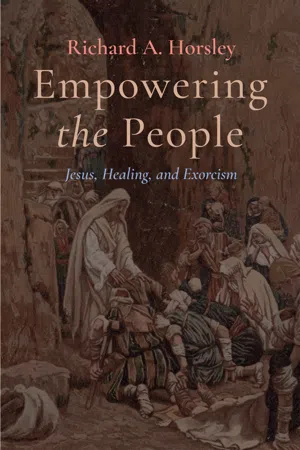
In this innovative study, Horsley builds on his earlier works concerning the problematic and misleading categories of "magic" and "miracle" to examine in-depth the meaning and importance of the narratives of healing and exorcism in the Gospels. Incorporating his work on oral performance and turning to important works in medical anthropology, a new image emerges of how these narratives help us re-evaluate Jesus's place in first-century Galilee and Judea. In his exorcisms and healings, Jesus-in-interaction was empowering the villagers in their struggles for renewal of personal and communal dignity in resistance to invasive Roman rule.
Information
Part I
Beyond Modern Misunderstandings
1
Gospel Portrayals versus Modern Interpretations
Modern interpreters present Jesus mainly as a teacher, focusing mostly on the sayings of Jesus. They give little or no attention to his healings and exorcisms. If and when they do examine the Gospel portrayals of healing and exorcism they find little that is reliable as “data” for their construction of “the historical Jesus.” This has been true for over a century, following the strong skepticism about the historical reliability of the Gospel sources that resulted from “the quest of the historical Jesus” that Albert Schweitzer surveyed at the end of the nineteenth century. The highly influential 1926 book on Jesus by Rudolf Bultmann, arguably the most significant New Testament scholar of the twentieth century, bore the significant title Jesus and the Word.4 The focus on teachings and inattention to healings and exorcisms, moreover, has continued in the surge of books on the historical Jesus during the last three decades.5
Inattention to Healing and Exorcism in Modern Scholarly Interpretation of Jesus
This overwhelming concentration on the teachings of Jesus and relative lack of attention to the healings and exorcisms can be explained from the modern European intellectual history in the midst of which study of the historical Jesus developed. The emergence of Enlightenment Reason placed biblical scholars on the defensive as they worked at interpreting the sacred Scripture in their branch of Christian theology. Whatever did not find a natural explanation, including many incidents and happenings portrayed in biblical stories, was defined as miracle, ascribed to a “supernatural” cause. Stories of Jesus’ healings and exorcisms were included in the category of “miracles.” As reality came more and more to be defined by the canons of Reason, Nature, and the modern scientific worldview, many biblical scholars found that they, as modern scientific people, could no longer “believe in” miracles. They could no longer place credence in miracle stories or in any narratives that seemingly involved the supernatural (angels, spirits, demons). As they sought to salvage parts of the Gospels as intelligible and acceptable, they retreated to the seemingly most rational parts. The only Jesus-traditions that could measure up to the canons of Reason as possible evidence for Jesus were his teachings, his parables and sayings. Unless a naturalistic “explanation” could be found, miracle stories were avoided as expressions of the “mythic” mentality of a by-gone era. They were hardly valid as evidence for the historical Jesus.
Critical biblical scholars also found other reasons to be suspicious of the Gospels and to move behind them to the sayings they still trusted as sources for the historical Jesus. They came to view the Gospels as products of “Easter faith,” with generous overlays of theology and secondary embellishments of the teachings and deeds of Jesus. A highly influential reading of the Gospel Mark at the beginning of the twentieth century, for example, found it dominated by “the messianic secret” motif supposedly in many miracle stories, an explanation of why Jesus was not recognized and acclaimed as the Messiah before the crucifixion and resurrection.6 In a development that illustrates the suspicion with which they viewed the “miracle stories,” a number of twentieth-century interpreters, found a disturbing tendency among some “early Christians” to focus on Jesus’ miracles as evidence that he was a “divine man” (a charismatic miracle-doer). Some then interpreted the Gospel of Mark as having “blocked” that dangerous trend by affixing the passion narrative and empty tomb to the string of stories of Jesus’ mighty deeds, so that it ended with a Christology of the cross that became the orthodox Christian interpretation of Jesus.7
Scholarly treatment of Jesus’ healings and exorcisms in the recent surge of “historical Jesus” studies shows little change since Bultmann’s work ninety-some years ago. Scholars view the Gospels basically as mere containers or collections of sayings and stories that had circulated separately. In typical scholarly practice, they sort the discrete items into categories such as individual sayings and various kinds of stories, the most extensive and important of which is “miracle stories.” They then classify “miracle stories” more particularly into “healings,” “exorcisms,” “nature miracles,” and stories of “raising the dead.” But the controlling classification of episodes of healing and exorcism is “miracle stories.”
Partly because the (supposedly historically reliable) sayings of Jesus also attest healings and exorcisms, many interpreters involved in the recent revival of interest in the historical Jesus repeat in some way Bultmann’s conclusion in 1926: “Most of the wonder tales contained in the gospels are legendary, at least they have legendary embellishments. But there can be no doubt that Jesus did the kind of deeds which were miracles . . . to the minds of his contemporaries, that is, deeds which were attributed to a supernatural, divine cause; undoubtedly he healed the sick and cast out demons.”8 Yet the healings and exorcisms were not necessarily interpreted as something important in themselves. When included in the discussion, healings and exorcisms, like other “miracles,” were interpreted merely as signs of the kingdom of God or as indicators of Jesus’ authority or the means by which he attracted listeners to his teaching, rather than as actions central to his mission.9
The most telling illustrations of how unimportant healing and exorcism continue to be in reconstructions of the historical Jesus are some thoroughgoing recent investigations of the miracle stories. A mark of the rigor of their critical inquiry, these scholars simply ignore...
Table of contents
- Title Page
- Preface
- Abbreviations
- Introduction
- Part I: Beyond Modern Misunderstandings
- Part II: The Historical Context
- Part III: Understanding and Using the Gospel Stories Appropriately as Sources
- Part IV: The Effect and Significance of Exorcisms and Healings
- Bibliography
Trusted by 375,005 students
Access to over 1.5 million titles for a fair monthly price.
Study more efficiently using our study tools.
Frequently asked questions
Yes, you can cancel anytime from the Subscription tab in your account settings on the Perlego website. Your subscription will stay active until the end of your current billing period. Learn how to cancel your subscription
No, books cannot be downloaded as external files, such as PDFs, for use outside of Perlego. However, you can download books within the Perlego app for offline reading on mobile or tablet. Learn how to download books offline
Perlego offers two plans: Essential and Complete
- Essential is ideal for learners and professionals who enjoy exploring a wide range of subjects. Access the Essential Library with 800,000+ trusted titles and best-sellers across business, personal growth, and the humanities. Includes unlimited reading time and Standard Read Aloud voice.
- Complete: Perfect for advanced learners and researchers needing full, unrestricted access. Unlock 1.5M+ books across hundreds of subjects, including academic and specialized titles. The Complete Plan also includes advanced features like Premium Read Aloud and Research Assistant.
We are an online textbook subscription service, where you can get access to an entire online library for less than the price of a single book per month. With over 1.5 million books across 990+ topics, we’ve got you covered! Learn about our mission
Look out for the read-aloud symbol on your next book to see if you can listen to it. The read-aloud tool reads text aloud for you, highlighting the text as it is being read. You can pause it, speed it up and slow it down. Learn more about Read Aloud
Yes! You can use the Perlego app on both iOS and Android devices to read anytime, anywhere — even offline. Perfect for commutes or when you’re on the go.
Please note we cannot support devices running on iOS 13 and Android 7 or earlier. Learn more about using the app
Please note we cannot support devices running on iOS 13 and Android 7 or earlier. Learn more about using the app
Yes, you can access Empowering the People by Richard A. Horsley in PDF and/or ePUB format, as well as other popular books in Theology & Religion & Biblical Criticism & Interpretation. We have over 1.5 million books available in our catalogue for you to explore.