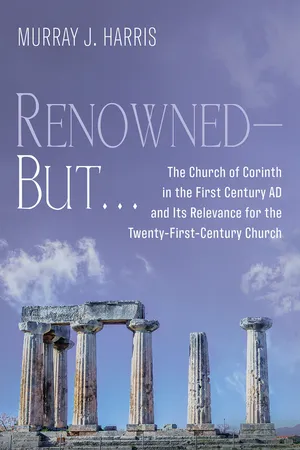
eBook - ePub
Renowned—But . . .
The Church of Corinth in the First Century AD and Its Relevance for the Twenty-First-Century Church
- 144 pages
- English
- ePUB (mobile friendly)
- Available on iOS & Android
eBook - ePub
Renowned—But . . .
The Church of Corinth in the First Century AD and Its Relevance for the Twenty-First-Century Church
About this book
Here is the inside story of the only New Testament church we know about in detail during both the 50s and the 90s of the first century AD. What did the church of Corinth look like forty years after it was founded by the apostle Paul? Did his positive influence in this church continue after he left Corinth--or did some of the earlier problems still haunt the church? And are there some timeless lessons we can learn from this church's early history? All those questions are answered here in a fascinating detective investigation that includes thirteen captivating archaeological photos.
Information
Topic
Theology & ReligionSubtopic
Biblical CommentaryPart One:
Background
I. The City of Corinth
A. History
There are three important dates that form the background to Corinth in the first century AD. Each determined the cultural shape and distinctives of this city.
1. 146 BC: Destruction
Corinth’s origin in the tenth century BC is shrouded in the mists of competing myths. But we know that in 243 BC it joined the Achaean League, a confederation of Greek city-states in the central and north-western parts of the Peloponnese. In 146 BC Corinth boldly rejected the third of three Roman embassies that aimed to end the ominous dispute between the League and Sparta, and then Corinth declared war on Sparta, Rome’s ally. This prompted the Roman Republic under its general Lucius Mummius to lay siege to Corinth and finally destroy it. (This general was awarded the cognomen Achaicus to mark his final conquest and dissolution of the Achaean League). Corinth’s male citizens were executed, women, children and freed slaves were all reduced to slavery, and the city’s renowned wealth and treasures were plundered. Most if not all of the city’s buildings were burned to the ground. As a result, for some one hundred years this celebrated icon of the Greek world lay in ruins, largely deserted except for an insignificant village.
2. 44 BC: Restoration
In the year 44 BC, now at the height of his power, Julius Caesar founded “the colony of Corinth in honor of the Julian dynasty” (Colonia Laus Iulia Corinthiensis) (see photo #1).

#1. The Temple of Octavia (=Temple E), the sister of the emperor Augustus, that was dedicated to the gens Iulia, the patrician family (including Julius Caesar) that founded Roman Corinth. Source credit: http://www.HolyLandPhotos.org.
As it happened, this founding occurred shortly before Caesar’s assassination. Caesar’s more practical motivation for this gesture of reconciliation towards Corinth was to provide an appropriate relocation for his veterans and for restless or ambitious freedmen and artisans in Rome, be they Roman, Greek, or Jewish. Plots of arable land in Corinth were made available for the new settlers. It has been estimated that by AD 50, some one hundred years later, the population of this cosmopolitan city had risen to some 50,000 people, largely due to its strategic geographical location (see Geography below) and the artistic energy of its city council that matched the generosity of its citizens who were vying for public recognition and honor. Corinth quickly became the proverbial “boom town” with hoardes of immigrants eager to capitalize on the manufacturing materials such as clay and bronze that were easily accessible locally and on the endless tourist traffic.
Evidence of the Romanization of Corinth may be found in several of the city’s features.
•Most inscriptions were in Latin, not Greek
•The Roman theater in Corinth, rebuilt in the late first century BC, that later hosted gladiatorial shows (seating capacity about 14,000) (see photo #2)
•Several Corinthians or Corinthian inhabitants mentioned in the NT had Latin names (Titius Justus, Crispus, Fortunatus, Lucius, Gaius, Erastus, Quartus)
•Imperial cult activity (as in Temple E and the Julian Basilica)
•There was the minting of coins in Latin, although Greek influence continued with Aphrodite and Poseidon figuring prominently on the coins

#2. The semi-circular Corinthian theater. After Paul’s time it was used for wild beast and gladiatorial shows. Source credit: http://www.HolyLandPhotos.org.
3. 27 BC: Recognition
In this year the Emperor Augustus established Corinth as the capital of the Roman province of Achaia (= peninsular Greece). In spite of this imperial accolade, Corinth never eclipsed Athens as Greece’s intellectual and educational center. If a Roman province was considered to be safe, it was under the control of the Senate as a senatorial colony; if it was likely to be the scene of political unrest or disturbance, it fell under the jurisdiction of the Emperor himself as an imperial colony with a permanent Roman garrison on site. Corinth began as a senatorial province, given the fact that many of its original inhabitants in 44 BC had served Rome under Julius Caesar or were loyal Roman citizens. But in AD 15 the Emperor Tiberius made Achaia an imperial province, while under Claudius it regained its senatorial status that it enjoyed during Paul’s association with Corinth.
B. Geography
The site of ancient Corinth is about 3.5 miles southwest of modern (New) Corinth and about 50 miles west of Athens (see item #3).

#3. Map of Southern Greece, showing the position of Corinth on the Isthmus and the two Corinthian ports of Lechaion (on the Gulf of Corinth) and Cenchreae (on the Saron...
Table of contents
- Title Page
- Preface
- Acknowledgments
- Abbreviations
- Select Bibliography
- Part One: Background
- Part Two: The Apostle Paul and Corinth
- Part Three: The First Epistle of Clement of Rome to the Corinthians
- Part Four: Lessons for the Twenty-First-Century Church
Trusted by 375,005 students
Access to over 1.5 million titles for a fair monthly price.
Study more efficiently using our study tools.
Frequently asked questions
Yes, you can cancel anytime from the Subscription tab in your account settings on the Perlego website. Your subscription will stay active until the end of your current billing period. Learn how to cancel your subscription
No, books cannot be downloaded as external files, such as PDFs, for use outside of Perlego. However, you can download books within the Perlego app for offline reading on mobile or tablet. Learn how to download books offline
We are an online textbook subscription service, where you can get access to an entire online library for less than the price of a single book per month. With over 1.5 million books across 990+ topics, we’ve got you covered! Learn about our mission
Look out for the read-aloud symbol on your next book to see if you can listen to it. The read-aloud tool reads text aloud for you, highlighting the text as it is being read. You can pause it, speed it up and slow it down. Learn more about Read Aloud
Yes! You can use the Perlego app on both iOS and Android devices to read anytime, anywhere — even offline. Perfect for commutes or when you’re on the go.
Please note we cannot support devices running on iOS 13 and Android 7 or earlier. Learn more about using the app
Please note we cannot support devices running on iOS 13 and Android 7 or earlier. Learn more about using the app
Yes, you can access Renowned—But . . . by Murray J. Harris in PDF and/or ePUB format, as well as other popular books in Theology & Religion & Biblical Commentary. We have over 1.5 million books available in our catalogue for you to explore.