- 208 pages
- English
- ePUB (mobile friendly)
- Available on iOS & Android
eBook - ePub
The London 'E/1' Tram
About this book
"A fine tribute to the thousand-strong fleet of E/1 trams which gave such sterling service to Londoners for nearly fifty years, including two world wars." —Tramway Review
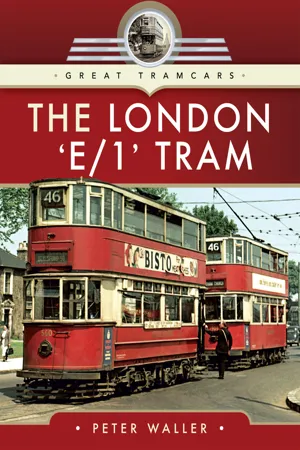
Probably the single most numerous of tramcar constructed for operation on Britain's first generation electric tramways, the London County Council's 'E/1' class had an operational history that stretched for almost fifty years. The first were produced towards the end of the first decade of the 20th century and the last were withdrawn with the conclusion of 'Operation Tramaway'—the final conversion of the once great London tramway system—in July 1952.
Over the years, more than 1,000 were built for operation by the LCC with similar cars being constructed for a number of the council operated systems in the capital prior to the creation of the LPTB in July 1933. The last batch—effectively rebuilds of single-deck cars that had once operated through the Kingsway Subway prior to its modernization—not completed until the early 1930s. During the 1920s the LCC cars had undergone a Pullmanisation program and, during the following decade, a number underwent the LPTB's Rehabilitation scheme. Moreover, with the removal of the restriction on the use of enclosed lower-deck vestibules, many others were converted to full-enclosed during that decade.
Although withdrawals commenced in the 1930s, as the tram system north of the river was converted to trolleybus operation, and others were lost as a result of enemy action during the war, a sizable number survived to the system's final days.
This book examines the history of this important class from development through to preservation.
Information
Table of contents
- Cover
- Title
- Copyright
- Contents
- Abbreviations
- Introduction
- The London County Council era
- Non-LCC ‘E/1’-type cars
- Reconditioning through to the Second World War
- Through to closure
- Preservation
- Appendix
- Bibliography
Trusted by 375,005 students
Access to over 1.5 million titles for a fair monthly price.
Study more efficiently using our study tools.
Frequently asked questions
Yes, you can cancel anytime from the Subscription tab in your account settings on the Perlego website. Your subscription will stay active until the end of your current billing period. Learn how to cancel your subscription
No, books cannot be downloaded as external files, such as PDFs, for use outside of Perlego. However, you can download books within the Perlego app for offline reading on mobile or tablet. Learn how to download books offline
Perlego offers two plans: Essential and Complete
- Essential is ideal for learners and professionals who enjoy exploring a wide range of subjects. Access the Essential Library with 800,000+ trusted titles and best-sellers across business, personal growth, and the humanities. Includes unlimited reading time and Standard Read Aloud voice.
- Complete: Perfect for advanced learners and researchers needing full, unrestricted access. Unlock 1.5M+ books across hundreds of subjects, including academic and specialized titles. The Complete Plan also includes advanced features like Premium Read Aloud and Research Assistant.
We are an online textbook subscription service, where you can get access to an entire online library for less than the price of a single book per month. With over 1.5 million books across 990+ topics, we’ve got you covered! Learn about our mission
Look out for the read-aloud symbol on your next book to see if you can listen to it. The read-aloud tool reads text aloud for you, highlighting the text as it is being read. You can pause it, speed it up and slow it down. Learn more about Read Aloud
Yes! You can use the Perlego app on both iOS and Android devices to read anytime, anywhere — even offline. Perfect for commutes or when you’re on the go.
Please note we cannot support devices running on iOS 13 and Android 7 or earlier. Learn more about using the app
Please note we cannot support devices running on iOS 13 and Android 7 or earlier. Learn more about using the app
Yes, you can access The London 'E/1' Tram by Peter Waller in PDF and/or ePUB format, as well as other popular books in Technology & Engineering & Modern British History. We have over 1.5 million books available in our catalogue for you to explore.