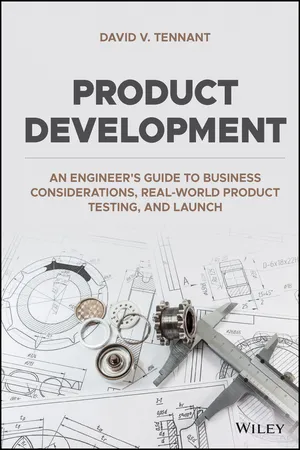
An insightful development roadmap to help engineers and businesspeople successfully bring a product to market
In Product Development: An Engineer's Guide to Business Considerations, Real-World Product Testing, and Launch, accomplished project manager, engineer, and business strategist David V. Tennant delivers a comprehensive walkthrough of the full scope of product development activities, from initial business considerations to real-world product testing and launch. The book covers key product development considerations like determining the target market, working with a product development team, management challenges, funding, user identification, ergonomics, product design, testing, and launch.
The distinguished author presents the material in the form of practical, hands-on tutorials with case studies featuring large corporations and small- and mid-size firms. He also includes team exercises and question-and-answer features to help early-career and aspiring engineers acquire the interdisciplinary and inter-department coordination skills they'll require to successfully bring a new product to market.
Readers will learn about the critical roles played by the engineering, marketing, and finance departments, as well as each stage of the product development process. The book also includes:
Thorough introductions to product development and the role of the marketing group in product development, including corporate strategy, product and business plans, and marketing leadership
Comprehensive explorations of the role of the engineering group in product development, including functional areas led by engineers and engineering leadership
Practical discussions of the core team and teamwork in product development, including executives' roles, the role of the accounting department, and the identification of key stakeholders
In-depth examinations of how to move forward with product development after project approval
Perfect for early- and mid-career engineers working in product-oriented companies, as well as marketers and other business professionals seeking to understand engineering best practices, Product Development is the ideal reference for use in upper-level undergraduate Product Development courses.
My formal academic training began as a student of mechanical engineering. Simultaneously, I worked part-time as a designer to pay for my education. In this case, my work allowed me to see how products were developed to the lower level where I was doing the technical drawing. And my engineering education helped me learn the limits of materials, think about product technical features, and how to apply mathematical formulas to solve technical problems.
However, nowhere did I learn about how products are really developed. What drives a company to success? How do companies know which products will be accepted in the marketplace? What is a marketplace or a market segment? As a result, my education and early work experience taught me a lot about applying engineering principles, but I had no knowledge of marketing, sales, business finance, C-level executive support, or how R&D (research and development) and the other areas are supposed to all work together. I simply (and naively) believed that new products were developed and launched by the engineering department. The product that had the better design would always be preferred by consumers.
Since those days in college, and my early career in engineering, I have come a long way to understanding that product development is a multi-faceted effort involving many diverse groups and talents. It is so much more than R&D or engineering.
Similarly, I have noticed that other disciplines – marketing, sales, etc. – do not always understand the engineering or R&D process in product development, which can be equally frustrating for those on the business side of a company.
The underlying purpose of this book is to serve as a bridge between the various groups that are responsible for developing and launching new products and services. It will assist engineering students, marketing professionals, R&D scientists, and product developers in how to effectively plan and launch new products.
This does not mean your future projects will all be successful: the market determines who survives and who doesn’t. However, the techniques, methods, and studies in this book can help you determine which projects should go forward and how to best plan and execute a flawless development and launch. And which projects should be scrapped early in the development process. Half of the key is knowing which projects have a greater chance of success vs. those that don’t. To illustrate important points, case studies will be provided that illustrate real-life failures and successes that reinforce the principles in this book. This book is very practical and does not dwell on theory or untested ideas.
Figure 1.1, Core Team in Product Development, illustrates some of the various functional areas and their interaction in product development. This figure is dynamic, so the participants will change depending on the type of product, its complexity, and it’s corporate visibility or priority.
Figure 1.1 Core Team – Product Development.
It should also be noted that product development will require market research, data analytics, realistic objectives, project management, and leadership.
Project Management and Product Development
A part of this book will introduce the reader to key concepts of project management which can be useful in bringing a product to market in a timely and efficient manner. Of course, the project manager, or leader, plays a key role in planning how the work will be accomplished, how it will be executed, and by whom. Further, this book will provide insights and processes in developing new products. It is not a book about project management; however, because project management (PM) is such a core skill needed to successfully launch new products, the reader will find key PM concepts detailed throughout the book. This will offer a good grasp on how to manage a project using these techniques and the reader is encouraged to pursue further reading on the topic of project management. It will be apparent that “product management” and “project management” are used interchangeably.
It should be noted that product development requires a multi-discipline approach, with each participating department understanding their role and responsibility. Many times, people have described PM as similar to herding cats. Product development will have similar challenges.
Through research, my own experience, and discussions with product development professionals, it is clear that project management plays a strong role in staying focused on the scope, budget, and schedule for the new product’s development. Successful companies have recognized over the last 20 years that project management processes are a huge competitive advantage. It has always been the author’s perspective that successful product launches require two ingredients: technical excellence and managerial excellence.
In recent years, there has been a drive to embrace an agile project management philosophy. This is much more suited to software and IT projects and certainly has its place in that industry. The primary differences between traditional and agile project management will be presented in Chapter 5.
What Is Product Development?
We first need to ask ourselves, what is a product? A product is simply an item or service that brings value to the customer in exchange for a price. You may find it odd that a “service” can be considered a product, but it is. A service can be a utility providing electricity to its customers. It can be an insurance policy that you purchase for your car, or the lawn service that keeps your company’s green spaces looking nice. Services can also be developed and sold similar to “hard” products. While services can be considered a product, marketing services is different from marketing a hard product. Further, think about apps that are developed for your smartphone. Are these a product or a service? Sometimes the line can be blurry.
It is appropriate to consider that products can originate from a variety of sources. Perhaps your R&D group has developed a new smart widget. It is most likely now the engineering department’s mission to determine how to commercialize it and manufacture it in a cost-effective manner.
The marketing group will need to determine the channels necessary to distribute the widget, how to develop a sales and marketing strategy, and determine estimates for pricing, profit, breakeven point, etc. Essentially, there are many moving parts to successfully launching a product. Where do products come from? Figure 1.2 shows some (but not all) of the points whereby ideas for new products are generated.
Figure 1.2 Types of optimization models.
How This Book Is Organized
It is suggested the reader go through each chapter in sequence. This is because each chapter builds on concepts presented in the previous chapters. Also, developing products should have a structured approach and this book provides this in the correct order.
In many chapters, there are “Tabletop Discussion” questions. These are provided for group discussions and should have about a 30-minute time frame. These should encourage students or product teams thinking about key topics and how to address them.
Case studies are included to reinforce the concepts presented in each chapter. While there are one or two “hypothetical” cases, most of the cases presented are real-world examples. The author has had significant experience in rescuing projects (or product developments) that were in deep trouble. In these instances, it would be in poor taste to name companies or individuals. Many of these cases challenge the reader with questions pertaining to how they would have addressed, prevented, or rescued these difficult issues.
Key points are summarized at the end of each chapter, followed by questions for students or readers to answer.
The answers to both the case studies and questions are also provided.
Subsequent chapters include:
Chapter 2 – The Role of Marketing
This provides an overall perspective on the basics of marketing, how it is different from sales, and how pricing, product, promotion, and place are part of a strategy. Marketing many times drives new products; indeed, a marketing professional may be placed in charge of a product’s development. Marketing also performs competitor analysis, obtains customer feedback (e.g., focus groups), and develops sophisticated models – usually an Excel spreadsheet – to evaluate pricing sensitivity.
Chapter 3 – The Role of Engineering
Engineers play a key role in the development of products. And there are many disciplines in this field. Listed in Chapter 3 are the types of engineering – mechanical, electrical, instrumentation, etc. – and how they work together to develop a project. There is a controlled approach to defining and solving engineering problems. Also, computer modeling can reduce development time and reduce the number of prototypes that are produced.
In addition to the technical challenges, engineers often have to design a product with the potential to be misused, either accidentally or intentionally. This brings into focus the need to consider ergonomics (human factors engineering) and product liability issues.
Chapter 4 – Core Team and Teamwork
Which groups and who should be involved in the product’s development? What is the role of executive management in the pr...
Table of contents
Cover
Title page
Copyright
Table of Contents
Acknowledgments
About the Author
1 Introduction to Product Development
2 The Role of Marketing in Product Development
3 The Role of the Engineering Group in Product Development
4 The Core Team and Teamwork in Product Development
5 Getting Started – Project Approved: Product/Project Management and Engineering
6 Product Development for Small Firms and Entrepreneurs
7 Manufacturing the New Product
8 Engineering Product Design and Testing
9 Successful Product Launch and Post Review
10 Summary – Connecting the Dots
Index
End User License Agreement
Trusted by 375,005 students
Access to over 1.5 million titles for a fair monthly price.
Study more efficiently using our study tools.
Frequently asked questions
Yes, you can cancel anytime from the Subscription tab in your account settings on the Perlego website. Your subscription will stay active until the end of your current billing period. Learn how to cancel your subscription
No, books cannot be downloaded as external files, such as PDFs, for use outside of Perlego. However, you can download books within the Perlego app for offline reading on mobile or tablet. Learn how to download books offline
Perlego offers two plans: Essential and Complete
Essential is ideal for learners and professionals who enjoy exploring a wide range of subjects. Access the Essential Library with 800,000+ trusted titles and best-sellers across business, personal growth, and the humanities. Includes unlimited reading time and Standard Read Aloud voice.
Complete: Perfect for advanced learners and researchers needing full, unrestricted access. Unlock 1.5M+ books across hundreds of subjects, including academic and specialized titles. The Complete Plan also includes advanced features like Premium Read Aloud and Research Assistant.
Both plans are available with monthly, semester, or annual billing cycles.
We are an online textbook subscription service, where you can get access to an entire online library for less than the price of a single book per month. With over 1.5 million books across 990+ topics, we’ve got you covered! Learn about our mission
Look out for the read-aloud symbol on your next book to see if you can listen to it. The read-aloud tool reads text aloud for you, highlighting the text as it is being read. You can pause it, speed it up and slow it down. Learn more about Read Aloud
Yes! You can use the Perlego app on both iOS and Android devices to read anytime, anywhere — even offline. Perfect for commutes or when you’re on the go. Please note we cannot support devices running on iOS 13 and Android 7 or earlier. Learn more about using the app
Yes, you can access Product Development by David V. Tennant in PDF and/or ePUB format, as well as other popular books in Design & Product Design. We have over 1.5 million books available in our catalogue for you to explore.