- English
- ePUB (mobile friendly)
- Available on iOS & Android
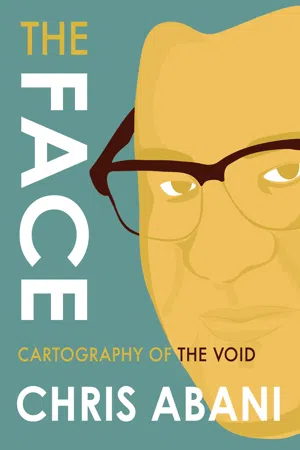
The Face: Cartography of the Void
About this book
"A fascinating meditation on identity that explores the novelist's own mixed heritage and mixed feelings….A true citizen of the world….With great insight and compassion, Abani reveals that behind his—and every—face are unseen scars." —San Francisco Chronicle
In The Face: Cartography of the Void, acclaimed Nigerian-born author and poet Chris Abani has given us a profound and gorgeously wrought short memoir that navigates the stories written upon his own face. Beginning with his early childhood immersed in the Igbo culture of West Africa, Abani unfurls a lushly poetic, insightful, and funny narrative that investigates the roles that race, culture, and language play in fashioning our sense of self.
As Abani so lovingly puts it, he contemplates "all the people who have touched my face, slapped it, punched it, kissed it, washed it, shaved it. All of that human contact must leave some trace, some of the need and anger that motivated that touch. This face is softened by it all. Made supple by all the wonder it has beheld, all the kindness, all the generosity of life." The Face: Cartography of the Void is a gift to be read, re-read, shared, and treasured, from an author at the height of his artistic powers.
Alternately philosophical, funny, personal, political, and poetic, the short memoirs in The Face series offer unique perspectives from some of our favorite writers. Find out more at www.restlessbooks.com/the-face.
Frequently asked questions
- Essential is ideal for learners and professionals who enjoy exploring a wide range of subjects. Access the Essential Library with 800,000+ trusted titles and best-sellers across business, personal growth, and the humanities. Includes unlimited reading time and Standard Read Aloud voice.
- Complete: Perfect for advanced learners and researchers needing full, unrestricted access. Unlock 1.4M+ books across hundreds of subjects, including academic and specialized titles. The Complete Plan also includes advanced features like Premium Read Aloud and Research Assistant.
Please note we cannot support devices running on iOS 13 and Android 7 or earlier. Learn more about using the app.
Information
This Is True
- My dead father and I look alike. I wear his face.
- My father tried his whole life to be a good man.
- My father was generous to the world and to strangers.
- My father was stingy at home, with money and his emotions.
- My father made strangers laugh.
- My father and I have never laughed together.
- My father cheated on my mother constantly.
- My father grew up poor. His father was a houseboy for Catholic priests.
- My father wore his father’s face.
- My father barely spoke to his father.
- My grandfather tried to keep my father from taking the scholarship the Church offered him.
- At twenty-three he had never been more than a hundred miles from my town.
- At twenty-three, my father left for the University of Cork, Ireland and later Oxford.
- My father was the first university graduate from my town.
- My father came back in 1956 with a white woman.
- My father married that white woman in 1957 in my small town.
- My father beat my mother. Often. I still carry the guilt of my helplessness.
- My father, outside of monogamy, was the most honest man I have ever known.
- My father made me the man I am today.
- My father loved me even though violence was his preferred mode of affection.
- My father was raised to be a warrior.
- My father was a school principal.
- My father was a member of parliament in the first republic.
- My father was a state superintendent of schools.
- My father was the federal commissioner for public complaints.
- My father was a customary court chairman.
- My father was not required to be a warrior in any of these roles.
- My father brought the war home to us every night and fought his demons.
- My father’s demons were his family, apparently.
- My father tried to self-medicate, but the alcohol only made it worse.
- My father educated me.
- My father kept me on the straight and narrow.
- My father taught me that, even when it hurts you and others, loyalty is absolute.
- My father tried to beat the creative and artistic leanings out of us.
- My father wanted us to have sensible jobs.
- My father played jazz piano at Oxford.
- My father is easier to love as a spirit, a ghost, than as a man.
- My father’s face stares back at me from the mirror.
- My father has been forgiven.
This Is Not A Sitcom
Table of contents
- Threshold
- Caveat
- A Slow Violence
- Orientation
- Photographs
- Call
- Face Value
- The Performance
- On Beauty
- This Is True
- This Is Not A Sitcom
- Text Message
- To Chew Pepper
- Lavender
- The Terrain
- This Is Hope
- Pater Nostra
- The Architecture of Loss
- This May Not Be True
- Truce
- Coda
- Comfort
- About the Author
- Colophon