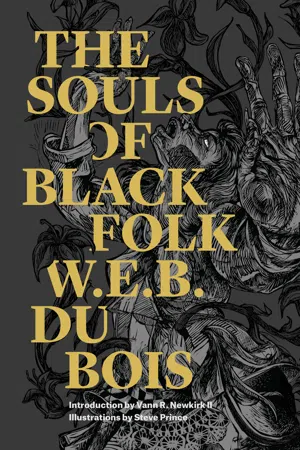
Restless Classics presents The Souls of Black Folk: W. E. B. Du Bois's seminal work of sociology, with searing insights into our complex, corrosive relationship with race and the African-American consciousness. Reconsidered for the era of Obama, Trump, and Black Lives Matter, the new edition includes an incisive introduction from rising cultural critic Vann R. Newkirk II and stunning illustrations by the artist Steve Prince. Published in 1903, exactly forty years after the Emancipation Proclamation, W.E.B. Du Bois's The Souls of Black Folk fell into the hands of an American nation that had still not yet found "peace from its sins." With such deep disappointment among African-Americans still awaiting full emancipation, Du Bois believed that the moderate and conciliatory efforts of civil-rights leader Booker T. Washington could only go so far. Taking to the page, Du Bois produced a resounding declaration on the rights of the American man and laid out an agenda that was at the time radical but has since proven prophetic. In fourteen chapters that move fluidly between historical and sociological essays, song and poetry, personal recollection and fiction, The Souls of Black Folk frames "the color line" as the central problem of the twentieth century and tries to answer the question, "Why did God make me an outcast and a stranger in mine own house?" Striking in his psychological precision as well as his political foresight, Du Bois advanced ithe influential ideas of "double-consciousness"—an inner conflict created by the seemingly irreconcilable "black" and "American" identities—and "the veil, " through which African-Americans must see a spectrum of economic, social, and political opportunities entirely differently from their white counterparts'.Now, over fifty years after Du Bois's death and the Civil Rights Act, we need this seminal work more urgently than ever. Long overdue for reconsideration, it is the latest installment of Restless Classics, featuring illustrations by master printmaker Steve Prince and a new introduction by Atlantic staff writer Vann R. Newkirk II.
- English
- ePUB (mobile friendly)
- Available on iOS & Android
eBook - ePub
The Souls of Black Folk
About this book
Information
Chronology
1850s The Underground Railroad, a network of safe houses leading escaped slaves to Canada and the free northern states, reaches its peak of success, leading an estimated one thousand slaves to freedom each year. Rallying around iconic figures such as Harriet Tubman, abolitionists are able to rescue as many as one hundred thousand slaves before the Civil War begins.
1859 John Brown leads a small offensive against a US arsenal in Harper’s Ferry, Virginia in an attempt to spark a slave revolt. The operation ultimately fails, but Brown is viewed as a martyr by members of the abolitionist movement.
1861 After a number of southern states, beginning with South Carolina, declare their secession from the Union, the American Civil War begins with a Confederate attack at Fort Sumter on April 12.
1863 On January 1, President Lincoln issues his Emancipation Proclamation, banning slavery in the Confederate States. The scope of the executive order is limited, however, and slavery is still legal in many parts of the United States.
1865 In April, after Confederate generals Lee and Johnston surrender their armies, the Civil War draws to a close. President Andrew Johnson, who has taken over in the wake of Lincoln’s assassination, declares a Union victory on May 9.
By December of the same year, twenty-seven out of the then thirty-six states have ratified the Thirteenth Amendment, one of three Reconstruction Amendments, and slavery is abolished in the United States.
1866 Congress passes the Civil Rights act of 1866, establishing equal rights for all citizens in the wake of the Civil War. President Johnson opposes the legislation, and its measures are largely counteracted by the violent tactics of white supremacist organizations throughout the southern states.
1868 On February 23, William Edward Burghardt Du Bois is born in Great Barrington, Massachusetts to Alfred and Mary Silvina Du Bois. His mother’s family belongs to a small community of free, landowning African Americans established in the area.
In July of the same year, the states ratify the Fourteenth Amendment, which builds upon the abolition of slavery by providing all citizens with equal rights and protections under the law, though several states continue to contest these measures.
1870 Alfred Du Bois leaves the family, forcing his wife Mary to move back into her parents’ home while she works to support her son.
On February 3, the Fifteenth Amendment is ratified, prohibiting states from denying the right to vote based on race. However, many obstacles continue to prevent black Americans from voting, including poll taxes, literacy tests, and obstruction from white supremacists.
1875 On March 1, President Grant signs the Civil Rights Act of 1875 into law. The act seeks to provide equal access to public transportation and accommodations and also combats discrimination in the selection of juries.
1884 At the age of sixteen, W. E. B. Du Bois graduates valedictorian from Great Barrington High, an integrated public school. Although recognized for his intelligence by the faculty, Du Bois has his first personal experiences with racism during this period.
Meanwhile, the decade is marked by the highest incidence of lynching in US history.
1885 For a year following his graduation, Du Bois works in Great Barrington to support his mother, who has been largely disabled since a stroke some years before. After Mary dies in March, Du Bois moves south to enroll at Fisk University in Tennessee, a historically black institution. Living in the American South for the first time, Du Bois encounters extreme levels of poverty.
1888 Du Bois graduates from Fisk University and receives a scholarship to continue his education at Harvard College, where he works to earn a second bachelor’s degree given that Harvard will not accept all of the credits he earned at Fisk.
1890 Du Bois graduates from Harvard, where he had become the first African American member of the Harvard Philosophical Club at the invitation of Professor William James, earning a degree in history with cum laude honors. He would continue his education at Harvard a year later after receiving a scholarship to attend the University’s graduate program in sociology.
1892 Midway through his graduate education, Du Bois receives a fellowship from the John F. Slater Fund to continue his studies in Berlin. During the next two years, he is able to travel extensively throughout Europe, study under several prominent German social scientists, and complete a thesis on the economic history of Southern US agriculture.
1894 Returning to the United States, Du Bois begins teaching classics and modern languages at Wilberforce University in Ohio while working to complete his doctoral thesis for Harvard, “The Suppression of the African Slave Trade to the United States of America, 1638–1870.” Soon after submitting his project the following year, he becomes the first African American to earn a PhD from Harvard.
1896 On May 12, Du Bois marries Nina Gomer, a student at Wilberforce University, in her hometown of Cedar Rapids, Iowa. His Harvard thesis is published around the same time, appearing as the first volume in the Harvard Historical Studies series, and he leaves Wilberforce to conduct a year-long sociological study at the University of Pennsylvania, inventing new survey techniques in order to gather data.
Meanwhile, in the case of Plessy v. Ferguson, the US Supreme Court upholds racial discrimination in schools under the doctrine of “separate but equal.”
1897 Nina Gomer Du Bois gives birth to the couple’s first child, Burghardt, named in honor of her family.
After completing his research in Philadelphia, Du Bois accepts a position as professor of history and economics at Atlanta University, where he is to remain for more than a decade and where he establishes his academic reputation.
1899 At less than two years of age, Burghardt is infected with diphtheria and dies soon after, a devastating event that Du Bois would return to in later writings.
Du Bois publishes The Philadelphia Negro, based on the research conducted at the University of Pennsylvania. It represents the first in a number of important sociological studies examining the living conditions of African Americans.
1900 Du Bois travels to London to take part in the first Pan-African Conference, where he heads a committee to write an “Address to the Nations of the World,” entreating governments to bring about an end to racism and colonialism.
1901 Booker T. Washington publishes his autobiographical work Up from Slavery, which has an enormous impact on thought in the African American community, and he is invited to the White House by President Roosevelt, making him the first African American to receive such an invitation. Despite the violent and racist comments that result from the meeting, Washington goes on to advise Roosevelt, and his successor Taft, on a number of social issues. Du Bois and Washington would become ideological adversaries, in part due to the ...
Table of contents
- Praise for W. E. B. Du Bois and The Souls of Black Folk
- Introduction
- Chronology
- Artist’s Statement
- The Souls of Black Folk
- The Forethought
- I. Of Our Spiritual Strivings
- II. Of the Dawn of Freedom
- III.Of Mr. Booker T. Washington and Others
- III.Of the Meaning of Progress
- V. Of the Wings of Atalanta
- VI. Of the Training of Black Men
- VII. Of the Black Belt
- VIII. Of the Quest of the Golden Fleece
- IX. Of the Sons of Master and Man
- X. Of the Faith of the Fathers
- XI. Of the Passing of the First-Born
- XII. Of Alexander Crummell
- XIII. Of the Coming of John
- XIV. Of the Sorrow Songs
- The Afterthought
- Further Readings
- About the Authors and Illustrator
- Copyright
Trusted by 375,005 students
Access to over 1.5 million titles for a fair monthly price.
Study more efficiently using our study tools.
Frequently asked questions
Yes, you can cancel anytime from the Subscription tab in your account settings on the Perlego website. Your subscription will stay active until the end of your current billing period. Learn how to cancel your subscription
No, books cannot be downloaded as external files, such as PDFs, for use outside of Perlego. However, you can download books within the Perlego app for offline reading on mobile or tablet. Learn how to download books offline
Perlego offers two plans: Essential and Complete
- Essential is ideal for learners and professionals who enjoy exploring a wide range of subjects. Access the Essential Library with 800,000+ trusted titles and best-sellers across business, personal growth, and the humanities. Includes unlimited reading time and Standard Read Aloud voice.
- Complete: Perfect for advanced learners and researchers needing full, unrestricted access. Unlock 1.5M+ books across hundreds of subjects, including academic and specialized titles. The Complete Plan also includes advanced features like Premium Read Aloud and Research Assistant.
We are an online textbook subscription service, where you can get access to an entire online library for less than the price of a single book per month. With over 1.5 million books across 990+ topics, we’ve got you covered! Learn about our mission
Look out for the read-aloud symbol on your next book to see if you can listen to it. The read-aloud tool reads text aloud for you, highlighting the text as it is being read. You can pause it, speed it up and slow it down. Learn more about Read Aloud
Yes! You can use the Perlego app on both iOS and Android devices to read anytime, anywhere — even offline. Perfect for commutes or when you’re on the go.
Please note we cannot support devices running on iOS 13 and Android 7 or earlier. Learn more about using the app
Please note we cannot support devices running on iOS 13 and Android 7 or earlier. Learn more about using the app
Yes, you can access The Souls of Black Folk by W. E. B. Du Bois,Steve Prince in PDF and/or ePUB format, as well as other popular books in Social Sciences & African American History. We have over 1.5 million books available in our catalogue for you to explore.