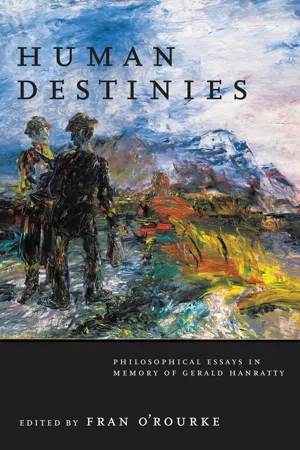
Human Destinies
eBook - PDF

Human Destinies

Philosophical Essays in Memory of Gerald Hanratty

  1. English
  2. PDF
  3. Available on iOS & Android
eBook - PDF

Human Destinies

Philosophical Essays in Memory of Gerald Hanratty

About this book

From 1968 until his death in 2003, Gerald Hanratty was professor of philosophy at University College Dublin. In this volume dedicated to his memory, Fran O'Rourke has assembled twenty-six essays reflecting Hanratty's broad philosophical interests, dealing with central questions of human existence and the ultimate meaning of the universe. Whether engaged in historical investigations into Gnosticism or the Enlightenment, Hanratty was concerned with fundamental themes in the philosophy of religion and philosophical anthropology.

Human Destinies brings together a wide range of approaches to these central questions. Included are historical studies of classical thinkers of the ancient and medieval periods (Aristotle, Plotinus, Augustine, Aquinas) and studies of numerous modern authors (among them, Kant, Husserl, Heidegger, Marcel, Adorno, Derrida, Plantinga, Scruton, and many others).

Contributors: Fran O'Rourke, Peter L. P. Simpson, Rowland Stout, Andrew Smith, Eoin G. Cassidy, Cyril O'Regan, Michael Nolan, Patrick Masterson, Tim Lynch, James R. O'Shea, CiarĂĄn McGlynn, Maria Baghramian, Mark Dooley, Brendan Purcell, Brendan Sweetman, CiarĂĄn Benson, Richard Kearney, Dermot Moran, Belinda McKeon, Brian Elliott, Eileen Brennan, Liberato Santoro-Brienza, Brian O'Connor, Timothy Mooney, David Walsh, and Gerard Casey.

Frequently asked questions

Yes, you can cancel anytime from the Subscription tab in your account settings on the Perlego website. Your subscription will stay active until the end of your current billing period. Learn how to cancel your subscription.
At the moment all of our mobile-responsive ePub books are available to download via the app. Most of our PDFs are also available to download and we're working on making the final remaining ones downloadable now. Learn more here.
Perlego offers two plans: Essential and Complete
  • Essential is ideal for learners and professionals who enjoy exploring a wide range of subjects. Access the Essential Library with 800,000+ trusted titles and best-sellers across business, personal growth, and the humanities. Includes unlimited reading time and Standard Read Aloud voice.
  • Complete: Perfect for advanced learners and researchers needing full, unrestricted access. Unlock 1.4M+ books across hundreds of subjects, including academic and specialized titles. The Complete Plan also includes advanced features like Premium Read Aloud and Research Assistant.
Both plans are available with monthly, semester, or annual billing cycles.
We are an online textbook subscription service, where you can get access to an entire online library for less than the price of a single book per month. With over 1 million books across 1000+ topics, we’ve got you covered! Learn more here.
Look out for the read-aloud symbol on your next book to see if you can listen to it. The read-aloud tool reads text aloud for you, highlighting the text as it is being read. You can pause it, speed it up and slow it down. Learn more here.
Yes! You can use the Perlego app on both iOS or Android devices to read anytime, anywhere — even offline. Perfect for commutes or when you’re on the go.
Please note we cannot support devices running on iOS 13 and Android 7 or earlier. Learn more about using the app.
Yes, you can access Human Destinies by Fran O'Rourke in PDF and/or ePUB format, as well as other popular books in Philosophy & Ancient & Classical Philosophy. We have over one million books available in our catalogue for you to explore.

Table of contents

  1. Cover
  2. Half title
  3. Frontispiece
  4. Title page
  5. Copyright
  6. Contents
  7. Introduction
  8. Chapter One: Human Nature and Destiny in Aristotle
  9. Chapter Two: Aristotle’s Self
  10. Chapter Three: Mechanisms That Respond to Reasons
  11. Chapter Four: Plotinus on Fate and Free Will
  12. Chapter Five: A Zealous Convert
  13. Chapter Six: Answering Back
  14. Chapter Seven: Man’s Natural Condition
  15. Chapter Eight: Philosophical Sources of Aquinas’ Quarta Via
  16. Chapter Nine: Philosophy and Its Value
  17. Chapter Ten: Kant and Dennett on the Epistemic Status of Teleological Principles
  18. Chapter Eleven: Human Nature and One-Eyed Reason
  19. Chapter Twelve: Relativism and Religious Diversity
  20. Chapter Thirteen: The Plagues of Desecration
  21. Chapter Fourteen: Dawkins’ Fear of Reason
  22. Chapter Fifteen: The Experiential Argument for the Existence of God in Gabriel Marcel and Alvin Plantinga
  23. Chapter Sixteen: A Secular Spirituality?
  24. Chapter Seventeen: Eucharistic Imagination in Merleau-Ponty and James Joyce
  25. Chapter Eighteen: Immanence, Self-Experience, and Transcendence in Edmund Husserl, Edith Stein, and Karl Jaspers
  26. Chapter Nineteen: Presuming the Other from Stein to Husserl
  27. Chapter Twenty: The Unity of Thought in Aristotle, Kant, and Heidegger
  28. Chapter Twenty-one: Communication, Struggle, and Human Destiny
  29. Chapter Twenty-two: Forgetting Aristotle?
  30. Chapter Twenty-three: Immanent Transcendence?
  31. Chapter Twenty-four: On Losing Uniqueness
  32. Chapter Twenty-five: The Person and the Common Good
  33. Chapter Twenty-six: Ethics and Economics
  34. Contributors
  35. Index