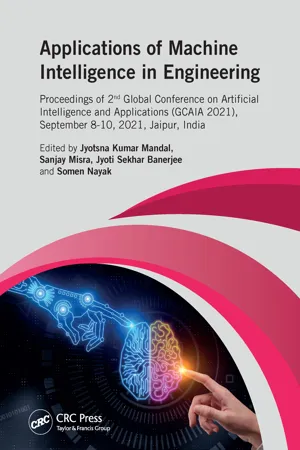
Applications of Machine intelligence in Engineering
eBook - ePub

Applications of Machine intelligence in Engineering

Proceedings of 2nd Global Conference on Artificial Intelligence and Applications (GCAIA, 2021), September 8-10, 2021, Jaipur, India

  1. 620 pages
  2. English
  3. ePUB (mobile friendly)
  4. Available on iOS & Android
eBook - ePub

Applications of Machine intelligence in Engineering

Proceedings of 2nd Global Conference on Artificial Intelligence and Applications (GCAIA, 2021), September 8-10, 2021, Jaipur, India

About this book

The Global Conference on Artificial Intelligence and Applications (GCAIA 2021) provides a prominent venue for researchers, engineers, entrepreneurs, and scholar students to share their research ideas in the area of AI. Academic researchers would reveal the results and conclusions of laboratory based investigations via the GCAIA 21 platform, which bridges the gap between academia, industry, and government ethics. The GCAIA 21 platform will also bring together regional and worldwide issues to explore current advancements in contemporary Computation Intelligence.

This Conference Proceedings volume contains the written versions of most of the contributions presented during the conference of GCAIA 2021. The conference has provided an excellent chance for researchers from diverse locations to present and debate their work in the field of artificial intelligence and its applications. It includes a selection of 62 papers. All accepted papers were subjected to strict peer-review by 2–4 expert referees. The papers have been selected for this volume because of their quality and their relevance to the theme of the conference.

Trusted by 375,005 students

Access to over 1.5 million titles for a fair monthly price.

Study more efficiently using our study tools.

Information

Publisher
CRC Press
Year
2022
Edition
1
eBook ISBN
9781000645835

CHAPTER ONE An Enhanced Implementation of Security Management System (SSMS) using UEBA in Smart Grid based SCADA Systems

Abdul Wahid Mir and K. R. Ram Kumar
Chitkara University Institute of Engineering and Technology, Chitkara University, Punjab, India
DOI: 10.1201/9781003269793-1
AbstractSecurity pertaining to critical infrastructures based industrial control systems is of utmost importance to any nation owing to its operational dependency for sectors like nuclear stations, electricity services, transportation services, hospital services, water, and public services, etc. The cyberattacks and threats that include ransomware attacks, worms, trojans, ciyptomining, etc. are appearing in different forms and posing threats with high-risk stakes for the organizations. The new technologies like artificial intelligence (AI) and machine learning (ML) are not only used for business productivity but also used by cybercriminals as AI fuzzing, swarm-based attacks using self-learning, and even services like Malware as a Service (MAAS) abilities. The traditional security systems and procedures cannot handle and mitigate the growing volume of innovative polymorphic nature of threats that are either known or unknown. The hackers continue to innovate persistently, and findings new ways, leverage in compromised user credentials, traditional signatures, patterns, and rules applied within the defenses leading to minimal ability to detect the attacks. This paper presents a proposal to implement User and Entity Behavior Analytics (UEBA) for electricity utilities using SCADA systems. It also summarizes the review of top twenty solutions available in the market.
Keywords—SCADA, critical infrastructure, end user-based analytics, security systems, smart grid, industrial control systems (ICS)

I. INTRODUCTION

The security of critical national infrastructure remains the serious threat as it is being focus targeted by various entities due to its vital importance for any given country [1]. It remains highest priority for the nations to address the security in such critical service areas of that include electricity, transportation, water, gas, hospitals and other equally important services or systems that are essential part of our daily lives. In present world, without availability of even one of such services can be unnerving and devastating. With the convergence of information technology (IT) and operational technology (OT), in order to advance in this cyber age, the ICS vendors shifted from airgapped and serial systems offering to off-the-shelf commercial solutions with the internet protocol (IP) platform features [2]. The transition has enhanced the visibility and connectivity of the infrastructure and systems but also have exposed the vulnerabilities to the same level of enterprise or corporate networks.
Securing industrial control systems based supervisory control and data acquisition (SCADA) systems is very critical and arduous challenge in present age of sophisticated threat landscape that continues to evolve in scale. With the know history of high-profile attacks, ransomware attacks at global level and the cryptomining malware cases on rise, organizations need to step up the security controls specifically in extremely critical services sectors like that of electricity utilities. The organizations need to implement right controls, processes, and procedures in conjunction with new technologies, frameworks, and security requirements.
It is reported that the thirty percent of the data breaches within an organization is directly associated with the insiders within the organizations who act either negligently or maliciously resulting in the data breaches. Since there is implicit trust for insiders, they pose an inimitable threat to an organization as they have access privileges to most of the systems with options to evade security controls thus establishing themselves as the blind spots for the security teams monitoring the security of the systems.
One of the key issues in the security is the human factor. The source to various threats and vulnerabilities are humans which makes it important to monitor their behavior in order to identify any possible malicious activities they are part or responsible for. The ability to monitor users for any violations and to profile and analyze their activities, the User and Entity Behavioral Analytics (UEBA) [3] solution can be deployed.
This paper presents a User and Entity Behavior Analytics (UEBA) solution that can be implemented for electricity utilities using SCADA systems. It also summarizes the review of top twenty solutions available in the market.

II. USER AND ENTITY BEHAVIOR ANALYTICS (UEBA)

UEBA is a valuable system for the security teams to detect any malicious activity happening within the network. It monitors the user’s activities; hardware devices and networks log with the already set b...

Table of contents

  1. Cover Page
  2. Half-Title Page
  3. Title Page
  4. Copyright Page
  5. Table of Contents
  6. List of Figures
  7. List of Tables
  8. Acknowledgements
  9. Preface
  10. Foreword
  11. 1 An Enhanced Implementation of Security Management System (SSMS) using UEBA in Smart Grid based SCADA Systems
  12. 2 An Analysis to Understand Various Image Steganography Techniques
  13. 3 Review on Collaboration and Coordination Between NPU, Artifcial Neural Network & Deep Learning
  14. 4 An Effcient Solution for Choosing a Reliable Pathway in Wireless Body Area Networks
  15. 5 The Capteur: IoT based Device used for Real-time Scenario Analyzing
  16. 6 A Survey on Parallel Clustering Techniques for Big Data Framework
  17. 7 Message Authentication over Network using IoT Architecture
  18. 8 Relationship between Independent and Dependent Variables and Calculating the Accuracy of Predicted and Actual Values using Linear Regression Method of Machine Learning
  19. 9 Comparative Study of IoT Protocols: RPL vs LIBP and its Thwarting Issues
  20. 10 Prediction of Liver Disorders Using Simple Logistic Technique of Machine Learning .... by Arshdeep Kaur and Anil Kumar
  21. 11 IoT based Alcohol Detection System for Small Organization
  22. 12 Cognition of UnQL Queries in Context Database using Decision Tree
  23. 13 Indoor Navigation System using Augmented Reality
  24. 14 Optical Character Recognition using Deep Learning Techniques
  25. 15 Deep Learning In Medical Imaging: A Review
  26. 16 An Intelligent Chatbot for Admission System of an Educational Institute and Prediction of User Interest in Taking Admission
  27. 17 Naari: A Women Safety Application
  28. 18 A Virtual Book based on Human Anatomy
  29. 19 Crime by Crowd is Not Crime any More: A Predictive Analysis of Riot and Radicalization Oriented Text of Social Media
  30. 20 Computer Aided Segmentation of Oral Mucosa to Detect Cancer
  31. 21 Assessing the Concerns of People in the Pandemic Situation: An Analytical Approach on the Social Media Data
  32. 22 Sentiment Analysis of Online Reviews for Educational Institutions
  33. 23 IoT based Automated Vehicle Parking System
  34. 24 Employopedia: Bridge the Gap of Employability
  35. 25 The River Cleaning Trash Bot
  36. 26 Progressive Cleaning and Mining of Uncertain Smart Water Meter Data
  37. 27 Spatial Domain Least Signifcant Bit Method Latest Improvement’s
  38. 28 Comparative Study of Bagging Ensemble and ARIMA model for prediction of Covid-19 in India
  39. 29 FPGA Based MAC Units for Signal Processing Algorithms with Non-Binary Numeral System: An Effective Analysis
  40. 30 Using Data from In-Vehicle Recommender Systems to Predict Traveler Characteristics ...
  41. 31 An Artifcial Intelligence Based Path Estimation of Heterogeneous Droplets in Digital Microfuidic Biochip
  42. 32 The Prediction of Coronavirus using the Logistic Regression Technique of Machine Learning
  43. 33 A Modifed Backoff Algorithm for Performance Improvement of MANETs
  44. 34 Contactless Attendance and Temperature Monitoring System
  45. 35 MASKA: Mutual Authentication and Session Key Agreement Protocol in Global Mobility Networks
  46. 36 Patient Adaptive Heart Beat Classifcation System Using Kernel Based Feature Extraction Method
  47. 37 Data Management Framework for Resource Constrained IoT Applications
  48. 38 Using Machine Learning for Obesity Level Estimation
  49. 39 Multiclass Semantic Segmentation of COVID-19 CT Scan Images using Deep Learning ...
  50. 40 Sentiment Analysis using Machine Translation
  51. 41 An Automatic Summarization System to Understand the Impact of COVID-19 on Education
  52. 42 A Message Encryption Technology using Matrix
  53. 43 A Comparative Analysis of Copy-Move Forgery Detection Algorithms
  54. 44 Fruit Quality Assessment using VGG16 and ImageNet Based Transfer Learning Technique
  55. 45 Industry 4.0 in Dairy: Application of Machine Learning for Product Classifcation
  56. 46 Real-Time Facial Expression Recognition using CNN
  57. 47 Human Identifcation by Gait using Body-Worn Sensors
  58. 48 Android Malware Detector Based on Hybrid Features
  59. 49 Green IoT for Intelligent Cyber-Physical Systems in Industry 4.0: A Review of
  60. 50 AI Algorithm-based Triangulation Modelling in Aerospace Vehicular Applications
  61. 51 Conversational Question Answering System using RASA Framework
  62. 52 On Analyzing the Twitter Usage and Sentiment in India During the
  63. 53 Comparative Analysis of Various Text Summarization Techniques via Leveraging Transformer Model for the Fake News Detection
  64. 54 A Comparative Review on Machine Learning Based Algorithms to Convert Handwritten Document to English Characters
  65. 55 Iris Recognition Using Transfer Learning of Inception V3
  66. 56 Cognitive Radio-Enabled Internet of Things (CR-IoT): An Integrated Approach towards Smarter World
  67. 57 Analyzing Challenges in Adoption of SIOT System by using Fuzzy AHP Methodology
  68. 58 Intelligent Vehicle Accident Detection and Smart Rescue System
  69. 59 A Review on Topological Data Analysis in Human Activity Recognition
  70. 60 Hydrone : IoT enabled Autonomous Underwater Vehicle for Aquatic Ecosystem Monitoring
  71. 61 IoT-Based Smart City for the Post COVID-19 World: A Child-Centric Implementation Emphasis on Social Distancing
  72. 62 Infrared Gait Recognition using Point Light Animation and Spatio-Temporal Features

Frequently asked questions

Yes, you can cancel anytime from the Subscription tab in your account settings on the Perlego website. Your subscription will stay active until the end of your current billing period. Learn how to cancel your subscription
No, books cannot be downloaded as external files, such as PDFs, for use outside of Perlego. However, you can download books within the Perlego app for offline reading on mobile or tablet. Learn how to download books offline
Perlego offers two plans: Essential and Complete
  • Essential is ideal for learners and professionals who enjoy exploring a wide range of subjects. Access the Essential Library with 800,000+ trusted titles and best-sellers across business, personal growth, and the humanities. Includes unlimited reading time and Standard Read Aloud voice.
  • Complete: Perfect for advanced learners and researchers needing full, unrestricted access. Unlock 1.5M+ books across hundreds of subjects, including academic and specialized titles. The Complete Plan also includes advanced features like Premium Read Aloud and Research Assistant.
Both plans are available with monthly, semester, or annual billing cycles.
We are an online textbook subscription service, where you can get access to an entire online library for less than the price of a single book per month. With over 1.5 million books across 990+ topics, we’ve got you covered! Learn about our mission
Look out for the read-aloud symbol on your next book to see if you can listen to it. The read-aloud tool reads text aloud for you, highlighting the text as it is being read. You can pause it, speed it up and slow it down. Learn more about Read Aloud
Yes! You can use the Perlego app on both iOS and Android devices to read anytime, anywhere — even offline. Perfect for commutes or when you’re on the go.
Please note we cannot support devices running on iOS 13 and Android 7 or earlier. Learn more about using the app
Yes, you can access Applications of Machine intelligence in Engineering by Jyotsna Kumar Mandal, Sanjay Misra, Jyoti Sekhar Banerjee, Somen Nayak, Jyotsna Kumar Mandal,Sanjay Misra,Jyoti Sekhar Banerjee,Somen Nayak in PDF and/or ePUB format, as well as other popular books in Computer Science & Computer Science General. We have over 1.5 million books available in our catalogue for you to explore.