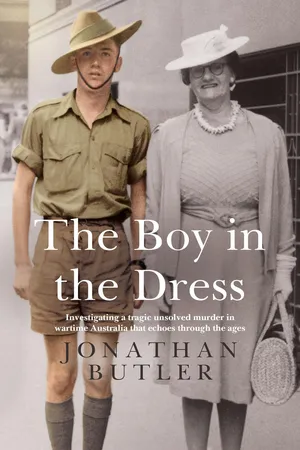
On a balmy Townsville night in 1944, a young serviceman, Warwick Meale, is found murdered. The army and police do not, or will not, conduct a proper investigation and history forgets the killer - until now. Nearly eighty years on, Warwick's descendant Jonathan Butler dusts off the case and chases the leads that were there all along.The Boy in the Dress exhumes secrets of life on the home front during World War II, where tensions between soldiers boiled over, new expressions of sexuality flourished and the threat of invasion catapulted the status quo into disarray.The truth of this family legend, and this little-known chapter in Australian military history, is more complex and engrossing than anyone could have imagined.
eBook - ePub
The Boy in the Dress
Searching for the truth behind a historical hate crime on home soil during WWII
- 288 pages
- English
- ePUB (mobile friendly)
- Available on iOS & Android
eBook - ePub
The Boy in the Dress
Searching for the truth behind a historical hate crime on home soil during WWII
About this book
Information
Subtopic
World HistoryIndex
HistoryCHAPTER 1
‘OUT COLD’
Signalman Clyde Neumann burst through the entrance of a Townsville Military Police tent at 11.40pm, Tuesday 15 August 1944. He had fresh blood on his hands and down his front. Breathless and sweating, he wiped at his damp hair with the back of his hand.
‘One of my cobbers has been booted pretty bad, maybe hit over the head with a bottle or something. He needs a doctor, quick!’ Neumann said.
Provost Corporal John Colquhoun, the Military Police officer on the graveyard shift, sat up and pushed his papers aside. A single light globe illuminated the tent, which had a temporary wooden floor and just enough space for a few pieces of repurposed furniture. There had been a dance earlier in the evening and Colquhoun would have been used to seeing thirsty young men – emboldened by the carelessness that comes with a limited stay – flooding into Townsville to get drunk, get into fights and get lucky. And there was no doubt the man who’d just rushed into the tent had been drinking.
‘He’s out cold. Where’s the closest hospital?’ said Neumann.
‘We’ll need to drive,’ Colquhoun replied. His depot wasn’t important enough to have one of the rationed Australian Army vehicles. Colquhoun picked up the phone and dialled the number of the nearby American Military Police station. Compared to the Australians, the Americans seemed to have an endless supply of resources, including vehicles.
Moments later, a pair of American Military Police arrived in their jeep, and the two Australian soldiers jumped in. Neumann directed them towards Ross Creek, the waterway that snakes its way through Townsville and divides the city in two. Along the way, they passed the Toc H services club. People were stumbling out of the venue and onto the street. The war had tripled Townsville’s once-modest population and now there were servicepeople everywhere. As the jeep approached Victoria Bridge, at the end of Hanran Street, Neumann told them to pull over.
The beam of the jeep’s headlights lit the otherwise pitch-black creek bank. In the pool of light lay the limp body of a young, uniformed Australian soldier. His head was cradled in the lap of a fellow signalman, Thomas Ambler, who was sitting in front of a fence that adjoined a concrete air-raid shelter. Ambler looked up with relief. The group from the jeep ran towards the injured soldier. Dry blood covered the victim’s entire face.
‘He hasn’t spoken a word,’ said Ambler.
Colquhoun could immediately see that this was a bad one. ‘We need to get this soldier into the vehicle,’ he said. The unconscious man was carried up the grassy bank and lowered into the back of the jeep.
At his depot, Colquhoun ordered Neumann and Ambler to lay their injured friend down on the floor while he phoned for a military ambulance. With the ambulance on its way, Colquhoun tried to rouse the soldier, to no effect. The only evidence that he was still alive was a faint pulse. Blood still trickled down his face, matting his hair into clumps. Colquhoun unbuttoned the soldier’s shirt in search of an identity disc to confirm the soldier’s name, but his neck was bare. Picking up his slack arm, he noted that he was wearing a watch. He then checked the soldier’s pockets. Along with a few coins, he found a small piece of paper. Pulling it out into the light, he instantly recognised it as a leave pass. In the top-right corner was written ‘Sig Meale W.S.’ – Signalman Warwick Sidney Meale. The pass was valid for another fifteen minutes, until midnight.
A few minutes later, Colquhoun watched as the ambulance disappeared down the dark street. Back in the tent – where a pool of blood was smeared on the floor – Colquhoun ordered Neumann and Ambler to sit down. It was time for them to explain what the hell had led to this mess.
CHAPTER 2
THE WAR IN WARWICK
In the Sydney of 1923, construction had just begun on the Harbour Bridge. A telephone link between the harbour city and Brisbane had opened for the first time. A forerunner of the modern Anzac Day dawn service, commemorating World War I and the massive toll of war, was held on 25 April. And, on 9 November, Irene and Sidney Meale welcomed their second son, a boy they named Warwick Sidney.
Warwick’s family home was on Cameron Avenue in the south-western Sydney suburb of Earlwood. By the 1920s, 40 per cent of Sydney’s population growth was happening around Warwick’s home, as World War I veterans snapped up cheap farmland that had been rezoned. Record numbers of houses and factories were being built, the streets were newly lit by electric lights and the scales had just tipped towards motor vehicles over horse-drawn carts.
The Meale home had a front veranda enclosed by two columns, a red-tile gabled roof, impeccable hedges and a deep-brown brick-and-white-plasterboard facade. There was a compact backyard with a patch of grass and a shed. It was in this backyard that Irene took the photo of young Winifred and Warwick playing Mummies and Daddies.
Warwick’s mother, who went by the name Rene (pronounced Ree-nee), was a boisterous and energetic woman with social ease and creative flair. She liked to dress her boys up in costumes, though Warwick’s older brother, Neville, preferred sailor’s uniforms to dresses.
As a girl, my maternal grandmother, Winifred, lived only a short bike ride from her cousin Warwick. She would babysit him often, making sure that he was fed and in bed before her aunt and uncle returned from a night out. Warwick and Winifred were nine years apart, but they didn’t let the age gap come between them. In fact, it drew them closer. They shared a special bond. They were pseudo-siblings, brought closer by the shared scars of being forgotten by their considerably older brothers and sisters.
Warwick’s family was more financially stable than Winifred’s. Winifred was forced to leave school when she was just twelve to start earning an income to bolster her father’s salary as a builder. Warwick’s father, Sidney, worked as a clerk at the local Canterbury council, earning a salary in today’s terms of approximately $34,500 (£264 8s 1d). The salary was enough to keep Warwick in school for three years more than Winifred. It also protected them from the worst of the Great Depression in 1929. Many houses were foreclosed in Warwick’s suburb and the poorest families were evicted for failing to pay rent – many had no choice but to move to an unemployment camp.
Earlwood Public School, an austere building crowned with many chimneys, was only a four-minute walk away from the Meale family home. Children between the ages of seven and fourteen were required to attend school for only two hours in the morning and two hours in the afternoon. Warwick passed his final primary exam and continued on to secondary school, completing the three years to obtain his Intermediate Certificate.
From there, Warwick landed a job as a sales assistant. He would ride the tram into the city to work the shop floor. Much glamour and excitement must have greeted the sixteen-year-old, with new high-rises and fast trains that zoomed over the awe-inspiring Sydney Harbour Bridge.
But dark clouds were looming. On Sunday 3 September 1939, the Meale family gathered to celebrate Father’s Day with Sidney. Later that evening, at 9.15pm, the city ground to a halt. Cinemas stopped rolling film, bands stopped playing and radio serials were cut short. The voice of prime minister Robert Menzies could be heard on every radio station, making an announcement that would change the course of so many lives forever.
War was once again declared in Europe, just as the worst of the Depression had begun to ease and Warwick was entering adulthood. Soldiers in their freshly minted uniforms were everywhere he looked, marching through the streets of Sydney and in his mum’s magazines. US president Franklin D Roosevelt and British prime minister Winston Churchill stipulated a ‘beat Hitler first’ strategy for the Allied forces, which prioritised defeating Germany, even in the event that Japan entered the war. Shiploads of Australian soldiers were sent to the Northern Hemisphere to aid in the war effort in the European Theatre.
Two years later, the country was rocked again. Japanese forces were advancing through the Pacific towards Australia, and in January 1942, a month after Japan’s surprise attack on the US naval base at Pearl Harbor, Warwick went to the enlistment hall in the nearby suburb of Belmore. The government had only just dropped the minimum enlistment age to eighteen from nineteen years old, and Warwick had celebrated his eighteenth birthday two months earlier. But, because he was under twenty-one, Warwick needed his father to accompany him and grant consent for his youngest boy to join the army.
Inside Belmore Hall, boards divided the space into cubicles for interviews. Other areas of the hall were sectioned off for aptitude testing, photographs and medical examinations. The air was stiflingly hot. The day before had been a sweltering 42 degrees, the hottest day Sydney had seen for three years. Warwick and Sidney took a seat in the rows of benches next to the other men. All around them, railway surveyors, carpenters, bricklayers, bootmakers and salesmen sat sweating in their high-waisted trousers and wide-collared shirts, all ready to swap their day jobs for a job with the armed forces.
It must have been difficult for Sidney to watch his youngest boy follow in the footsteps of Sidney’s brother, Frederick, who had died on the Gallipoli Peninsula at the age of twenty during World War I. The Australian Army didn’t know exactly which day Frederick had been killed: his military files state that it was sometime between 6 and 9 August 1915. Frederick’s battalion had been among the third wave of troops to land on the peninsula, desperately wading ashore through a hail of bullets, scaling cliffs and battling the enemy with bare hands and bayonets. Though it was ultimately a disastrous and crushing defeat, the Australian media of the time portrayed the ‘landings’ at Gallipoli as ‘a cheerful, quiet, confident, nerveless race of athletes’. Frederick was one of more than 8000 Australian casualties at Gallipoli. His belongings were shipped back to his grieving family: a hymn book, a soap case, a pack of cards, letters, eight coins, camera film, a money belt and photos. Sidney and Rene would later preserve Frederick’s memory in the middle name of their first son, Neville Frederick Meale, who was born a year before the end of World War I.
It’s a mystery as to what motivated Warwick to enlist on that sunny summer’s day in 1942. He had a good job. He’d lost an uncle to World War I and conscription wouldn’t begin until several months later. It seems unlikely that there was any pressure from Warwick’s family for him to sign up. His father and older brother never did. His cousin Winifred loathed the war. And Warwick was probably aware that some new recruits faced social stigma, being labelled ‘economic conscripts’ or even ‘5-bob-a-day murderers’ for signing up in the name of employment security. But perhaps he, like so many Australians at the time, genuinely feared for Australia’s future. Or perhaps he liked the prospect of adventure, far away from his family and the small Sydney bubble he had been confined to growing up. There was the allure of the personal challenge, too. He may have simply wanted to prove to himself that he could be a soldier.
~
‘Next,’ called the attendant at the enlistment desk.
Warwick took a seat and started to fill out his paperwork, now preserved in the National Archives of Australia. It is one of the precious few primary documents I have of Warwick’s life. The attendant pulled out a small blue form and reeled off the questions:
‘Can you drive a motor vehicle?’
‘No.’
‘Can you cook?’
‘No.’
‘Can you use a typewriter?’
‘No.’
‘Do you have any experience in signalling wireless?’
‘No.’
‘Do you have any experience in Morse code?’
‘No.’
‘Can you write shorthand, keep accounts or play a band instrument?’
‘No.’
Warwick’s eighteen years in the city hadn’t given him the opportunity to develop any vocational skills, but he had received a good education. He scored well on the aptitude test. Next up was the medical examination. After clearing him of ingrown toenails and dandruff, the medical officers looked in Warwick’s ears, tested his eyesight and made him cough to check for piles. A cold stethoscope was pressed to his chest and back, and they took note of his blue eyes and brown hair. They searched for distinctive marks, finding none. Finally, they took his body measurements, noting his slim physique.
Two weeks later, he received a letter from the Australian Army. He was in.
~
I have two photographs of Warwick as a teenager. The first is a group shot of the Meale family, taken in the backyard of their Cameron Avenue home. Warwick is already wearing his informal summer military uniform, so it was sometime between him enlisting in January and commencing his basic training in February. Tucked behind his ...
Table of contents
- Cover
- About the Author
- Title
- Copyright
- Dedication
- Contents
- Author’s Note
- Preface
- Chapter 1: ‘Out Cold’
- Chapter 2: The War in Warwick
- Chapter 3: The Linesmen
- Chapter 4: Back Home
- Chapter 5: Me in a Dress
- Chapter 6: Big Night Out
- Chapter 7: Just a Little Blood
- Chapter 8: After the Dance
- Chapter 9: In Warwick’s Footsteps
- Chapter 10: ‘A Shocking State of Affairs’
- Chapter 11: ‘Three Silly Sailors’
- Chapter 12: Detective Work
- Chapter 13: Hot-Set
- Chapter 14: Post-Mortem
- Chapter 15: The Big Blond
- Chapter 16: The Yanks
- Chapter 17: Cover of Darkness
- Chapter 18: Sex and Soldiers
- Chapter 19: A Prophecy Comes True
- Chapter 20: Magnetic Island
- Chapter 21: Troubled Waters
- Chapter 22: Blackout
- Chapter 23: Frank Flies In
- Chapter 24: Me in a Time Capsule
- Chapter 25: The ‘P’ Word
- Chapter 26: Jack
- Chapter 27: The ‘Girls’ in New Guinea
- Chapter 28: Section 8
- Chapter 29: The Deserters
- Chapter 30: Single Ladies
- Chapter 31: After the Inquest
- Chapter 32: Death in the Paddock
- Chapter 33: ‘A Suggestion Has Been Made’
- Chapter 34: Norm’s Word
- Chapter 35: Mum’s News
- Chapter 36: Elusive Peace
- Chapter 37: ‘Gay Panic’
- Chapter 38: Breaking Ranks
- Chapter 39: ‘Tomfoolery’
- Chapter 40: Liberation
- Chapter 41: The Unknown
- Chapter 42: Tom and Clyde
- Chapter 43: Journey’s End
- Acknowledgements
- Image Credits
- Pictures Sections
Trusted by 375,005 students
Access to over 1.5 million titles for a fair monthly price.
Study more efficiently using our study tools.
Frequently asked questions
Yes, you can cancel anytime from the Subscription tab in your account settings on the Perlego website. Your subscription will stay active until the end of your current billing period. Learn how to cancel your subscription
No, books cannot be downloaded as external files, such as PDFs, for use outside of Perlego. However, you can download books within the Perlego app for offline reading on mobile or tablet. Learn how to download books offline
Perlego offers two plans: Essential and Complete
- Essential is ideal for learners and professionals who enjoy exploring a wide range of subjects. Access the Essential Library with 800,000+ trusted titles and best-sellers across business, personal growth, and the humanities. Includes unlimited reading time and Standard Read Aloud voice.
- Complete: Perfect for advanced learners and researchers needing full, unrestricted access. Unlock 1.5M+ books across hundreds of subjects, including academic and specialized titles. The Complete Plan also includes advanced features like Premium Read Aloud and Research Assistant.
We are an online textbook subscription service, where you can get access to an entire online library for less than the price of a single book per month. With over 1.5 million books across 990+ topics, we’ve got you covered! Learn about our mission
Look out for the read-aloud symbol on your next book to see if you can listen to it. The read-aloud tool reads text aloud for you, highlighting the text as it is being read. You can pause it, speed it up and slow it down. Learn more about Read Aloud
Yes! You can use the Perlego app on both iOS and Android devices to read anytime, anywhere — even offline. Perfect for commutes or when you’re on the go.
Please note we cannot support devices running on iOS 13 and Android 7 or earlier. Learn more about using the app
Please note we cannot support devices running on iOS 13 and Android 7 or earlier. Learn more about using the app
Yes, you can access The Boy in the Dress by Jonathan Butler in PDF and/or ePUB format, as well as other popular books in History & World History. We have over 1.5 million books available in our catalogue for you to explore.