- 336 pages
- English
- PDF
- Available on iOS & Android
About this book
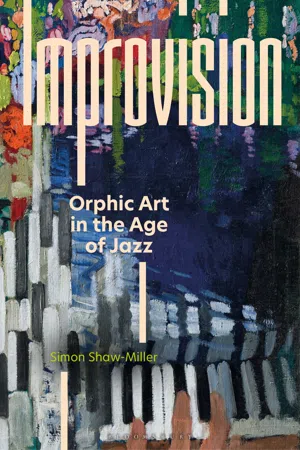
Central to the development of abstract art, in the early decades of the 20th century was the conception (most famously articulated by Walter Pater) that the most appropriate paradigm for non-figurative art was music. The assumption has always been that this model was most effectively understood as Western art music (classical music). However, the musical form that was abstract art's true twin is jazz, a music that originated with African Americans, but which had a profound impact on European artistic sensibilities. Both art forms share creative techniques of rhythm, groove, gesture and improvisation. This book sets out to theorize affinities and connections between, and across, two seemingly diverse cultural phenomena.
Tools to learn more effectively

Saving Books

Keyword Search

Annotating Text

Listen to it instead
Information
Table of contents
- Cover
- Halftitle page
- Title page
- Copyright page
- Dedication
- Contents
- Illustrations
- Acknowledgements
- Introduction and Theoretical Preliminaries: Art, Abstraction and All That Jazz
- 1 The Sight and Sound of Nascent Jazz: Words, Definitions and Rags
- 2 Orphism and a New Tune I: Dance, Music, Painting
- 3 Orphism and a New Tune II: Words, Music, Image
- 4 Orphism in America: Art, Machines and Jazz Rhythm
- 5 Objects, Improvisation and Rhythm: Kandinsky, Duchamp and Beyond
- Index
Frequently asked questions
- Essential is ideal for learners and professionals who enjoy exploring a wide range of subjects. Access the Essential Library with 800,000+ trusted titles and best-sellers across business, personal growth, and the humanities. Includes unlimited reading time and Standard Read Aloud voice.
- Complete: Perfect for advanced learners and researchers needing full, unrestricted access. Unlock 1.4M+ books across hundreds of subjects, including academic and specialized titles. The Complete Plan also includes advanced features like Premium Read Aloud and Research Assistant.
Please note we cannot support devices running on iOS 13 and Android 7 or earlier. Learn more about using the app