Hitchcock was a masterful director, popular with audiences of all ages and critically acclaimed both during and after his unusually long career. What may have been sensed by many viewers but not fully articulated until now is the extent to which his works subtly engage philosophical themes: What is evil, and how does it shield and reveal itself? Can we know what is inside the mind of another person? What is at stake when one knows the truth but cannot speak of it or cannot persuade others? How is Hitchcock's loving critique of humanity manifested in his films? Why are Hitchcock's works so often ambiguous? What is the hidden purpose and theory behind his use of humor?
Hitchcock employs cinematic techniques–from camera angles and use of light to editing and sound–partly to convey suspense and drama but also to engage and advance philosophical issues, ranging from identity crises to moral ugliness.
Roche unlocks Hitchcock's engagement with philosophical themes, and he does so in a way that appeals to both the novice and the seasoned philosopher, as well as enthusiastic admirers of Hitchcock's films.
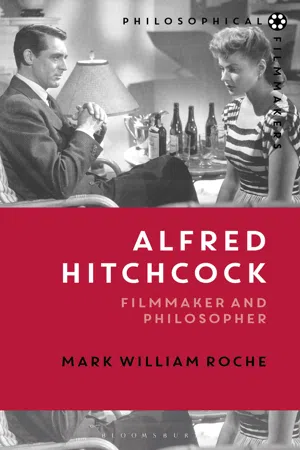
- 216 pages
- English
- ePUB (mobile friendly)
- Available on iOS & Android
eBook - ePub
About this book
Information
Chapter 1 Hitchcock’s Philosophical Universe
Hitchcock’s engagement with philosophical questions ranges widely. His films give rise to questions concerning knowledge. They address the value of uncovering contradictions. Of central concern to him are power as the defining element of the social in modernity and the often deceptive ways in which evil surfaces in our world. Hitchcock repeatedly returns to a classical virtue (courage) and a Christian virtue (love). He also shows how love of an ideal can motivate courage. Finally, Hitchcock’s extensive portrayals of inhumanity and misfortune are nonetheless complemented by occasional glimpses of benevolence and providence.
Knowledge and Incongruities
What we can know, how we can know, and how we can know that what we think we know is true are significant philosophical questions. Hitchcock places knowledge at the forefront of his films. Often the audience knows more than the figures on the screen, a gap that drives suspense.1 Knowledge can be knowledge of different spheres: knowledge of an ideal realm, including knowledge of what we should do; knowledge of the physical world; knowledge of self; and knowledge of the social world, including other persons.
Following Vittorio Hösle, who revises Hegel’s three realms of reality and Karl Popper’s concept of three worlds, I explore Hitchcock in terms of four worlds.2 The first world is the world of ideal meaning, which includes mathematical truths and valid conceptual and logical arguments. Valid transcendental norms, including those concerning the dignity of the human being, to which Hitchcock affectionately refers, belong to this first realm. The other three realms fall within the spatiotemporal world. The second is the physical world, available to us through experience. It is the focus of the natural sciences, which seek to understand its laws and so its grounding in the first world. The physical world, including non-verbal gestures, provides clues concerning hidden motivations. When nature is prominent, as in the magnificent aged redwood trees in Vertigo, the vast fields in North by Northwest, or the horror of The Birds, film captures this second world as well as or better than any other art. The third world is the interior world, which we access through introspection and which forms the subject of psychology. It presupposes a physical world as its basis and reveals itself indirectly and partially through physical signs. Whereas long shots can evoke the majesty of the physical world, close-ups tend to capture physical representations of the mind, thus interweaving the second and third worlds. For Hitchcock, the “visual image” makes manifest “thought” (Hitchcock on Hitchcock 1.296). Reaction shots, “the juxtaposition of imagery relating to the mind of the individual,” also illuminate the third world (Bogdanovich 522). Reaction shots dominate in Rear Window. An intriguing third-world activity is self-deception, which we see with characters as diverse as Eve in Stage Fright and Devlin in Notorious. The fourth world is the social world, which involves the interaction of beings with interior dimensions and so builds on the third world as well as the second, where interior dimensions manifest themselves. The fourth world is the subject of both the humanities and the social sciences. This fourth world is the most fascinating, as it involves both interior and exterior realms. We can know the interior depth of other persons only through their physical and social manifestations. The fourth world also relates to the first: social norms, including also laws, seek (or at least should seek) their ultimate grounding in the first world. The fourth world is further related to the second insofar as the collective identity of a culture manifests itself in the natural landscape of a country and its most prominent physical symbols. Consider Saboteur, with its trip across the country, culminating at the Statue of Liberty.
Hitchcock’s films belong of course to the fourth world, but they are also physical entities, which we experience in the physical world, and they are the result of conscious acts. Moreover, they seek to portray meanings whose validity can be assessed in relation to the first world. Hitchcock engages then all four worlds, though his primary interest is not the first or second world, but the psychological and social realms we find in the third and fourth worlds. Above all his fascination is with subject-subject relations, including how and to what extent a person knows others and how a hero can defend their position against evidence that seems to implicate the hero and against an external consensus that rallies against the hero.
Power and love are the two great intersubjective themes that dominate Hitchcock’s immersion in the fourth world. The MacGuffin, a desired object in the physical world, as with the uranium-enriched sand in Notorious, or a sought-after intellectual formula, as in The 39 Steps, is simply a stratagem to generate intersubjective action involving power, love, or both. In Hitchcock’s best films the two themes, power and love, are intertwined, as in Shadow of a Doubt, where a love relationship develops into a power struggle, or Notorious, where the spy story and love story are so interwoven that love and power are constantly at odds with one another. While power and love are the most important categories of the fourth world, they are also opposites. Power involves treating persons merely as means, whereas love presupposes that persons are also ends. Power is necessarily asymmetrical, whereas love culminates in symmetry. Power is something that in all but the most unusual cases involves will, force, and manipulation, whereas love cannot be forced. It must be a voluntary act and is often undeserved, animated by a kind of grace.
Because Hitchcock trusts in a moral universe and does not often focus on the hero’s intellectual anguish, his references to the first world, what transcends us and what we should do, tend to be implicit or given. Note that for a director who works mainly with visuals and wants to avoid photographs of people talking, the first world cannot be a primary focus. Nonetheless, Hitchcock offers a window on to the question, how we might access the first world. Many of his characters trust in goodness and display an intuitive suspicion of evil. Even in a work such as The Man Who Knew Too Much, which brings forward an intellectual quandary, in each version the scream (and thus the resolution of the conflict) comes seemingly from the subconscious. Films such as Spellbound and Rope give us the language to understand Hitchcock’s view of intuition as a mode of accessing a higher realm. Most Hitchcock heroes are intuitively moral and not at all self-reflective. Indeed, when it comes to morality and self-reflection, they tend to be self-deprecating. Self-righteousness surfaces instead among minor, unappealing characters, such as the coroner in Vertigo, who at the end of the inquest unleashes a tirade against Scottie, even as he exonerates him and remains oblivious to the truth, or Mr. Struck, who in Marnie is not only self-righteous but also lecherous, even as he denies it (which motivates others to roll their eyes). Sophistication, as we see with the villains in The 39 Steps, Saboteur, Notorious, and Rope, does not guarantee a moral compass any more than does majority opinion. Often the first world is evoked ex negativo by the way in which characters in the fourth world misjudge persons. The attack on consensus is an appeal to what is valid and what transcends what persons recognize—and thereby to what should be recognized because it is valid. The blind man in Saboteur, who falls in a long tradition, beginning with Tiresias, of insightful blind persons, states: “one’s duties as a citizen sometimes require breaking the law.” That is an appeal to the first world. Indeed, the widespread defiance of the law in Hitchcock, which we find with innocent heroes who flout the authorities and with their allies who break the law at some risk to themselves, such as Erica in Young and Innocent and Constance in Spellbound, underscores the director’s recognition that the first and fourth worlds differ.
Though a philosopher might criticize Hitchcock for not grounding his moral norms in reason, Hitchcock is decidedly not seeking to do philosophy but to create art and indeed art that elicits emotions and evokes mystery. Moreover, because his films convey meaning indirectly and integrate emotional motivation, their mode of communication differs radically from philosophical argument. One of Giambattista Vico’s insights is that it is not enough to ground philosophically the norms and institutions that give societies and cultures stability; we must also bond with them emotionally. In a society that offers endless reflection on the end of art and on art as negativity, Vico’s theory and Hitchcock’s works display the advantages of an alternative mode of art, whose emotional power can help bring us closer to values and to one another. The one Hitchcock film in which at the very center is a longing for something like the first world, a yearning for transcendence, for ideal beauty, for a union with what goes beyond everyday, empirical reality is Vertigo, which offers a distinctive cinematic achievement, for it is a film about what cannot be visualized. Even here, then, Hitchcock gives us an emotional, not a rational, connection, to the worlds.
Given his fascination with power and evil, Hitchcock dwells less vigorously on the second world, though The Birds is an obvious exception, even if in this film the threat from the natural world is another way of opening up human relations. Other exceptions, such as the massive rock formations in The Manxman and the rolling autumn landscape in The Trouble with Harry, underscore via tragedy and comedy, respectively, that the individual alone is not fully in charge of their fate or destiny.
Identity crises and struggles with how one should relate to the world play roles in many Hitchcock films. A thinker who explores fear is naturally drawn to the unconscious. Take Notorious, where after feeling ashamed by her father’s postwar adherence to the Nazis, Alicia loses herself in alcohol and then longs for some form of recognition, be it by finding love with Devlin or sacrificing herself for patriotism. Just as Hitchcock shows the value of trusting in the future, even as he makes us aware of evil rampant in the world, so he displays the interpersonal longing for trust, which is often thwarted by egoism, coldness, and cynicism. Each figure, Devlin and Alicia, does not want to be rejected, to land in an asymmetrical position of loving and not being loved, so they protect themselves; each holds back from declaring their love for the other—and so events unfold horrifically. Devlin stays silent and cold, remaining first and foremost a spy and not confessing his love for Alicia or even his faith in her, such that Alicia is reduced to a means; Alicia, in turn, expresses hatred toward Devlin, even as she loves him. This collective silence leads to Alicia’s dishonest relationship with Sebastian and eventually her being poisoned by him and her mother. And yet, we see the opposite as well. Sebastian trusts too quickly, too thoughtlessly, and is as a result betrayed by Alicia.
In Spellbound the hero suffers an acute identity crisis (he doesn’t even know who he is), which derives from his suppressing knowledge that is too difficult to bear. As Constance says to him, “You remain sane by forgetting something too horrible to remember.” Here knowledge follows a fascinating dialectic. Alex explains: “The human being very often doesn’t want to know the truth about himself, because he thinks it will make him sick. So he makes himself sicker trying to forget.” One must fight for knowledge—even about oneself, and gaining that knowledge can involve pain and risk. The hero, John, suffers an extreme version of an identity crisis virtually all persons undergo as they abandon earlier views by gaining a more complex mental framework. Constance herself undergoes a transition from one identity to another, moving from a focus on reason and book learning to an elevation of emotions and personal experience. The dual development is underscored by the two parallel lines that trigger John’s disturbances and act as a cinematic leitmotif.
But above all the exploration of intersubjective relations defines Hitchcock’s primary focus, the fourth world. Puzzles of knowledge bring together the third and fourth worlds, the relation of inner and outer and the individual’s relations to others. These also drive action: the hero’s desire for knowledge, the attempt to find exculpatory evidence, and the difficulties and possibilities of deciphering and combating evil. Furthermore, the audience recognizes incongruities as essential elements of cinematic horror and comedy. Knowledge thus drives a certain reception. Rarely does Hitchcock present mere physical power. That is too simple for his sense of nuance, complexity, and development. Instead, we see the search for knowledge and a contest of forces.
Vertigo, which displaced Citizen Kane in the most recent Sight and Sound ranking of the best films ever made, is arguably Hitchcock’s most interpreted film. Primar...
Table of contents
- Cover
- Half-title Page
- Dedication Page
- Series Page
- Title Page
- Contents
- List of Figures
- Acknowledgments
- Introduction
- Chapter 1 Hitchcock’s Philosophical Universe
- Chapter 2 Hitchcock as a Master of Form
- Chapter 3 Ambiguities in Shadow of a Doubt
- Chapter 4 Hitchcock’s Real and Apparent Gaps
- Chapter 5 Hitchcock and Beyond
- Notes
- Credits
- Works Cited
- Index
- Copyright Page
Trusted by 375,005 students
Access to over 1.5 million titles for a fair monthly price.
Study more efficiently using our study tools.
Frequently asked questions
Yes, you can cancel anytime from the Subscription tab in your account settings on the Perlego website. Your subscription will stay active until the end of your current billing period. Learn how to cancel your subscription
No, books cannot be downloaded as external files, such as PDFs, for use outside of Perlego. However, you can download books within the Perlego app for offline reading on mobile or tablet. Learn how to download books offline
Perlego offers two plans: Essential and Complete
- Essential is ideal for learners and professionals who enjoy exploring a wide range of subjects. Access the Essential Library with 800,000+ trusted titles and best-sellers across business, personal growth, and the humanities. Includes unlimited reading time and Standard Read Aloud voice.
- Complete: Perfect for advanced learners and researchers needing full, unrestricted access. Unlock 1.5M+ books across hundreds of subjects, including academic and specialized titles. The Complete Plan also includes advanced features like Premium Read Aloud and Research Assistant.
We are an online textbook subscription service, where you can get access to an entire online library for less than the price of a single book per month. With over 1.5 million books across 990+ topics, we’ve got you covered! Learn about our mission
Look out for the read-aloud symbol on your next book to see if you can listen to it. The read-aloud tool reads text aloud for you, highlighting the text as it is being read. You can pause it, speed it up and slow it down. Learn more about Read Aloud
Yes! You can use the Perlego app on both iOS and Android devices to read anytime, anywhere — even offline. Perfect for commutes or when you’re on the go.
Please note we cannot support devices running on iOS 13 and Android 7 or earlier. Learn more about using the app
Please note we cannot support devices running on iOS 13 and Android 7 or earlier. Learn more about using the app
Yes, you can access Alfred Hitchcock by Mark William Roche in PDF and/or ePUB format, as well as other popular books in Media & Performing Arts & Film History & Criticism. We have over 1.5 million books available in our catalogue for you to explore.