Under the Skin investigates the role of cross-cultural body modification in seventeenth-century and eighteenth-century North America, revealing that the practices of tattooing and scalping were crucial to interactions between Natives and newcomers. These permanent and painful marks could act as signs of alliance or signs of conflict, producing a complex bodily archive of cross-cultural entanglement.
Indigenous body modification practices were adopted and transformed by colonial powers, making tattooing and scalping key forms of cultural and political contestation in early America. Although these bodily practices were quite distinct—one a painful but generally voluntary sign of accomplishment and affiliation, the other a violent assault on life and identity—they were linked by growing colonial perceptions that both were crucial elements of "Nativeness." Tracing the transformation of concepts of bodily integrity, personal and collective identities, and the sources of human difference, Under the Skin investigates both the lived physical experience and the contested metaphorical power of early American bodies.
Struggling for power on battlefields, in diplomatic gatherings, and in intellectual exchanges, Native Americans and Anglo-Americans found their physical appearances dramatically altered by their interactions with one another. Contested ideas about the nature of human and societal difference translated into altered appearances for many early Americans. In turn, scars and symbols on skin prompted an outpouring of stories as people debated the meaning of such marks. Perhaps paradoxically, individuals with culturally ambiguous or hybrid appearances prompted increasing efforts to insist on permanent bodily identity. By the late eighteenth century, ideas about the body, phenotype, and culture were increasingly articulated in concepts of race. Yet even as the interpretations assigned to inscribed flesh shifted, fascination with marked bodies remained.
eBook - ePub
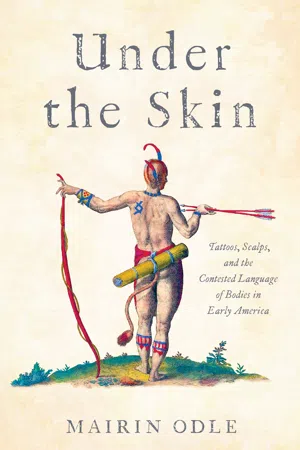
Under the Skin
Tattoos, Scalps, and the Contested Language of Bodies in Early America
- 192 pages
- English
- ePUB (mobile friendly)
- Available on iOS & Android
eBook - ePub
About this book
Information
CHAPTER 1 Pownced, Pricked, or Paynted
Colonial Interpretations, Indigenous Tattoos
In the watercolor, a woman stands with one foot hooked behind the other leg, her arms curved upward over her chest, hands resting on her shoulders. She gazes outward at the viewer, parallel dotted lines extending along her cheekbones, three vertical lines on her chin. A dark “V” in the center of her forehead and geometric bands encircling her bicep and calves complete her detailed tattoos. In addition to these marks, she is dressed simply in a fringed, knee-length skirt made of skin and a blue beaded necklace. The painter did not record this woman’s name, labeling the piece, “One of the wyves of Wyngyno”—one of the wives of Wingina, the chief ruler of the island of Roanoke.
The watercolorist, an Englishman named John White, wrote no other information about the sitter or her appearance. His title for the painting reflected his own society’s assumptions about gender and status, describing the woman solely through her relationship to an elite man. But for all that White failed to see, what he chose to record was also significant. This portrait, along with others made during the same journey, would be closely studied by many in England and be the inspiration for copies viewed widely throughout Europe. As viewers attempted to read the physical appearance of Native Americans, some focused on what they perceived as the “writerly” nature of tattoos, attempting to decipher the messages such marks might carry and questioning what tattooing said about the individuals and societies that practiced it.

Figure 1. Watercolor portrait by John White of an elite woman of the Pamlico River region, tattooed on her face, arms, and legs. White described her as “one of the wyves of Wyngyno,” referring to Wingina, the werowance of Roanoke. Undated watercolor [c. 1585]. © The Trustees of the British Museum, all rights reserved. Museum registration number 1906,0509.1.17.
In July 1585, John White stood aboard a ship named the Tyger and watched the coast of North America edge over the horizon. He had accompanied a similar voyage the previous year, but this time he had an additional reason to closely observe the landscape.1 He, along with several other members of the expedition, had been given specific orders to document crucial information about the plants, animals, landscapes, and people they might encounter. As gentleman-limner (or watercolor painter) for the voyage, White was expected to assist in mapping both the unfamiliar American terrain and the unfamiliar appearance of its people.2
He was joined by Thomas Harriot, mathematician, scientist, and scholarly polymath, who was charged with learning and translating local languages as well as writing an account of the region’s natural history and its cultures. Harriot’s account, published a few years later under the title A Briefe and True Report of the New Found Land of Virginia, was meant both as a report for the voyage’s sponsors and as an advertisement for potential investors in future colonial efforts. The exploratory expedition, under the sponsorship of Sir Walter Raleigh, made landfall in the Outer Banks of what is now known as North Carolina—a land known to its native Algonquian communities as Ossomocomuck.
Several years later, Harriot described the expedition’s arrival: “Wee came unto a Good bigg island, the Inhabitant[s] therof as soone as they saw us began to make a great an horrible crye, as people which never befoer had seene men apparelled like us.… Suche was our arrivall into the parte of the worlde, which we call Virginia, the stature of bodye of which people, their attire, and maneer of livinge … I will particullerlye declare unto you.”3 Harriot’s words, like White’s paintings, were tasked with describing the bodies of newly encountered people, and exploring the significance of physical appearance in cross-cultural settings.4 In their drawings and descriptions of Native tattoos, the chroniclers of this English expedition attempted to translate such markings and explore their limits as a communication system. English attention to Algonquian tattoos demonstrates that early English colonists did not see the Native societies of the Americas as exclusively oral cultures but rather as possessing complex media forms that they saw as analogous but not equivalent to their own writing. Such efforts to find and ascribe legibility could also function as a means of making people and places easier to colonize.
During such cross-cultural encounters, the outward appearances of new peoples attracted careful scrutiny. Judgments about the intentions, capabilities, and cultures of strangers started at the surface of their bodies. For early modern Europeans, observations of people were as much a form of navigation as observations of wind and ocean currents might be: both were means of understanding where exactly one was in the world.5 Travelers were urged to make systematic observations, writing, drawing, and collecting samples where possible. John White was expected to create maps of coasts and towns, paintings of animals and plants, and portraits of newly encountered people. While White’s exact orders no longer exist in the record, the directions given to the artist and surveyor for a proposed 1582 expedition, Thomas Bavin, were likely similar. His instructions requested that Bavin draw, among other things, “the figures and shapes on men and woeman in their apparrell as also their manner of wepons in every place as you shall finde them differing.”6
Given the space limitations and expenses faced by early exploratory voyages, the inclusion of an artist might seem like a luxury.7 But artists were crucial for recording information that was more clearly documented in images than in writing, particularly the costuming and appearance of foreign bodies. Such depictions also enabled firsthand interpersonal encounters to be interpreted and shared with those at a distance. Face-to-face embodied readings, potentially intense in affect, could thereby be translated—and moderated—and thus conveyed to others with no immediate knowledge of new peoples, through books, artwork, or spoken accounts.
Art and text complemented one another in early modern ethnographic accounts. Indeed, visual authority often took precedence over textual, in part because audiences for these works were not universally literate. The sixteenth century in Europe saw the emergence of a class of images designated by terms like contrafacta (counterfeit) and ad vivum (from the life): terms implying images were “uninterpreted nature” that recorded “things and events as they were witnessed by the eye, not as they were composed by the artist.” As art historian Michael Gaudio notes, this insistence that visual sources were neutral and unmediated was an “untenable yet hugely productive claim.”8 The untenable nature of the idea is itself flagged by the uneasy flexibility of “counterfeit” in early modern English usage. It was often a positive term, simply indicating a close portrayal or representation, yet by the late sixteenth century was beginning to acquire negative connotations in some contexts, indicating deceit and forgery.9 Images were no more unmediated than text, but such ideas were powerful and generated close attention to multiple media forms by European readers and viewers as they pondered how best to convey information.
Efforts to inventory novel aspects of unfamiliar societies were intended to catalog the distinguishing characteristics of a people: how to tell who was from one nation or another. They were also attempts to interpret individual intent: a stranger’s potential for violence or for trade and political alliance. Mapping people meant, especially, mapping their self-presentation, including dress, gesture, hairstyles, and bodily adornment.
In early modern Europe, these aspects of appearance that could be manipulated were often held to provide valuable insights into the culture and social status of their bearers—perhaps more so than bodily characteristics that might be innate.10 Clothing and body modifications (whether temporary or permanent) showed what people valued enough to change and how they wished to be perceived by others. Such elements also seemed to require the most translation. Particularly during initial meetings, when spoken communication seemed difficult or impossible, appearance and gesture provided much of the available knowledge.11 At the same time, because items such as clothing and hairstyles could be modified, there was always the possibility that physical appearance could be deliberately manipulated to deceive observers, making accurate observations and analysis crucial.12
In Native America, similar attentiveness was paid to the crucial information supplied by the dress and body modifications of strangers. The Carolina Algonquian communities who met John White and the other Englishmen on the 1585 voyage would have carefully examined their hairstyles (devoid of the asymmetrical scalp locks and topknots their own adult men usually wore), their pox scars (which Native people would soon, devastatingly, acquire), their jewelry and attire. Their interest in colonists’ clothing was apparent in one early miscommunication. During their efforts at human and geographic mapping, members of the Philip Amadas and Arthur Barlowe voyage of 1584 had reported that the land was called Wingandacoa. But a few years later, in an updated interpretation, Sir Walter Raleigh reported that “when some of my people asked the name of that Countrie, one of the Salvages answered Wingandacon which is to say, as you weare good clothes, or gay clothes.”13 Arthur Barlowe had also noticed Native interest in his crew members’ bodies, which he imputed to differences in skin tone: “They wondred mervelously when we were amongest them, at the whitenes of our skinnes, ever coveting to touch our breastes, and to view the same.”14 What Barlowe understood as wonder at “whitenes” may have been an investigation of English bodies for identifying marks, with Algonquians looking for information that could be concealed by European clothing.
Special scrutiny was given to permanent body modifications that decorated the skin: what Bavin’s orders had called “the figures and shapes on men and woeman.” Such marks required commitment, signaling something important enough that physical pain and changing one’s appearance forever was worth it. They were also cultural emblems, “consciously assumed markers” of self-presentation, that seemed harder to falsify or misrepresent than jewelry that might be taken off or paint that might be washed away.15 Attempting to learn what such bodily signs communicated was a pressing concern for both newcomers and natives, as urgent as learning a stranger’s “manner of wepons.”
The mapping efforts of cross-cultural encounters could be considered a process of translation on several levels—not just efforts to learn what others were saying but also attempts to make the unfamiliar legible and manageable within one’s own cultural norms. Issues of language and translation function as metaphors for the broader processes of colonization, mapping new places and peoples into familiar categories. Controlling language and even defining its forms acted as crucial parts of the contest for linguistic, cultural, and political power in early America.16
Early North American encounters between colonizing groups and Native Americans were therefore negotiated via an embodied form of reading, and one of the most visible sign systems available for such translation was tattooing. Tattoos have historically been a widespread practice in Native North American societies, performing a range of symbolically powerful, communicative work within and between human communities, as well as with other-than-human persons or supernatural beings.17 Tattoos traditionally enacted a range of cultural work both through the chosen iconography and the act of tattooing, which took ritualized form in both religious and secular ceremonies. The functions of tattooing have varied widely among Native American societies, from signaling military honors and marking life stages to accessing sacred power, communicating with other-than-human persons, and enabling the performance of gender roles. While direct archaeological evidence for tattooing in the coastal Carolinas has been difficult to trace, a number of items found in sites across the Southeast are thought to be parts...
Table of contents
- Cover
- Series Page
- Title Page
- Copyright
- Contents
- Introduction. Stories Written on the Body
- Chapter 1. Pownced, Pricked, or Paynted: Colonial Interpretations, Indigenous Tattoos
- Chapter 2. The “Ill Effects of It”: Reading and Rewriting the Cross-Cultural Tattoo
- Chapter 3. Pricing the Part: Economies of Violence and Stories of Scalps
- Chapter 4. Playing Possum: Scalping Survivors and Embodied Memory
- Epilogue. Narrative Legacies and Settler Appropriations
- Notes
- Index
- Acknowledgments
Trusted by 375,005 students
Access to over 1.5 million titles for a fair monthly price.
Study more efficiently using our study tools.
Frequently asked questions
Yes, you can cancel anytime from the Subscription tab in your account settings on the Perlego website. Your subscription will stay active until the end of your current billing period. Learn how to cancel your subscription
No, books cannot be downloaded as external files, such as PDFs, for use outside of Perlego. However, you can download books within the Perlego app for offline reading on mobile or tablet. Learn how to download books offline
Perlego offers two plans: Essential and Complete
- Essential is ideal for learners and professionals who enjoy exploring a wide range of subjects. Access the Essential Library with 800,000+ trusted titles and best-sellers across business, personal growth, and the humanities. Includes unlimited reading time and Standard Read Aloud voice.
- Complete: Perfect for advanced learners and researchers needing full, unrestricted access. Unlock 1.5M+ books across hundreds of subjects, including academic and specialized titles. The Complete Plan also includes advanced features like Premium Read Aloud and Research Assistant.
We are an online textbook subscription service, where you can get access to an entire online library for less than the price of a single book per month. With over 1.5 million books across 990+ topics, we’ve got you covered! Learn about our mission
Look out for the read-aloud symbol on your next book to see if you can listen to it. The read-aloud tool reads text aloud for you, highlighting the text as it is being read. You can pause it, speed it up and slow it down. Learn more about Read Aloud
Yes! You can use the Perlego app on both iOS and Android devices to read anytime, anywhere — even offline. Perfect for commutes or when you’re on the go.
Please note we cannot support devices running on iOS 13 and Android 7 or earlier. Learn more about using the app
Please note we cannot support devices running on iOS 13 and Android 7 or earlier. Learn more about using the app
Yes, you can access Under the Skin by Mairin Odle in PDF and/or ePUB format, as well as other popular books in History & Art General. We have over 1.5 million books available in our catalogue for you to explore.